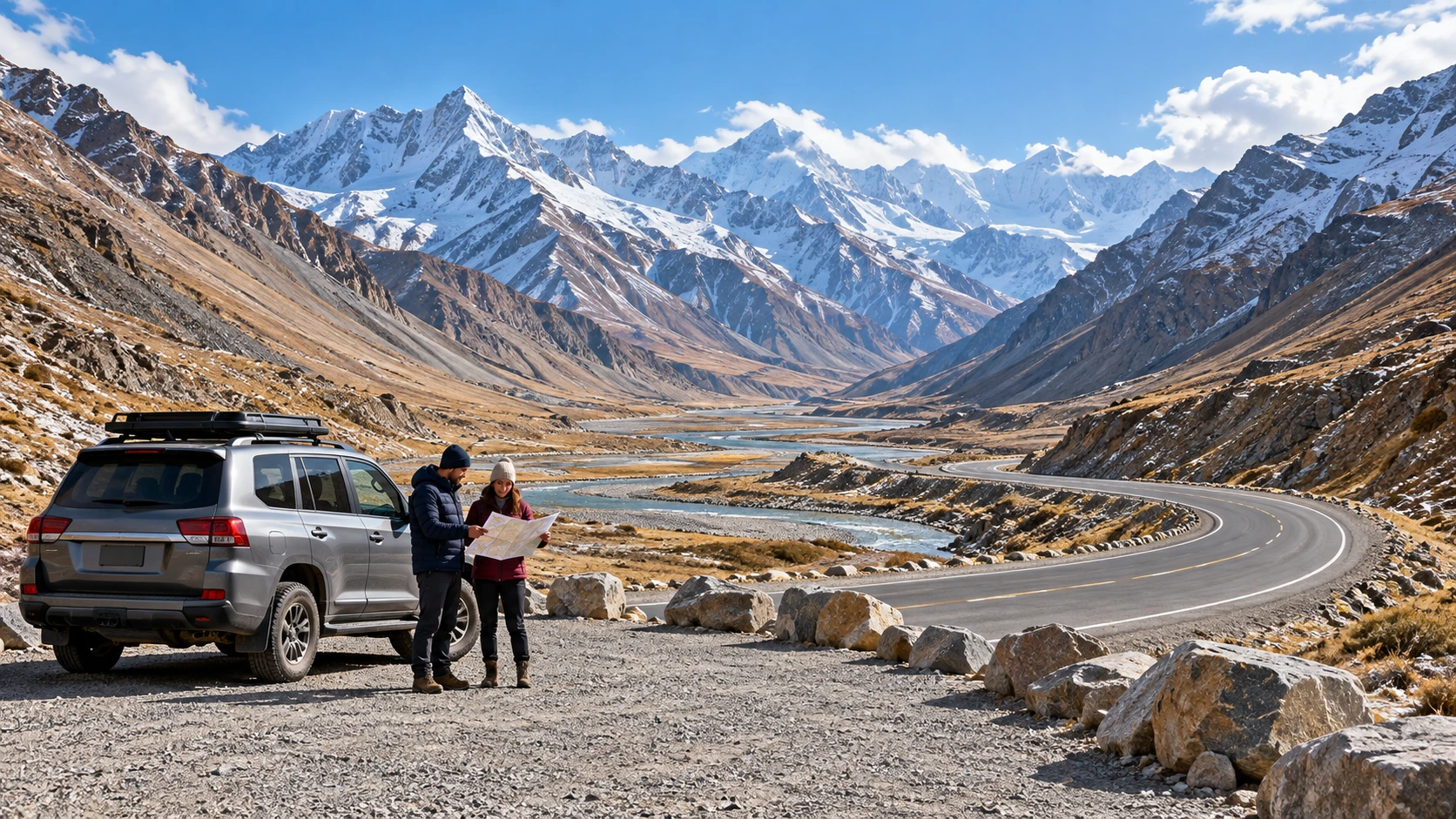
A Kyrgyzstan–China–Tajikistan overland route can be planned around a Kyrgyz crossing into Xinjiang, Kashgar and the Karasu–Kulma crossing towards Tajikistan’s eastern Pamirs. Decide first whether you actually want to visit China. For a through journey, China adds another country’s entry, vehicle and driving arrangements, while Kulma takes you into the Gorno-Badakhshan region, where regional permission matters before arrival.
Agree the traveller and vehicle conditions at both Chinese borders before booking a fixed mountain timetable. Then establish lawful accommodation and an appropriate sleeping-altitude sequence. A vehicle’s ability to cover the road is only one part of deciding whether this journey suits your group.
Updated 24 October 2026.
The feature image is an illustration of a generic high-mountain road journey, not a photograph of Karasu–Kulma, a named stopping place or actual guests.
Decide what the China section is for
Choose this connection for the places and road journey you want to retain, rather than assuming it is the simplest way between the neighbouring countries. Ask for an alternative proposal if your main aim is to reach Tajikistan. Any direct Kyrgyzstan–Tajikistan option needs its own current checkpoint, passport, vehicle and road confirmation; a route shown by navigation does not establish that it is available to you.
| Your priority | Route design to discuss | The deciding question |
|---|---|---|
| Kashgar plus a Pamir road journey | Kyrgyz approach, Kashgar, an authorised ascent and Karasu–Kulma. | Do the accepted entry, exit and lodging arrangements give you enough time for China and a suitable ascent? |
| Get from Kyrgyzstan to Tajikistan | Compare an admissible direct connection with the extra China section. | Which option actually accepts your passports and vehicle, on the intended dates and roads? |
| Travel without taking the same vehicle throughout | Separate authorised passenger transfers and domestic transport. | Who carries the people and luggage at each handover, and what happens to any existing vehicle temporary-import obligation? |
Understand Karasu, Kulma and the two permissions for Tajikistan
Karasu is the Chinese name used for the border crossing. Kulma, also written Qolma or 阔勒买, names the Tajik side. The 2011 China–Tajikistan port agreement describes an international road passenger and freight port open to both countries and third-country people and vehicles. It also requires domestic-law compliance and treats cross-border road transport under the relevant agreements. That framework does not replace the documents and decisions for your particular vehicle.
The same agreement identifies the Tajik location as Murghob District in Gorno-Badakhshan Autonomous Oblast, usually abbreviated GBAO. This makes GBAO access part of the entry design, rather than an optional sightseeing question to leave until you reach Dushanbe. Send the Tajik receiving party the intended checkpoint and the whole onward route.
The Tajik Ministry of Foreign Affairs’ consular guidance separates an electronic visa from permission for special border areas. Where an e-visa is applicable, the guidance explains selecting the relevant permission during application and printing the issued visa. If you qualify for visa-free entry, ask the responsible authority how to obtain the necessary GBAO permission separately before entering that region. Another traveller’s nationality, an airport visa process or a visa-free entitlement alone does not settle this land-border route.
Check your own government’s travel advice and your insurer’s position before committing. The U.S. State Department’s September 2026 advice describes GBAO as restricted for non-Tajik citizens and notes that permits may be suspended at short notice. Its advice to U.S. citizens is not a nationality-specific entry decision for everyone else. Agree how your route and financial commitments change if regional permission or access changes.
Match the travellers, vehicle and driver at each border
Make one shared dossier, but keep the different approvals identifiable. Every passport, the car’s registration country, ownership, vehicle class and every proposed driver affect the enquiry. A Chinese passenger-entry arrangement does not grant temporary import for the car, and an international driving document alone is not a substitute for the required Chinese driving permission.
| Part of the journey | Prepare | Obtain an exact answer |
|---|---|---|
| Leave Kyrgyzstan | Existing immigration and vehicle-import records, ownership authority and planned Chinese entry. | Departure customs procedure and proof that the vehicle record is properly closed. |
| Enter and drive in China | Passports, suitable entry basis, registration/translation, customs papers, insurance, route and receiving plan. | Accepted entry/exit, vehicle class, temporary vehicle documents and each driver’s appropriate Chinese permission. |
| Travel through the Xinjiang border area | The precise through route and any side trips. | Which border-area documents apply to foreign passports, and which office handles them. |
| Enter Tajikistan at Kulma | Correct passport-entry basis, GBAO permission and the vehicle dossier. | Checkpoint and date acceptance; temporary import, insurance, any security and its later discharge. |
| Continue across the Pamirs | Named accommodation, accepted roads, fuel range, recovery and the group’s needs. | Actual access and receiving responsibility for each stage, including any additional restricted area. |
The Chinese temporary-vehicle service checklist explains document categories, including registration, customs, insurance and the receiving plan. Its local service time is not a promise about a Xinjiang border appointment. The car and campervan entry guide explains the wider preparation.
Xinjiang’s border-management regulation distinguishes movement through border areas for entry/exit from other visits. Give the authorities your exact route and sightseeing detours. Do not copy a domestic traveller’s permit process or infer that one border document covers every stop. Where a foreign visitor needs a border permit, the national application guidance describes an in-person route through designated public-security offices.
Choose the Kyrgyz entry by your approach
For an approach from Osh and Sary-Tash, investigate Irkeshtam. For an approach from the Naryn side, investigate Torugart. Confirm the people and vehicle acceptance, the processing location and the actual meeting point for your direction. Our Irkeshtam versus Torugart comparison helps organise those questions.
Do not treat the named frontier, immigration office and vehicle-document office as one guaranteed stop. Request a dated handover plan: who meets you, which vehicle carries the guide, where luggage stays during processing and whom to call if one side releases you late. Carry an accessible overnight bag and keep identity documents available without leaving personal information visible on a dashboard or in public messaging groups.
Build the night plan around lawful stops and altitude
Kashgar is a useful planning and rest block, but office time and acclimatisation serve different purposes. Your recent sleeping altitudes and the intended next night matter. Coming from Kyrgyzstan does not by itself show that everyone is ready for another high sleeping location.
| Route block | Choose the overnight by | Keep this separate |
|---|---|---|
| Chinese entry and Kashgar | Actual arrival, document issue location, parking and driver rest. | The final Kyrgyzstan night and any earlier high-altitude stay. |
| Ascent towards the Chinese Pamir approach | A lawful available hotel pin, its sleeping altitude and a suitable ascent plan. | A scenic stop and an overnight are different; do not assume either grants the other. |
| Chinese exit and Kulma arrival | Agreed appointment, operating calendar and the receiving party’s supported destination. | Clearance time, waiting and the road after release. |
| Tajik Pamir continuation | Current regional permission, accepted roads, health needs and accommodation. | A Murghob/Murghab, Khorog or later Dushanbe extension requires its own night ledger. |
Count the Chinese hotels as Kashgar nights + authorised ascent nights + any additional Chinese nights. Count the first Tajik night separately. A fixed total is useful only after the actual lodging pins and ascent sequence are agreed. Do not create a nominal “short transit” by removing rest, choosing an unavailable mountain hotel or pushing a late border release into a long night drive.
CDC altitude guidance supports gradual ascent and explains that fitness does not eliminate altitude-illness risk. Discuss the sleeping sequence and individual conditions with a clinician. Do not ascend to sleep higher with altitude-illness symptoms. Descend if symptoms worsen despite rest at the same elevation, and seek medical help. Design a lawful lower base, an interruption or another journey as a real option, rather than treating the itinerary as a deadline.
Choose crossing dates with a waiting plan
The 2011 port agreement gives ordinary Monday–Friday working days, closure for both countries’ statutory holidays and locally agreed operating periods that account for the environment and weather. Its year-round status is not a promise of daily tourist clearance. Obtain the current calendar, working hours and appointment instructions from the responsible receiving parties for the exact dates.
Keep a daylight arrival margin, accessible warm clothing, water, medication and a suitable food reserve. Agree fuel or charging opportunities, tyre requirements, recovery contacts and the territories covered by insurance. A closure, permission change, vehicle fault or unwell traveller should trigger the agreed waiting or route-amendment process. Do not drive to a closed checkpoint simply because a hotel is already paid for.
Make a proposal comparable and workable for your group
Send Vero Trip every nationality, flexible dates, Kyrgyz starting place, intended Tajik endpoint, vehicle registration country, ownership, class and dimensions. List driver documents, recent high-country stays, children’s ages, mobility needs and meals or prayer requirements. Use the trip planning enquiry to establish these decisions before fixing a quote.
| Quote section | Ask for a written basis |
|---|---|
| People and reception | Named parties and contacts for both Chinese borders and Tajik arrival; language and the actual guide/driver roles. |
| Customs and documents | Who arranges each application, any financial security, who holds it and the evidence required to release it. |
| Travel costs | Rooms, parking, fuel, tolls, meals, visits, guide expenses and the precise beginning/end of Tajik support. |
| Disruption | Extra hotel nights, repairs, changed permissions, cancellation and lawful removal of the vehicle. |
Confirm hotel parking entrances, height restrictions, room access and the walk from the car with luggage. A campervan is not automatically permission to sleep at a roadside viewpoint. For families, include appropriate child restraints and breaks; for older travellers, prioritise suitable rooms and manageable walks. Identify who can actually drive the vehicle under the insurance and licence conditions if the main driver is tired.
Explain dietary and prayer requirements before the mountain stages. Confirm ingredients and preparation with the actual hotel or restaurant, carry an acceptable backup meal and arrange a suitable private prayer pause when a mosque visit cannot fit the border work. Keep these arrangements specific to the group; they do not follow automatically from a place name.
Can the route be done without visiting Pakistan?
Yes, the intended Chinese exit in this design is Karasu–Kulma towards Tajikistan. Khunjerab is the separate Pakistan crossing. Do not substitute one border’s receiving instructions, controlled-area rules or visa conditions for the other.
Does “transit” mean a visa-free vehicle shortcut?
No. Use an entry basis that actually covers your passport, checkpoint, route and stay. Settle the vehicle and driver requirements separately. An accepted passenger movement does not remove customs obligations or establish access to restricted regions.
Can motorcycles use the same proposal?
Confirm motorcycle reception, licence class and insurance explicitly. Exposure, fuel range, fatigue and luggage change the useful stages, so rebuild the daily plan around the riders rather than borrowing a car’s timetable.
Related Journeys to Compare
These existing routes offer starting points for the region or travel interests discussed above. Read the full daily itinerary to see what is included. A visit described in this guide, a specialist session or an international border crossing is added only when confirmed in your own programme.