Quick answer: China drives on the right and has a modern expressway network, extensive camera enforcement and dense mixed traffic in many cities. Foreign visitors should set up Amap, mobile data and payments before pickup; confirm the rental car’s plate restrictions and ETC process; save Chinese addresses; and carry an offline accident card with 122, 120, the rental company and insurer. Last fact-checked: 31 August 2026. National laws, local restrictions, toll arrangements, parking rules and charging access can change. Follow current signs and police instructions and confirm local rules for the vehicle’s registration city.
Before the first kilometre
Do not leave the rental branch until you can answer:
- Which fuel or charging connector does the car use?
- Is ETC installed, and how will charges be settled?
- Which number provides 24-hour roadside assistance?
- Where are the registration and insurance documents?
- Which plate restrictions are loaded into navigation?
- Is every driver registered in the contract?
- What does the insurer require after an accident?
If you have not completed permit and rental verification, go back to driving in China as a foreigner and renting a car in China as a foreign visitor.
Essential traffic rules in China
| Road situation | Best response | Avoid |
|---|---|---|
| Navigation changes near an exit | Follow lane arrows early and continue to the next exit if missed | Sudden lane crossing, stopping or reversing |
| E-bikes and pedestrians near a junction | Reduce speed and scan both sides before turning | Assuming a green light guarantees a clear path |
| Camera or average-speed section | Hold a steady speed below the posted limit | Braking only beside a visible camera |
| Warning light or tyre problem | Reach a safe position and contact the rental company | Continuing until the car fails in a live lane |
| Unclear parking or payment | Use a marked space and ask a staffed operator/hotel | Blocking an exit or relying on another parked car as proof |
Drive on the right
Traffic keeps to the right. Overtaking and lane rules follow signs and road markings. On multi-lane urban roads, lane direction can change near intersections; read the arrows before entering the junction.
Obey the posted limit
Expressways commonly allow higher limits than urban and rural roads, but the posted sign controls. Limits can change for tunnels, construction, weather, ramps and vehicle type. Camera enforcement is widespread, and average-speed sections may measure speed across a corridor rather than at one point. Never use a generic statement such as “China’s speed limit is 120 km/h” as permission to drive at that speed everywhere. A motorway can have a lower signed minimum or maximum for the lane and conditions.
Seat belts and child restraints
Wear seat belts in every seating position where fitted. Reserve a suitable child restraint before arrival and verify the installation at pickup. A supplier saying “child seat available” is not enough; confirm size, attachment and vehicle compatibility.
Red lights and right turns
Do not assume that a right turn on red is always allowed. Follow the signal, arrow signal, sign, lane marking and instructions at that intersection. Give way to pedestrians and other lawful traffic.
Alcohol and phones
Do not drink and drive. Do not hold or operate a phone while driving. Set the route and mount the phone before moving; stop safely if the navigation or translation needs attention.
Mixed traffic
E-bikes, scooters, delivery riders, bicycles and pedestrians can appear from blind spots or move differently from traffic expectations at home. Slow down near junctions, markets, village streets, school areas and parked vehicles.
A missed exit is not an emergency
Continue to the next safe exit. Never reverse or stop in a live expressway lane. In a genuine breakdown, activate warnings, move as far from traffic as safely possible and follow the emergency procedure.
Amap English in China
Amap, also known as Gaode Map (Gaode Map), is one of the most useful navigation tools for driving in China. The Shanghai government announced an English nationwide map experience, so old advice that Amap is “Chinese only” is outdated.
Set it up before pickup
- Install and update the app before travelling.
- Enable the English interface if available for the account/device.
- Save the rental branch, first hotel and permit office.
- Enter the rental car’s plate and vehicle details where supported.
- Download or screenshot the first-day route.
- Save every destination’s Chinese name, address and telephone.
Why Chinese addresses still matter
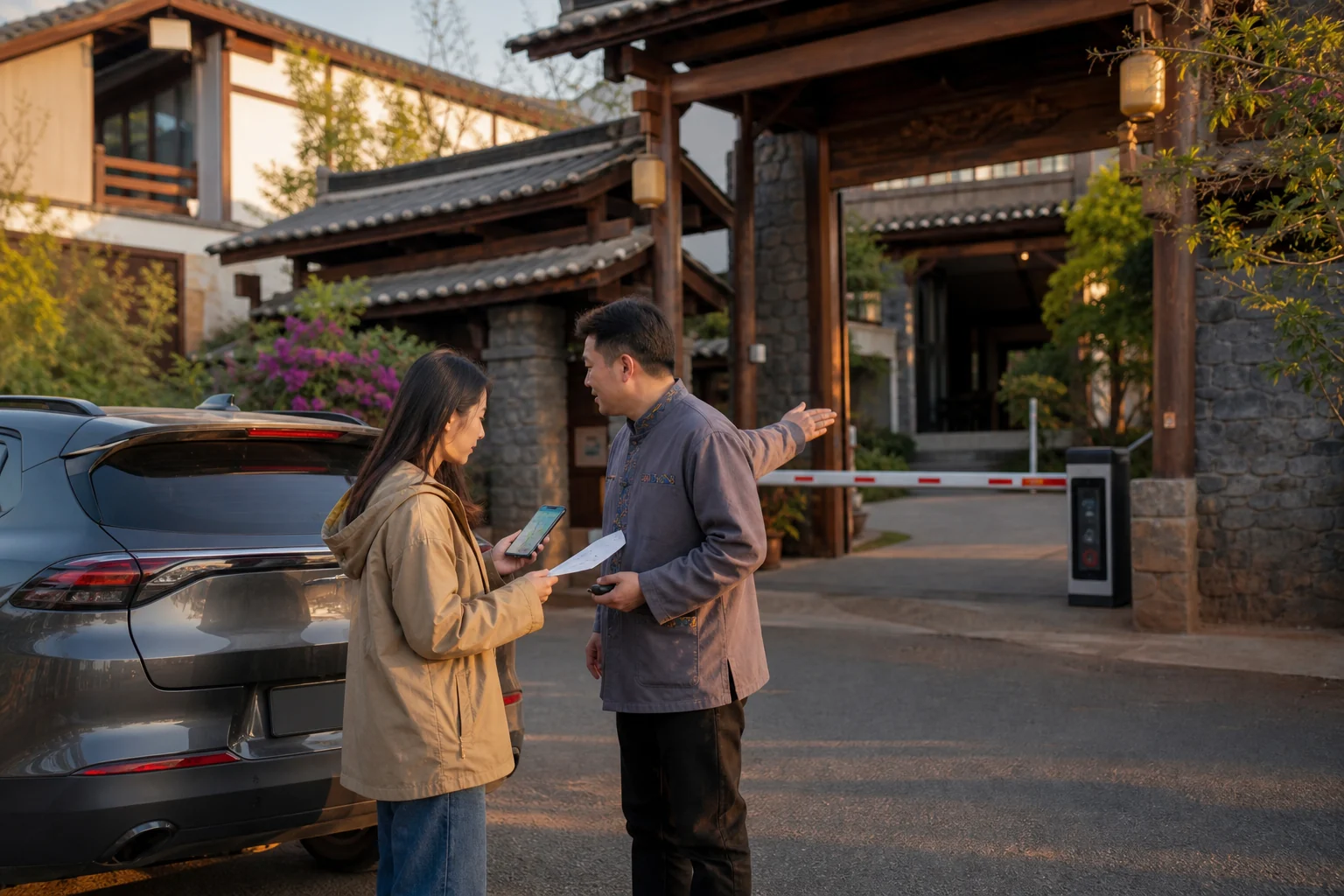
English names may point to a district centre, the wrong scenic gate or a pedestrian entrance. Ask hotels and route planners for:
- Chinese property name.
- Full Chinese street address.
- Parking entrance name.
- Gate number.
- Phone number.
- Coordinates or map pin.
Call the hotel before entering an old town or mountain road if the route appears to lead into a restricted lane.
Google Maps warning
Do not use an overseas map as the only navigation source for real-time driving in mainland China. Map data, routing, business listings and live road conditions may not be suitable. Keep Amap or another locally supported map as the operational tool.
Mobile data and phone preparation
A driving phone must be more than a camera. Confirm:
- Mobile data works outside the arrival city.
- The number can receive verification SMS.
- You can make local calls to the rental branch and hotel.
- The phone has a secure mount and charging cable.
- A power bank is available outside the car.
- Translation and incident phrases are saved offline.
If using roaming, check whether local apps and SMS functions work as expected. A local SIM or eSIM may be useful, but a data-only plan does not solve every voice-call or account-verification requirement.
China toll roads and ETC
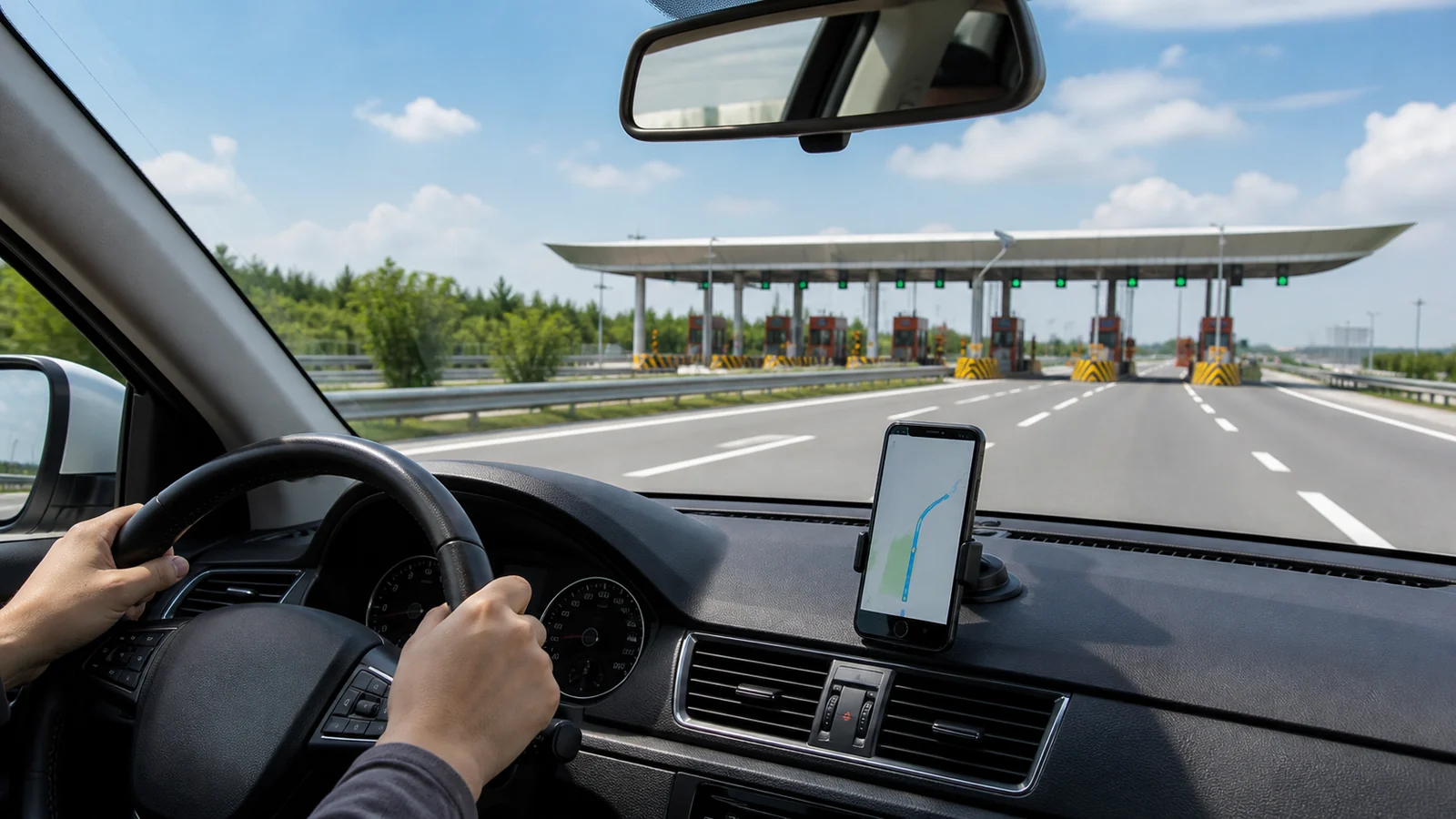
China’s expressway network uses tolling. Rental vehicles may have an ETC device, use manual lanes, or have charges billed later by the supplier. Before leaving the branch, ask:
- Is ETC active?
- Which lane should I use?
- Are tolls deducted immediately or invoiced after return?
- Is there a service fee?
- What happens if the device does not open the barrier?
- Does a manual lane accept the available payment method?
Carry mobile payment and cash backup. Not every remote booth or temporary situation can be assumed to accept a particular overseas card.
Expressway service areas
Service areas can provide fuel or charging, toilets, food and rest, but facilities vary. On remote routes, identify the last dependable stop before departure rather than waiting for the fuel or battery warning. During major public holidays, passenger cars may receive toll concessions under current policy, but congestion can outweigh the saving. Plan around traffic volume, not only price.
City parking
Parking is one of the strongest reasons not to rent for a major-city-only itinerary.
Before arriving
- Ask the hotel whether it has parking and whether a reservation is needed.
- Save the vehicle entrance, not just the lobby address.
- Check height restrictions for SUVs or roof boxes.
- Confirm overnight price and exit payment method.
- Check whether the street/garage is inside a plate-restricted zone.
In a car park
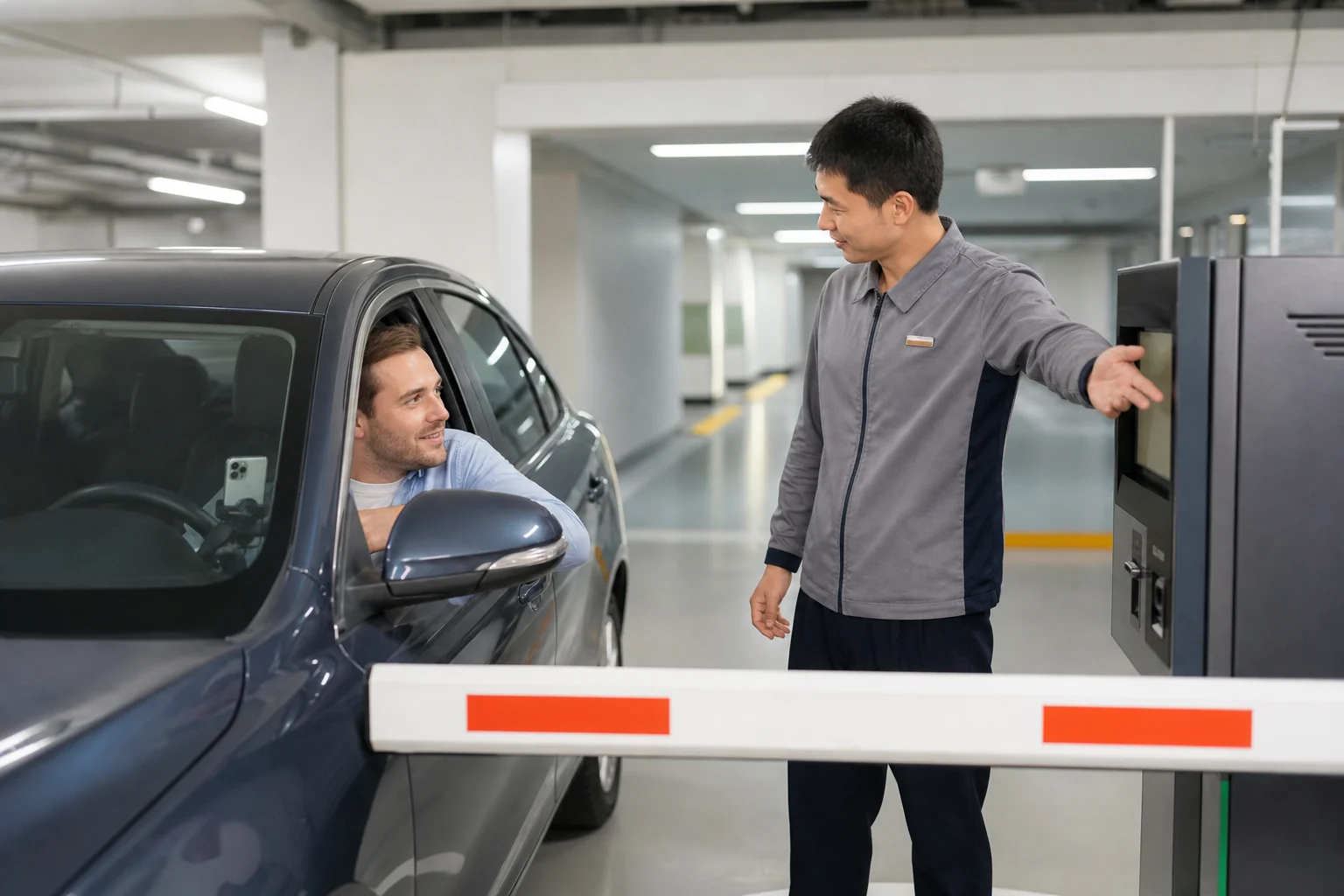
Automated barriers may read the licence plate. Payment can require scanning a QR code, entering the plate or using a mini-program. If the foreign account cannot complete the flow, use a staffed exit or ask the hotel to help—before a queue builds behind the vehicle.
Never assume a roadside space is legal
Use marked spaces and posted instructions. A navigation pin or parked local vehicle is not proof that a foreign visitor may stop there. Do not block emergency access, bus lanes, cycle lanes, residential gates or scenic-road traffic.
Local plate restrictions
Vehicle registration can affect access by day, time, district or road. Beijing and Shanghai are well-known examples, but other cities also apply local measures. Confirm:
- Registration city and plate type.
- Weekday/time restrictions.
- Inner-city or elevated-road restrictions.
- Required entry permit for an outside plate.
- Public-holiday or event changes.
- Whether the navigation app has the correct plate profile.
Recheck within 48 hours of entering a major city. If the route is mostly metropolitan, return the car outside the centre and switch to rail or local transport.
Fuel stations
Ask the rental branch which fuel grade to use and photograph the fuel-cap label. In some areas, station staff may request identity information or follow local refuelling procedures. Keep the passport or accepted ID accessible without leaving it unattended. Practical rules:
- Refuel before a remote stage.
- Do not carry fuel in an unapproved container.
- Keep the payment backup available.
- Check opening hours in sparse areas.
- Record the odometer and receipt if the rental contract requires a full-to-full return.
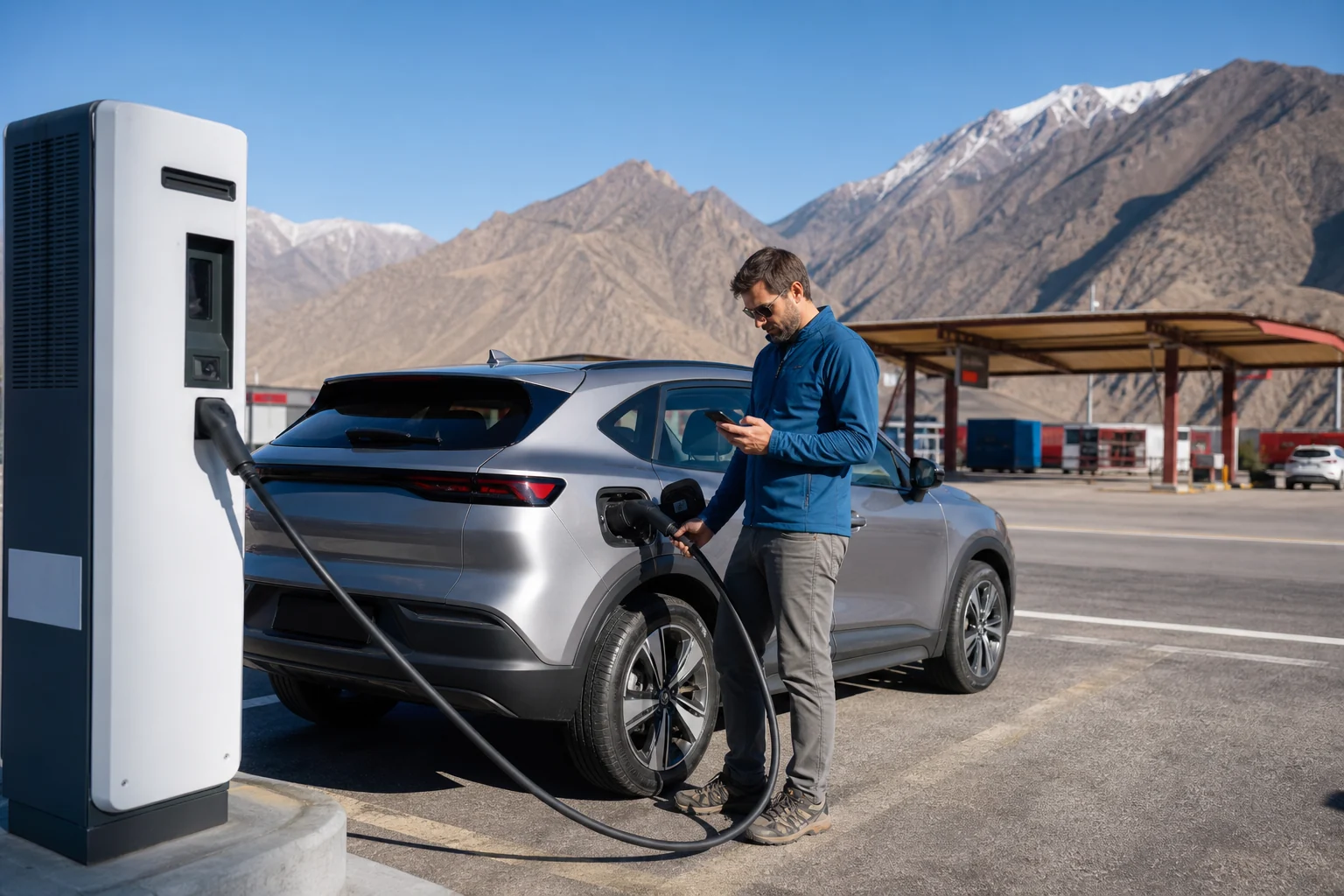
EV charging in China
China has extensive charging infrastructure, but the foreign visitor’s real problem is compatibility and account access. Before accepting an EV, confirm:
- Connector and charging standard.
- Cable supplied with the vehicle.
- Which apps or mini-programs operate the planned stations.
- Whether the traveller can register and pay with the available number/account/card.
- Overnight hotel charging.
- Winter and high-altitude range expectations.
- At least one backup charger before the battery reaches a critical level.
- Rental-company procedure for a failed charger or flat battery.
Choose an EV route by confirmed charging stops, not by nationwide charger totals. Petrol or hybrid may be the safer operational choice for western Sichuan, Qinghai, remote Yunnan or winter routes.
Rural roads, mountain roads and scenic areas
Reduce speed before blind bends, villages, livestock and roadworks. Do not follow a map onto an unpaved shortcut without confirming the rental contract and route condition. Mountain roadbook fields should include:
- Surface and lane width.
- Highest pass and sleeping altitude.
- Construction or landslide exposure.
- Snow-chain or winter-tyre need.
- Nearest fuel, repair and medical point.
- Last safe turnaround.
- Daylight arrival deadline.
For route comparisons, read the best road trips in China. The custom Yunnan self-drive route is designed to add local verification rather than rely on live navigation alone.
What to do after a breakdown
- Move to a safe position if possible and lawful.
- Switch on hazard lights.
- Place warning equipment as required without exposing yourself to traffic.
- Move passengers behind a barrier or away from traffic when safe.
- Call the rental-company roadside number.
- Call traffic police on 122 if the position creates danger or official help is needed.
- Do not authorise towing or repair that violates the rental/insurance process.
- Record location, dashboard warnings, time and calls.
What to do after an accident
Human safety comes first. Call 120 for medical emergency and 122 for traffic police. Then:
- Secure the scene without creating additional danger.
- Photograph the road, vehicles, signs, plates, damage and wider context.
- Exchange and photograph relevant documents.
- Notify the rental company and insurer immediately.
- Obtain the required police report or case number.
- Do not let an unregistered person take over the rental car.
- Do not sign an agreement you cannot understand.
- Keep towing, replacement, hotel and medical receipts.
The Road Traffic Safety Law establishes duties around stopping, protecting the scene and reporting accidents. The rental agreement can impose additional notification and evidence steps.
Offline driving card
Save this information as a phone screenshot and paper copy:
- Traffic police: 122
- Medical emergency: 120
- Rental roadside number: ______
- Rental branch: ______
- Insurer/claim number: ______
- Vehicle plate: ______
- Hotel Chinese name/address: ______
- Local support: ______
- “I am a foreign visitor. Please call the traffic police and my rental company.” 我是外国游客。请帮我联系交警和租车公司。
- “I need medical help.” 我需要医疗帮助。
Daily departure checklist
- Weather and road opening checked.
- Fuel/battery sufficient to reach the confirmed next stop.
- Amap route and plate settings checked.
- Destination and parking entrance saved in Chinese.
- Permit, licence, translation, passport and rental documents carried.
- Phone mounted and charging.
- Cash and second payment method available.
- Tyres, warning lights and visible leaks checked.
- Highest altitude and rest stops checked.
- Plan B saved offline.
Complete the self-drive planning sequence
This road-use guide assumes the legal and rental steps are already confirmed. If they are not, return to driving in China as a foreigner, the China temporary driving permit guide and the foreign visitor car-rental guide. Then compare the best road trips in China before fixing daily distances. The same checks can be applied to a custom Yunnan self-driving tour or a more remote 10-day Xinjiang Duku Highway and Pamir route, but the backup plan and support level should increase with remoteness.
Frequently asked questions
What map app should I use for driving in China?
Amap/Gaode is a practical choice and now provides an English experience for international users. Keep Chinese names and offline screenshots for critical stops.
Does Google Maps work for driving in China?
Do not use it as the only real-time driving source. Locally supported navigation is better suited to current routing, road restrictions and Chinese place data.
Can foreigners use ETC toll lanes?
The vehicle may have an ETC device arranged by the rental supplier. Confirm that it is active, which lane to use and how charges will appear after return.
Are toll booths cashless?
Payment varies by lane and location. Carry mobile payment and RMB backup rather than relying on one overseas card.
Is it easy to park in Chinese cities?
It can be difficult in dense centres and old towns. Verify the hotel/garage entrance and payment process in advance, and avoid a rental for a city-only itinerary.
Should I rent an EV in China?
Only when the route, connector, registration/payment flow and backup stations are confirmed for your account and dates. Charging-station quantity alone does not answer the question.
What number do I call after a traffic accident?
Call 122 for traffic police and 120 for medical emergency, then notify the rental company and insurer under the contract.