Start with one stretch of Yunnanyi’s stone caravan road, then choose one museum. The village in Xiangyun County offers two ways to think about transport. The old street shows how pack caravans stopped, traded and unloaded. The wartime transport museum explains why the same place later mattered for moving supplies by road and air. From Dali, allow a half-day for the village, lunch and a confirmed ride back to your hotel.
Save 祥云县云南驿村 or 云南驿古镇 and the address of the agreed public drop-off. The wider Yunnanyi township is larger than the heritage street. Keep 云南马帮文化博物馆 and 二战中印缅战区交通史纪念馆 as separate map labels if you want to visit a collection. They tell different stories, even though both are on the old route.
Read the stone road at walking pace
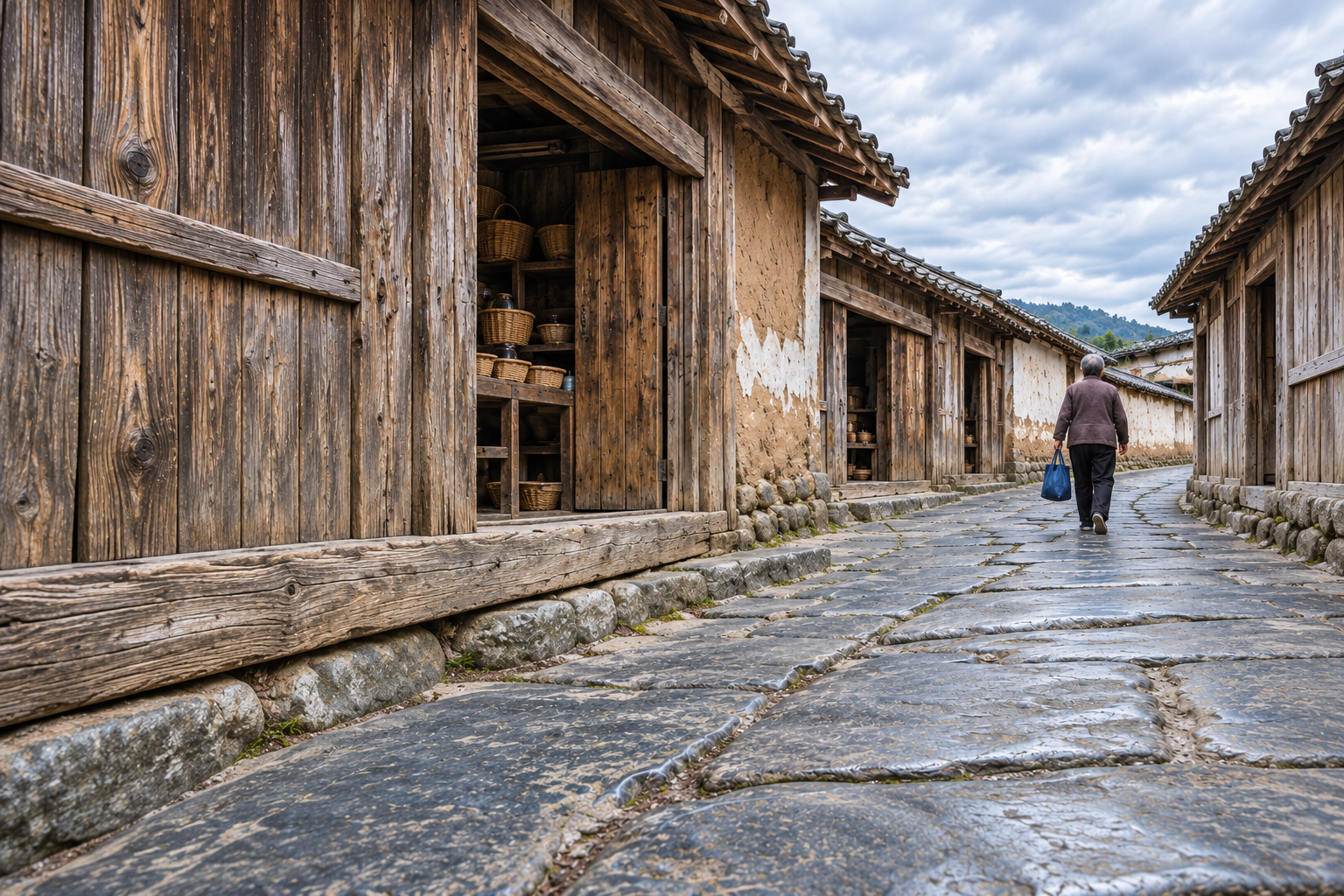
From the first open part of the lane, look down before you look up. The slabs differ in width, and wear shows where stone edges have become smoother. Lift your eyes to see how broad wooden thresholds meet the lane and how the eaves change its scale. These details give you a sense of a trading stop. Exact ages of pavement, walls and timber need the site’s labels or documentation. A 2025 reporting visit describes the surviving paved route, the over-street structure and the two museums facing one another. Reporting from the Yunnanyi heritage street.
Pause at a wider place where other people can pass. Look back at the route you just walked and imagine the work of moving a load from the street into a trading yard or inn. Yunnanyi is a village with homes and shops, so use signed public approaches and enter only an open public collection or a space where you have been invited. A Nanjing Audit University team’s 2024 visit records both the stone route and the caravan collection. The report records an oil lamp and a pack saddle in the caravan collection. If those are displayed, compare the scale of the saddle with the width of the thresholds outside. Nanjing Audit University’s village field report.
For photographs, choose one view that includes paving and shopfront proportions, and another that shows a sill or roof edge from the public lane. Ask before photographing a resident or an interior and follow museum signs. Keep your footing in mind while looking up. Old stone is uneven and can become slippery in rain.
| Focus | What to look for | How to keep it manageable |
|---|---|---|
| Paving | Joints, smooth surfaces and the lines of the old lane. | Choose a short open stretch and retrace it. Wear shoes with grip. |
| Entrances and eaves | The junction of a timber sill, walls and the road, and the changing height of eaves. | Stay in public space. Leave shop entrances and private doors clear. |
| Caravan collection | A label, an open display of travel equipment or a visual explanation of a stop. | Choose a named open space and check any steps and ticket requirements. |
Choose between caravans and wartime transport
Choose the caravan collection if you mainly want to know how a stop on the Tea Horse Road worked. Read the displays next to what you have just seen outside. In the war museum, look first for the map or model, then look through any open photograph and object displays. A 2025 Dali Daily account records a model of the old airfield and a map of the Hump air route. The map can help you understand the relationship between the airlift and the ground journey that supplies still had to make. Display availability can change, and the museum visit does not require approaching the former airfield. Dali Daily’s account of the wartime transport museum.
The story is wider than airplanes. Yunnanyi was an important transit point during the war. In August 2026, an organized Chinese and American youth visit included both museum subjects. An independent American writer visited the public street in 2017 and found the two museums closed on that visit. Ask the specific museum about your date, opening arrangements, photography, stairs and whether the staff can help with English. For admission or any named ticket, bring your original passport and check which booking channel supports it before paying. Yunnan Daily’s report on the 2026 visit and an American visitor’s account.
If the transport museum is the main reason for your trip, make its confirmed entry the first appointment. If neither museum is open, the public street still makes sense as an architecture visit on a dry day. For a deeper wartime history itinerary, compare the Flying Tigers material at Kunming Municipal Museum or the war memorial and museum visit in Tengchong. Give them their own days and confirmed entry.
| What interests you | First choice | What to confirm |
|---|---|---|
| Pack caravans and trade | Caravan collection and the adjacent public lane. | Which rooms are open and whether the explanation is available in a language you can use. |
| The Hump airlift and supply journeys | Wartime transport museum, starting with maps and the airfield model if displayed. | Date, passport channel, access to the rooms, stairs and photography. |
| Short walk or neither collection open | Stone lane and a few outside details. | Public approach and same-side pickup. Move the date if collection entry is essential. |
Leave room for a Xiangyun lunch and the return
Start at your Dali hotel after breakfast. Plan a licensed road ride to the agreed point near the heritage street and ask where the driver can collect you legally. If you want to leave through another end of the lane, confirm the walking connection and meeting point first. For a compact visit, start on the public stone road, choose one open collection, return to the agreed pickup and have lunch. Take the planned ride back to the same Dali hotel after the meal. A station drop-off can replace the hotel only when your bags and onward ticket are accounted for.
A bowl of ersi (饵丝), rice-based strips, suits a quick lunch. The GoKunming author tried a fried version in Yunnanyi. For a longer sit-down meal, consider cooked greens and Tianma tofu (天马豆腐), a Xiangyun speciality to look for on a county-town menu. Confirm broth, chilli, toppings, meat stock and allergies in Chinese or through someone who can translate. A simple meal in Xiangyun county town is a useful fallback if the choices at the village are limited. Set the lunch stop and return point before you start walking. Yunnan tourism reporting on Xiangyun food.
Wear shoes with grip and allow for steps and sills. Confirm that your party can manage the full approach from the car and any room you care about. Ask whether a seat and a ground-level visit are possible. In light rain, shorten the lane walk and use one confirmed interior. In heavy rain, use a different approved visit or move Yunnanyi to another day. An appointment in a public museum is a better weather backup than hoping a private courtyard will take visitors.
Choose a base and finish the trip
Keep Dali as the base if you are visiting Yunnanyi once and have other plans around Dali Old Town or Erhai. Consider a Xiangyun county-town night if you have a confirmed early museum visit or need a smoother onward transfer. Confirm the hotel accepts your passport, the entrance has suitable steps or a lift, and bags can be stored before check-in. Count the time between your hotel and any station or airport. Our Dali guide compares bases for the rest of the stay.
| Time available | Suggested sequence | Where you sleep |
|---|---|---|
| 3 days / 2 nights | Arrive in Dali and have dinner. Day 2 Yunnanyi, Xiangyun lunch and return to the same Dali hotel. Day 3 collect bags and leave for the station or airport. | Dali 2 nights. |
| 4 days / 3 nights | Day 1 Dali arrival. Day 2 Dali Old Town or your chosen lakeside outing. Day 3 Yunnanyi, lunch and hotel return. Day 4 depart after checkout. | Dali 3 nights. Use the middle days flexibly if the museum date changes. |
| 5 days / 4 nights | Days 1–3 arrive and explore Dali. Move to Xiangyun on day 4 for an early start on day 5 only if confirmed. On day 5 visit Yunnanyi, have lunch, collect your bags and use the agreed onward transfer. | Dali 3 + Xiangyun 1, or Dali 4 if your return and departure work better from there. |
Price on request for a tailored visit. Tell a Verotrip travel consultant which museum matters, your dates, hotel, walking needs and onward departure. Ask for the actual admission route, pickup and waiting times, lunch, lodging and any English-language help to be specified in writing if requested. Museum entry, vehicle, meals and room costs depend on the agreed plan. Make sure the last transfer ends at your confirmed hotel or departure point.
Questions about visiting Yunnanyi
Which museum should I choose first?
Choose the caravan collection for the old road and its trading stops. Choose the wartime museum for the Hump air route and supply journeys. Check the exact building and admission for your day, particularly if you are travelling mainly to see it.
Is it worth visiting when both museums are closed?
Yes if you are interested in the public lane, thresholds and rooflines. Give yourself a short out-and-back with an agreed pickup. If a collection is the main aim, move the visit to a date with confirmed entry.
Can I go to the former airfield?
Use the public museum to understand its history. The route described here stays on the public heritage street and inside admitted museum spaces. Ask about current public access before considering any other site.
Should I stay in Dali or Xiangyun?
Dali suits a single outing and a longer lake or Old Town stay. Xiangyun can suit a confirmed early visit or a separate onward leg. Compare the hotel entrance, meal options and complete departure before choosing.