A Vietnam–China–Mongolia overland journey via Hekou works best when southern Yunnan is part of the holiday. Enter from Lao Cai, explore Mengzi, Yuanyang and Jianshui, then travel north through Kunming, Sichuan and Xi’an. This example includes Beijing before the Erenhot–Zamyn-Uud crossing into Mongolia.
Allow 28 days and 27 nights in China for the framework below, plus your time in Vietnam and Mongolia. This is a planning allocation, not a border-processing guarantee. Secure a lawful entry, vehicle and exit plan covering your actual dates before paying for a fixed sequence of hotels.
Travelling with your own foreign-registered vehicle, renting within China and crossing as a passenger are different arrangements. A passport admission does not admit your car. A Chinese rental or hired driver also does not automatically provide transport across either international border.
Updated 15 October 2026.
Is the Hekou route the right choice?
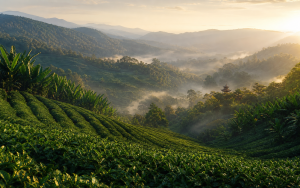
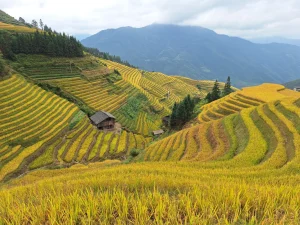
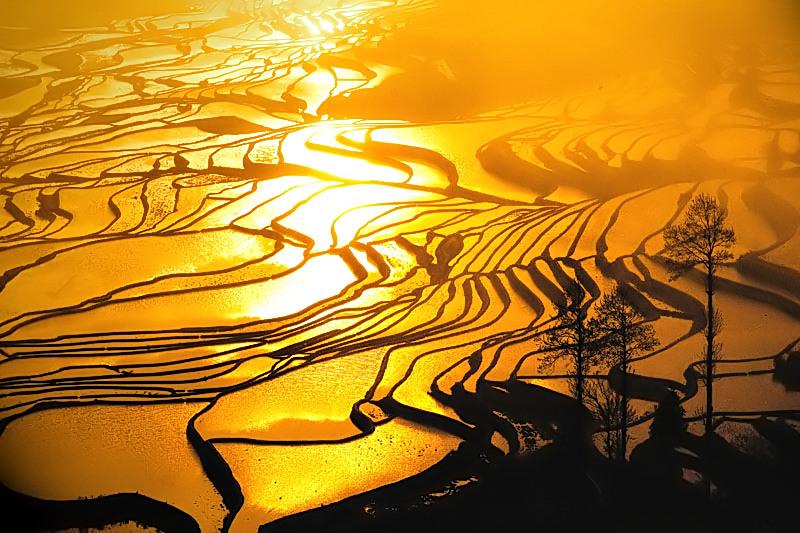
Choose Hekou for the Red River valley and southern Yunnan, especially if you are approaching from Lao Cai or Sapa. Mengzi gives you a practical first stop inland. Two nights around Yuanyang allow a proper terrace visit, while Jianshui adds old-town lanes and courtyards before the longer northbound stages.
| Your priority | Choose this approach | What changes |
|---|---|---|
| Yunnan landscapes and historic towns | Hekou–Mengzi–Yuanyang–Jianshui–Kunming | Use the full southern sequence; the terrace stay adds mountain driving and a separate hotel base. |
| A simpler northbound journey | Hekou–Mengzi–Kunming | Remove Yuanyang and Jianshui before the route is submitted; retain border and driving-rest allowances. |
| Guangxi and Guilin instead of Yunnan | Ask about a separate Vietnam–Guangxi entry plan | The approved port, China route and first overnight stages all change. It is not a last-minute substitution. |
| Holiday travel without importing a car | Passenger crossing, then domestic transport | Confirm each station transfer, domestic vehicle and Mongolia connection separately. |
Sapa sightseeing is on the Vietnamese side and sits outside the 28-day China example. Complete it before the agreed Lao Cai appointment. Beijing is an eastward cultural detour later in the journey; it is included here because three nights give the visit a purpose beyond driving through the city.
Settle the Vietnam exit and Hekou entry before the route
Start with the vehicle’s registration country and ownership, rather than assuming that every car parked in Vietnam follows the same procedure. Send clear registration details, vehicle dimensions, steering side, driver information and intended entry and exit dates to the responsible organisers.
| Vehicle situation | Arrange before approaching the border | Do not assume |
|---|---|---|
| Foreign-registered vehicle already temporarily in Vietnam | Check the existing Vietnamese approval and customs record, permitted departure gate and any route or departure-date amendment | Permission to tour Vietnam automatically allows departure through any gate. |
| Vietnam-registered private vehicle | Obtain the applicable Vietnamese outward vehicle and customs instructions, ownership authority and the separate Chinese receiving plan | Rules for foreign vehicles visiting Vietnam are the outward checklist for a Vietnamese vehicle. |
| Rental, borrowed or financed vehicle | Written owner permission for each country, plus customs and insurer acceptance | A rental agreement or a general authorisation grants international movement. |
| Passenger without a vehicle | Passport and entry eligibility, the actual passenger channel, and separate onward transfers | A fast pedestrian account proves foreign-car clearance or a guaranteed train connection. |
Vietnam’s rules for covered foreign tourism vehicles require an approved arrangement involving a Vietnamese international travel business. The framework under Decree 151/2024 was amended by Decree 236/2026, effective from July 2026. Ask the organiser to align your departure with the current approval and customs record. A change of route or departure information can require action before you continue.
Hekou is a port with different channels. Honghe’s published channel description assigns the Nanxi River bridge to passengers, business vehicles and self-drive tourism vehicles, and the Red River bridge to freight. That description identifies functions; it does not establish acceptance of your nationality, vehicle category or travel date. Obtain the exact approach and meeting point from the handling team.
Use our Hekou–Lao Cai border guide for the detailed channel and preparation questions. Keep Hekou North railway station separate from the border on your transfer plan. Label appointment times by country: 08:00 in Vietnam is 09:00 in China. Those are example clocks, not opening hours.
Prepare a China file for the people, vehicle and route
Check each traveller’s immigration permission for entry at Hekou, the full stay and departure at Erenhot. Do not build this four-week route around China’s 240-hour transit arrangement. Its conditions are specific, and ten days cannot cover the example below.
Chinese vehicle guidance lists registration and translation, customs admission, applicable inspection evidence and Chinese compulsory motor insurance among the relevant documents. Have the receiving team identify the exact local process and approved movement. A Beijing office’s published fee or processing period is not a Hekou quotation.
Each intended driver needs appropriate Chinese driving permission and the correct vehicle category. Current police guidance on temporary driving permission explains validity separately from immigration and vehicle admission. An international driving permit alone does not replace Chinese permission, and a longer driver document does not extend the car’s stay.
Use one document register showing the name, vehicle identity, permitted dates and responsible contact for each approval. Check spelling against the passport rather than an informal English name. Keep originals accessible, a protected digital copy and a small overnight bag outside the main luggage stack.
A 28-day route with 27 Chinese overnight stays
The table begins with China entry and ends with China exit. The initial two Hekou nights and final two Erenhot nights reserve room in the plan; actual formalities may require more time. If dates move, change accommodation and the approved journey together. Never let a sightseeing target push you beyond a document’s validity.
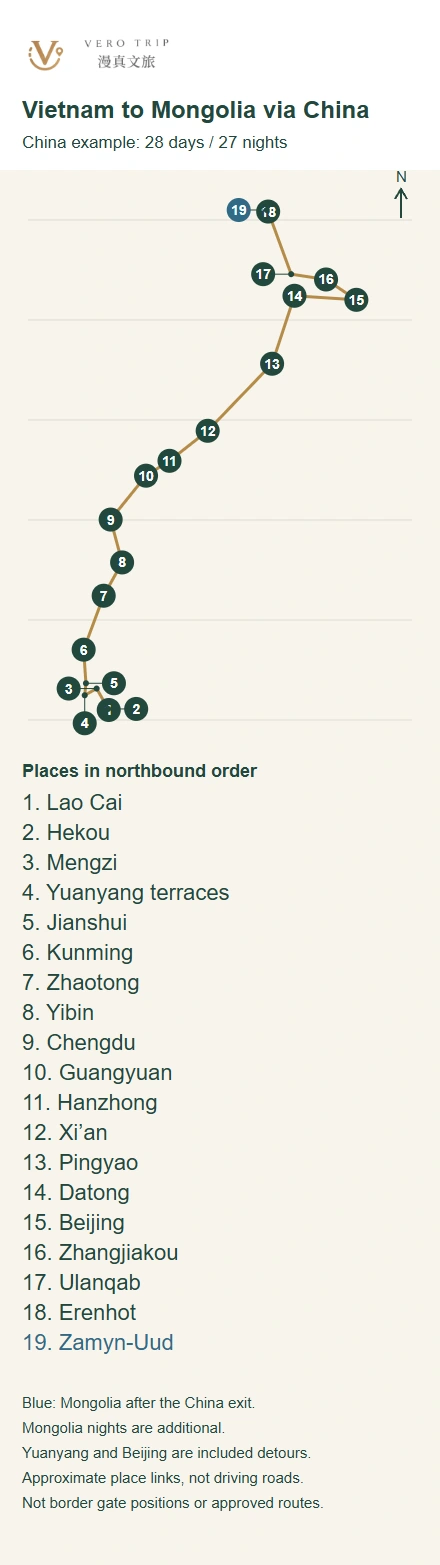
| Days | Route and focus | Overnight allocation |
|---|---|---|
| 1–2 | Lao Cai → Hekou. Border, vehicle and driver formalities; rest before heading inland. | Hekou: 2 nights |
| 3 | Hekou → Mengzi. Settle in, organise supplies and choose a manageable local walk. | Mengzi: 1 night |
| 4–5 | Mengzi → Yuanyang terrace area. One transfer day and one flexible landscape day. | Named terrace-area base: 2 nights |
| 6–7 | Yuanyang → Jianshui. Old-town walking and nearby heritage stops around the transfer. | Jianshui: 2 nights |
| 8–9 | Jianshui → Kunming. City rest, practical errands and preparation for the long northbound section. | Kunming: 2 nights |
| 10–11 | Kunming → Zhaotong → Yibin. Break the Yunnan–Sichuan journey into separate road days. | Zhaotong: 1; Yibin: 1 |
| 12–13 | Yibin → Chengdu. Arrival and a full non-transfer day; select one main city outing. | Chengdu: 2 nights |
| 14–15 | Chengdu → Guangyuan → Hanzhong. Staged northbound driving with meals and rest. | Guangyuan: 1; Hanzhong: 1 |
| 16–18 | Hanzhong → Xi’an. Arrival, cultural sightseeing and a lighter day before continuing. | Xi’an: 3 nights |
| 19–20 | Xi’an → Pingyao → Datong. Keep old-town or temple visits proportionate to each driving day. | Pingyao: 1; Datong: 1 |
| 21–23 | Datong → Beijing. Three nights for a city visit using suitable local transport. | Beijing: 3 nights |
| 24–25 | Beijing → Zhangjiakou → Ulanqab. Return west and north in two stages. | Zhangjiakou: 1; Ulanqab: 1 |
| 26–27 | Ulanqab → Erenhot. Rest, replenish and complete the agreed China exit preparations. | Erenhot: 2 nights |
| 28 | Erenhot → Zamyn-Uud, subject to the agreed border arrangements. | No China night; Mongolia lodging separate |
The 27 nights are accommodation planning units, not included hotel bookings. Driving roads, daily timing, city vehicle restrictions and exact accommodation must fit the final approved route. Beijing access and parking require particular attention: agree where the imported vehicle stays and use suitable local transport for sightseeing.
To shorten the journey, first compare removing the terrace detour or Beijing. Do not compress all the intervening road days to preserve every attraction. To slow it down, add nights in the places you most want to explore and obtain a matching document window before departure.
Make southern Yunnan a visit, not a series of rushed stops
Mengzi, Yuanyang and Jianshui serve different purposes. Mengzi is an inland staging base after Hekou. Yuanyang requires a choice between the lower county town and higher terrace-area villages. Jianshui works well for a longer pause around heritage streets and courtyards before Kunming.
For Yuanyang, book the named village or property and ask about the final vehicle approach, parking, steps and luggage help. A booking labelled simply “Yuanyang” does not tell you whether it suits an early viewpoint visit. Keep one full day flexible: cloud, rain and farming conditions can change the landscape completely.
Treat sunrise as an option dependent on visibility and rest, not an obligation after a tiring drive. If conditions are poor, choose an accessible village walk, a later viewpoint or more rest. Use open paths and ask before photographing people or entering private spaces.
For Jianshui, choose one principal heritage visit and leave time for walking and meals. Travellers interested mainly in these landscapes may prefer the separate 10-day South Yunnan journey, which starts in Kunming and finishes in Jinghong. Its domestic route does not include this Vietnam-to-Mongolia vehicle transit.
Plan the Erenhot–Zamyn-Uud handover as a new border process
The Erenhot–Zamyn-Uud crossing guide covers the final China approach, the vehicle handover and the first Mongolian stop. Railway and freight procedures do not replace the arrangements for your passengers and particular vehicle.
Erenhot is in China; Zamyn-Uud is in Mongolia. The Mongolia leg starts after the Chinese exit process and Mongolian admission, rather than simply continuing under the Chinese paperwork. Confirm the receiving contact, lawful travel document, vehicle arrangements and first Mongolian overnight before leaving your final Chinese base.
The Mongolian embassy’s temporary vehicle guidance identifies the vehicle certificate, owner’s passport and notarised authority when the driver is not the owner. It also requests host or inviting-party contact details. Bring the original carnet if the vehicle has one; that wording does not mean every vehicle must obtain a carnet.
Customs can require a tax deposit where the documentation does not meet requirements. If temporary admission is granted, keep the sealed endorsement sheet and return it on exit as instructed. Arrange your eventual vehicle departure from Mongolia, including what happens if the vehicle cannot be driven out. Immigration permission and the vehicle’s customs obligations remain separate.
Check the road passenger and private-vehicle arrangements for your date. Extended freight operating notices do not establish tourist hours. Make the first Mongolian overnight realistic after clearance; an immediate long drive to Ulaanbaatar should not be the default after a demanding border day. Ask your accommodation who handles the required foreign-guest registration.
Comfort, food and rest across a long journey
This route links warm border lowlands, Yunnan uplands and northern China. Pack layers accessible from the cabin. Check the actual forecast and road conditions before each stage; one season label cannot describe the whole corridor. For older travellers or children, preserve the two-night stops and reduce attractions before removing recovery time.
| Need | Build into the plan | Useful detail to send |
|---|---|---|
| Children, older travellers or limited walking | Regular comfort stops, accessible rooms and realistic sightseeing after driving | Child-seat needs, step tolerance, walking limit and room access. |
| Large luggage or a camper | Secure overnight parking, vehicle-clearance checks and easy access to essential bags | Height, length, luggage count, trailer details and any roof equipment. |
| Halal meals or other dietary needs | Identify actual meals and ingredients ahead, especially at rural stops | Your required standard, allergies and acceptable alternatives. No-pork food is not automatically halal. |
| Prayer arrangements | Date-specific breaks and a suitable agreed space, coordinated with driving and meals | Privacy, washing needs and whether a mosque visit is wanted; public access must be confirmed. |
| Driving fatigue | A realistic driver rota and a stop before continuing when tired | Every driver’s licence category and permission; passengers cannot automatically take over. |
Separate motor liability cover, damage or recovery cover and personal travel insurance. Ask insurers about all three countries, the actual drivers and the vehicle type. Carry a plan for a breakdown or accident that includes notification, lawful vehicle movement and document expiry; roadside assistance must not be assumed from a touring arrangement.
If the border, weather or vehicle plan changes
Agree a named contact and a decision point before every international crossing. If admission or clearance is delayed, remain in the lawful waiting location and request revised instructions. Do not switch to a freight queue, an unapproved neighbouring gate or a different driver simply to keep the calendar.
If Yuanyang roads or views are unsuitable, keep the lower-risk approved route and use Mengzi, Jianshui or Kunming for an extra pause. If a northern stage becomes unsafe, stop where accommodation and assistance are available. Changes affecting approved dates, roads or entry and exit points need the responsible organiser’s instructions before travel.
A passenger-only alternative may still be possible, but it requires a separate plan for the car. Leaving a temporarily imported vehicle behind is not resolved by buying a flight. Ask customs and the handling team how the vehicle will be stored, exported, recovered or otherwise dealt with lawfully.
What to request from VeroTrip
Send your dates, passports’ issuing countries, party size, registration country, ownership, vehicle category and dimensions, every driver’s licence details, and your intended Mongolia plans. Tell us whether Yuanyang, Jianshui and Beijing are priorities, plus room, language, food and walking requirements.
Ask for a written route and itemised proposal that distinguishes planning, local guiding, border assistance, vehicle documents, accommodation, meals, admission, insurance and recovery support. Identify what is included, what you arrange yourself, who handles each country and what happens if a permit or route changes. No fixed departure or cross-border service is confirmed by this example.
Explore the China self-drive travel options or send your route and vehicle details to VeroTrip. The next useful step is a feasible sequence of borders, overnight bases and responsibilities for your own trip.