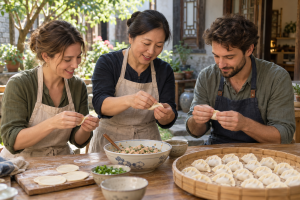
You can plan a vegetarian trip in China, but order by ingredients and preparation rather than by the photograph or the word “vegetable” alone. Start with a restaurant that can discuss your requirements, say whether you eat eggs and dairy, and ask separately about broth, cooking fat, sauces and garnishes. Tofu, noodles and a plate of greens are useful starting points, not automatic confirmation that the finished dish meets your diet.
For a first day in an unfamiliar city, identify one suitable meal near your hotel before trying several busy snack stalls. A clear conversation before the kitchen starts cooking is more useful than a long list of dishes you hope will be vegetarian. Keep the requirements on your phone in Chinese so you can show them again when ordering.
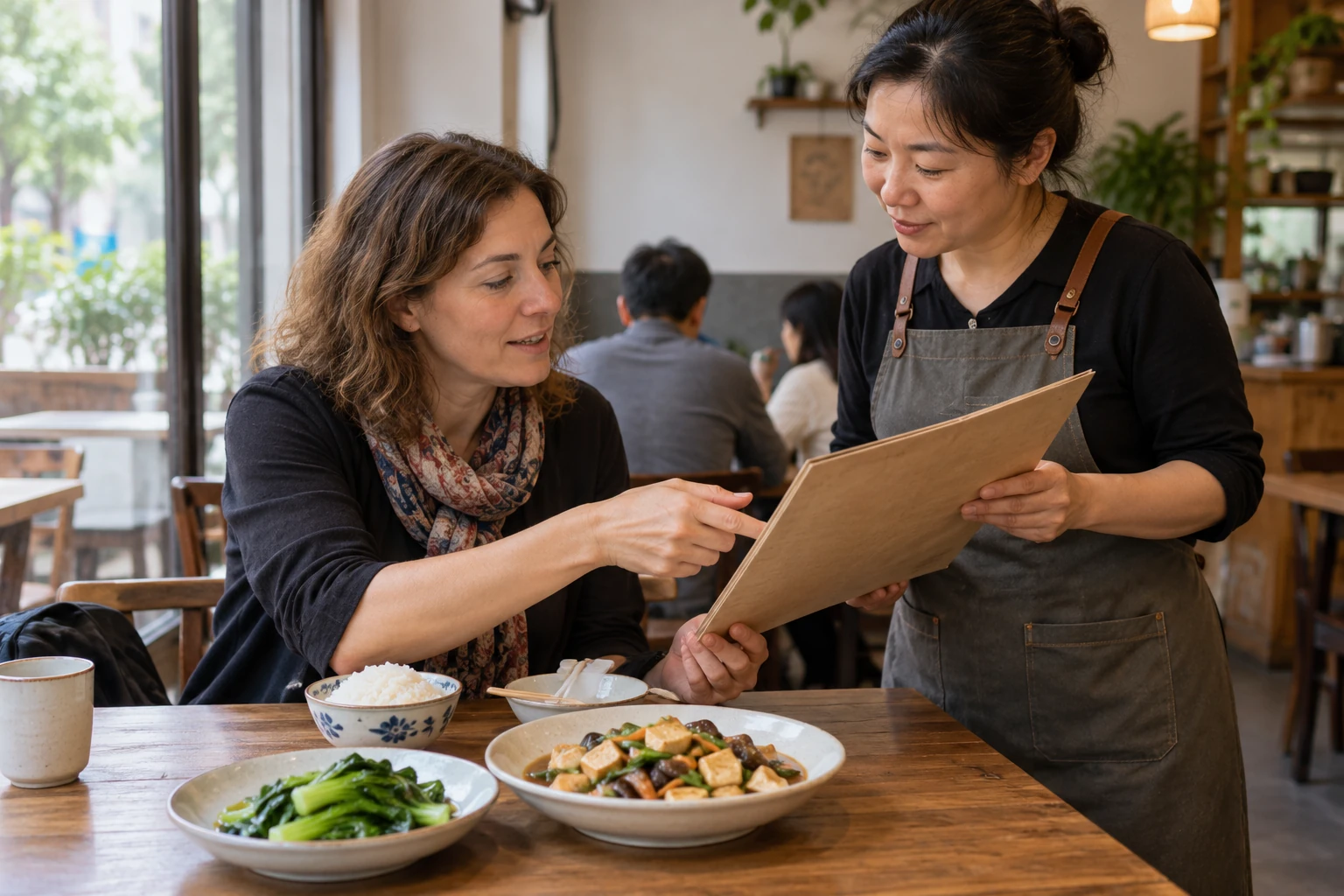
Updated 30 October 2026. The featured image is an original travel illustration of fictional adults discussing a menu. It does not show a real restaurant, Vero Trip customers or staff, or verified ingredients and kitchen practices.
Explain what vegetarian means for you
The useful first question is what you personally exclude. If you eat eggs and dairy, say so. If you avoid them, include that in the request rather than expecting “no meat” to cover everything. Also mention honey, animal stock or any other ingredient you specifically avoid.
素食 (sù shí) is a useful vegetarian search term and 纯素 (chún sù) a useful vegan search term. Treat these as ways to begin the conversation. Ask staff to confirm the actual dish, its seasonings and the preparation you require. A dedicated vegetarian restaurant can make that conversation easier, but it still needs to understand your particular restrictions.
A concrete example appears in Shanghai’s Fengxian dining guide: its vegetarian restaurant entry includes a salted-egg-yolk pumpkin dish. That is a reminder to distinguish vegetarian from egg-free eating, not a claim about today’s menu at every branch.
Check four parts of the dish
Look beyond the main ingredient. Ask about the base, the cooking fat, the seasoning and anything added just before serving. If staff cannot explain an ingredient, choose a simpler dish or another restaurant rather than treating an uncertain answer as confirmation.
| Part to check | Useful question | Why ask separately? |
|---|---|---|
| Broth or cooking liquid | Is this made with meat, fish or seafood stock? | The visible vegetables do not identify the cooking liquid. |
| Fat and oil | Can this be cooked with vegetable oil, without animal fat? | A familiar dish name does not specify the cooking fat. |
| Sauces and seasonings | Which sauce or seasoning product is used? | Oyster sauce and a vegetarian oyster-flavoured alternative are different products. |
| Filling and garnish | Does it contain meat, seafood, egg or dairy, including toppings? | Small additions and a mixed filling can change the finished dish. |
Shanghai’s June 2026 guide to pork-and-vegetable wontons describes both a mixed filling and broth made with animal ingredients, including lard. It illustrates why the filling and the soup need separate questions. Choosing a different filling would not, by itself, establish what is in the broth.
For sauces, ask about the exact product. Lee Kum Kee’s Premium Oyster Sauce ingredient list includes oyster extract, while its Vegetarian Oyster Flavoured Sauce is labelled vegan and lists mushroom flavouring. Similar names do not mean the same ingredients. That example does not tell you which bottle a particular kitchen uses.
Useful dishes to ask about, with the right follow-up
A manageable meal might be plain rice, a vegetable dish and a tofu or other bean-based dish that the kitchen has confirmed it can prepare to your requirements. Use the names below to discuss possibilities, rather than treating the list as a guaranteed vegetarian menu.
| Request or menu name | Follow-up question | Dietary distinction |
|---|---|---|
| Plain steamed rice · 米饭 | Is this plain rice, without added fat or toppings? | Distinguish it from a prepared fried or mixed rice dish. |
| Stir-fried seasonal vegetables · 清炒时蔬 | Can you use vegetable oil and avoid animal stock and sauces? | Confirm the actual seasoning even when no meat is visible. |
| Tomato and egg · 番茄炒蛋 | Can you confirm the oil and seasoning? | Contains egg; only an option if your diet includes it. |
| Vegetarian fried rice · 素炒饭 | Does it contain egg, meat seasoning or animal fat? | Specify the preparation rather than relying only on 素. |
| Tofu dish · 豆腐菜 | Can you prepare it without meat, seafood or animal stock? | Tofu is the main ingredient, not a guarantee about the sauce. |
| Vegetable-filled dumplings · 素馅饺子 | What is in the filling, wrapper, cooking liquid and dip? | Egg and mixed fillings need their own check. |
Mapo tofu is a good example of why the tofu itself is not the whole answer. Lee Kum Kee’s mapo-tofu rice recipe includes minced pork. A meat-free adaptation must be agreed with the kitchen; simply removing a visible garnish after serving would not explain how the sauce was prepared.
In a dedicated vegetarian restaurant, imitation-meat names can mean something different. Shanghai’s Longhua vegetarian-cuisine introduction includes vegetarian chicken and duck as well as kaofu, described as wheat gluten. Ask what the item is made from instead of judging only by an English name or a meat-like shape.
Chinese phrases to show before ordering
Choose only the statements that match your diet. Show the complete request and ask whether the kitchen can prepare it, rather than showing several disconnected “no” words after the order has been placed.
| What you mean | Chinese to show |
|---|---|
| I eat vegetarian food. | 我吃素。 |
| I do not eat meat, fish or seafood. | 我不吃肉、鱼和海鲜。 |
| Please do not add meat stock, lard or ordinary oyster sauce. | 请不要放肉汤、猪油或普通蚝油。 |
| I also do not eat eggs, dairy or honey. | 我也不吃鸡蛋、奶制品和蜂蜜。 |
| Can you use vegetable oil? | 可以用植物油吗? |
| Can you confirm the ingredients with the kitchen? | 可以帮我向厨房确认一下配料吗? |
For an egg-and-dairy-inclusive vegetarian request, you can combine the first three rows and add: 鸡蛋和奶制品可以。 This means “Eggs and dairy are okay.” For a vegan request, add the row excluding eggs, dairy and honey instead. Keep your own requirements consistent when you share the message with a hotel, guide and restaurant.
If preparation in shared equipment matters to you, explain what you require and ask whether it is feasible. A menu label alone does not answer questions about utensils, frying oil or a shared cooking surface.
Choose the restaurant format for the day
A dedicated vegetarian restaurant is useful when you want more choice and a meal centred on vegetables, mushrooms, bean products or imitation meats. Check the current menu and whether the restaurant can accommodate egg-free or dairy-free requirements. Vegetarian dining can range from a simple noodle meal to a multi-course tasting; confirm the price basis and what is included before reserving.
Shanghai’s August 2026 restaurant feature describes Fu He Hui as a vegetarian restaurant with a changing seasonal menu. It is one example of this more structured dining format. Check the restaurant’s own current offering, booking conditions and dietary suitability for your date; the published feature is not a reservation or a vegan guarantee.
An ordinary neighbourhood restaurant can work when staff understand the request and can confirm how the selected dishes are cooked. Order a small number of clearly explained dishes rather than asking the kitchen to redesign a large shared banquet at the table. If a sauce or soup base is already prepared with ingredients you avoid, ask about a different preparation.
A temple-related meal can add cultural context, but check whether the dining space is open to visitors and how the meal fits the visit. Do not assume temple admission includes food, that food is available whenever you arrive, or that a vegetarian description establishes your particular vegan requirements. Follow the venue’s dining and photography etiquette.
Hotpot, buffets and shared meals need an extra decision
At hotpot, confirm the broth first, then the ingredients, dipping sauce and utensils. A bowl of mushrooms or vegetables does not establish the ingredients of the soup base. If your companions will cook meat or seafood in the same pot, decide whether that arrangement matches your requirements before ordering. Ask about a separate pot if that is what you need, including any extra charge.
At a buffet, read ingredient labels and ask about dishes that are not explained. If shared serving tools matter to your diet, discuss that separately. A vegetarian label is also not an allergy statement: the vegan sauce example above explicitly lists soybeans and wheat. Tell the restaurant about any food allergy as a separate requirement.
For a mixed group, agree the serving arrangement before the meal. You might order confirmed vegetarian dishes for everyone alongside separately served meat dishes, or choose a dedicated vegetarian meal that the whole group wants to try. The important point is that everyone understands which dishes and utensils belong to the agreed arrangement.
Make meals fit your transport and sightseeing
On a late arrival, keep the first meal near the hotel and check whether the kitchen will still be serving. For an early departure, ask about a suitable breakfast or takeaway before the previous evening ends. Include your dietary request when discussing hotel breakfast; a buffet photograph does not show every ingredient.
For a long rural or scenic-area day, decide where lunch will be and what the realistic fallback is. Ask the organiser about the actual kitchen and menu before departure, or arrange an appropriate packed option that can be carried on the planned journey. A shopping stop or a plate of snacks should not accidentally become the day’s only meal.
Keep some flexibility in sightseeing if a suitable restaurant is a meaningful detour. When language support is needed, ask who will explain the requirements to the kitchen. A general promise to “arrange vegetarian food” is less useful than agreement on a meal, venue and preparation for the actual day.
Connect a food activity with a realistic route
The Hangzhou Lingyin temple and vegetarian-food route lists an activity preparing vegetarian noodles and osmanthus cake. It is a starting outline for combining culture and food, not confirmation that a particular workshop, recipe or kitchen meets every vegan or allergy requirement.
Before booking, confirm the date, venue, ingredients, participation, language support and temple-access arrangements in the written proposal. If the listed food activity cannot meet your needs, request a different meal or format. For a broader culinary holiday, compare how to plan a food and culture trip in China; keep ordinary meals in the schedule alongside tastings and classes.
Common questions about vegetarian travel in China
Is tofu always a vegetarian choice?
Ask about the finished dish. Tofu can be served with meat, seafood, stock or a sauce that does not match your diet. Explain the preparation you want and choose it only when the kitchen can confirm it.
Can I just ask for no pork?
That request excludes only pork. If you also avoid other meat, fish, seafood, animal stock or fat, state those exclusions. If you eat eggs or dairy, make that clear too.
Do I need to eat at vegetarian restaurants for every meal?
No single restaurant format suits every itinerary. Dedicated kitchens may offer more choice, while an ordinary restaurant can be practical when it understands and can meet your request. Keep a suitable alternative for days when the available kitchen cannot confirm the ingredients.
What should I tell Vero Trip before planning?
Send your dates, route, group size and exact dietary exclusions through Plan My Trip. Include eggs, dairy, honey, stock, sauces and shared-equipment requirements where relevant, and identify food allergies separately. Ask for meal arrangements and any extra costs to be stated in the trip-specific written proposal; this guide does not establish that every venue or meal is already included or suitable.