Choose a Shangri-La thangka experience by deciding whether you want to look at paintings, watch an artist work or try a small painting exercise yourself. These are different visits. For a hands-on session, agree the teaching language, subject, materials and take-home result before paying. A short introductory activity should give you a closer understanding of the craft, without promising a complete traditional scroll painting.
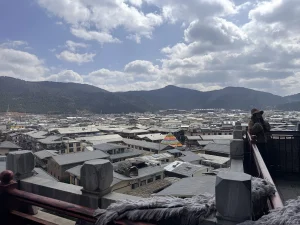
Dukezong Ancient Town is a practical starting area for researching local heritage experiences. Published cultural reports describe guided thangka outlining and colouring there, while a separate museum visit may suit someone who prefers interpretation to painting. Place the activity within your city stay rather than adding a distant stop simply because it is described as “cultural.”
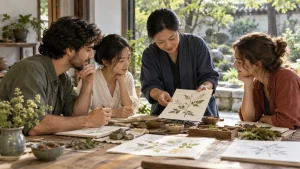
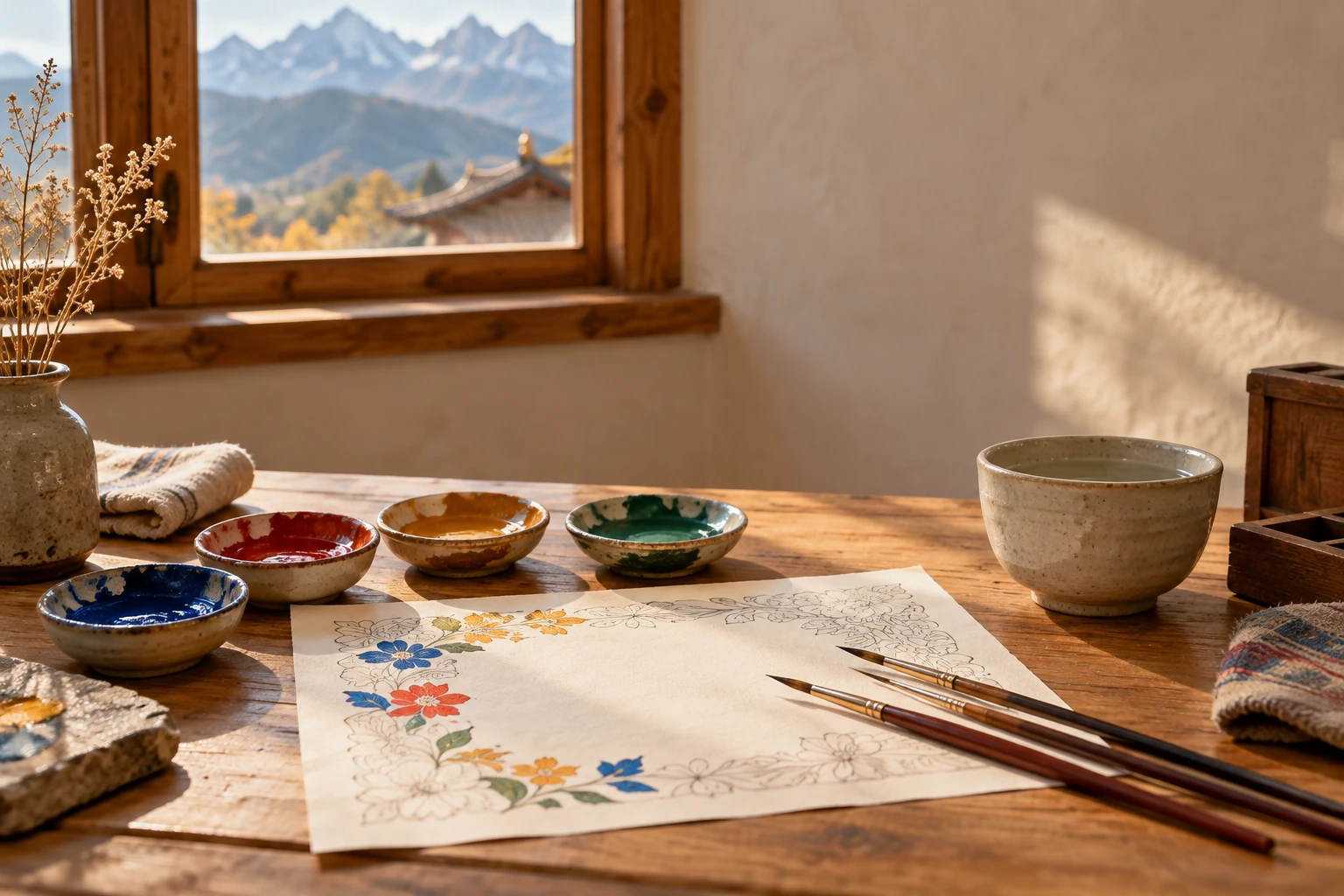
Updated 28 October 2026. The featured image is an original illustration of painting materials and a floral practice sheet, not a real Shangri-La studio, teacher, workshop or finished thangka.
What a thangka is—and what an introductory session can teach
Thangkas are traditional Tibetan scroll paintings with religious significance. The Smithsonian’s written explanation of thangka painting describes their role in worship and the stages of preparing a surface, outlining and painting. Its filmed examples come from Rebgong in Qinghai, so they explain the tradition rather than identify a Shangri-La workshop.
A visitor session can concentrate on looking closely, handling a brush or understanding one motif. Ask which part you will actually do. Starting with a prepared outline, drawing a small pattern and observing the teacher’s own work are different learning outcomes. None should be confused with training to produce a professional religious painting.
Let the teacher explain the meaning of the chosen subject and what is appropriate for beginners. If you prefer a non-religious decorative exercise or observation only, ask whether that format is available. Do not assume every studio teaches the same subject or that a demonstration includes permission to touch the work.
Gallery, demonstration or hands-on painting?
The best choice depends on your interest and attention span. You can appreciate the art without making something, and you can learn from an introductory exercise without expecting a display-ready scroll.
| Experience | Choose it when | Establish before booking |
|---|---|---|
| Gallery or museum visit | You want to understand subjects, materials and the wider cultural context. | Which collection is accessible, whether interpretation is available and whether entry needs a reservation. |
| Artist demonstration | You want to watch brushwork and ask about the process. | Whether an artist will actually be working, the viewing format and the language of discussion. |
| Introductory painting session | You want a small supervised exercise and time to work with a brush. | Subject, starting surface, teacher support, materials and exactly what you may take away. |
| Longer study arrangement | Art students want sustained practice or a specialist learning focus. | A named host, learning plan, dates, group size and teaching/interpretation responsibilities. |
Where to begin your search in Shangri-La
Dukezong’s heritage-experience area
The Diqing intangible-cultural-heritage protection centre’s Tourism Day article describes teacher-guided outlining and colouring at the Fanmiao Thangka Academy experience area (凡妙唐卡画院). The same article discusses the old-town heritage-experience centre. These are useful Chinese names to show your hotel or local organiser when asking for the current venue and a suitable appointment.
A separate heritage-route announcement places the urban experience around Dukezong and Jinlong Street (金龙街), including thangka and incense activities. Use it to group nearby interests, rather than treating an entire street as one bookable workshop. Confirm the actual studio door and map pin; the heritage centre website’s office address is not necessarily the class location.
Both pages display a publication date of 2 November 2025. A September 2025 government report also describes visitors practising outlines and colour with teachers in the old-town experience area. These accounts establish a specific local lead. They do not establish today’s timetable, price, teacher availability or teaching language.
Songtsam’s museum as a separate enquiry
Songtsam’s July 2022 museum announcement describes a Tibetan art museum within Songtsam Linka Retreat Shangri-La, including a thangka painting centre. Ask the operator about current museum access and what can be seen on your date. A painting centre in an announcement does not by itself confirm a bookable beginner class, English instruction or admission for a particular visitor.
Keep a museum visit and a workshop booking separate until the operator confirms the format. If staying elsewhere, establish non-resident access and transport as well. Neither this museum nor the named old-town experience area is presented here as a confirmed Vero Trip workshop partner.
The questions that make a workshop booking useful
Explain the result you want before comparing prices. “A class” is too broad: a private explanation, a shared colouring activity and individual teaching can involve different preparation and support. Ask for the answer in writing so it survives a language misunderstanding at the door.
| Question | Why it affects the visit | What a clear answer includes |
|---|---|---|
| Who teaches, and in which language? | English advertising does not necessarily describe the teacher’s working language. | Teacher/host arrangement and whether interpretation is included or separate. |
| What will I paint? | A prepared practice sheet differs from drawing on a blank surface. | Subject, surface, size and the stage a beginner can reasonably reach. |
| Which materials are included? | A displayed example may use different materials from a visitor exercise. | Brushes, paints, paper/cloth, protective clothing and any extras. |
| How does the session work? | Shared teaching and one-to-one attention are different experiences. | Start/end, group size, demonstration time, breaks and late-arrival terms. |
| Can children participate? | Seats, tools and instructions must suit the actual child. | Accepted ages, adult supervision and whether a simpler activity is offered. |
| What leaves with me? | Drying, mounting and packaging may be separate stages. | Whether the practice piece can leave that day and any collection or finishing arrangement. |
Also ask for the total price and cancellation terms, including what happens if the teacher or venue changes. Avoid assuming materials, interpretation, mounting, transport or refreshments are included because they appear in a photograph. A dated quotation is more useful than an old social-media price.
Helpful questions to show a host are “这是参观、示范,还是可以自己画?” (Is this a visit, demonstration or hands-on painting?), “有英语教学或翻译吗?” (Is teaching in English or interpretation available?) and “作品当天可以带走吗?装裱另外收费吗?” (Can I take the work away that day? Is mounting an extra charge?).
Put one focused session into your city stay
Allow room around the confirmed appointment for finding the entrance, settling in and discussing the exercise. A half-day left flexible for the workshop and nearby streets is easier to manage than fitting it between two distant excursions. Use the agreed session length to plan the rest of that day.
| Stage | A practical arrangement | What to avoid assuming |
|---|---|---|
| Before the appointment | Confirm the venue, language, participants, materials and take-home plan. | That a previous visitor’s class is still offered on the same terms. |
| At the studio | Ask for an explanation, watch the demonstration and try the agreed exercise. | That you may handle completed artworks or photograph every part of the room. |
| After painting | Discuss the result, drying and packaging; leave time for collection if needed. | That wet work can immediately go into a suitcase or that mounting is instant. |
| The rest of the day | Keep a nearby meal or unhurried Dukezong walk as the next step. | That a studio appointment includes a monastery visit, vehicle or other heritage activity. |
For arrival day, keep the booking flexible enough to accommodate travel delays and how you feel. A seated activity still involves an appointment and a journey to the venue. An indoor session can be an alternative to outdoor sightseeing in poor weather, provided the host is available and you can reach it comfortably.
Use the Shangri-La travel guide to choose your nights and arrival arrangements. If a class is near the old-town lanes, agree a vehicle-accessible meeting point and ask about steps to the actual room. “Indoor” does not automatically mean step-free.
Respect the artist, the work and its religious context
Ask before photographing people, copying a design or filming a demonstration. Permission to take part is not blanket permission to reproduce the teacher’s artwork. Follow the host’s directions about handling objects and where bags, drinks and equipment belong.
Ask questions about the subject rather than treating sacred imagery as a generic souvenir pattern. If you would rather watch, say so. Taking part in a painting exercise need not mean agreeing to a ceremony, purchase or another activity you did not request; clarify the programme beforehand.
When considering a contemporary artwork, distinguish an original hand-painted piece, a print and your own practice exercise. Request the maker, materials, size, finishing and price in a clear receipt. You can choose an observation-focused visit without committing to buy a painting.
Families, mixed interests and taking work home
For children, describe the age and interest level rather than booking the same exercise for everyone. Ask what materials the child will handle and what supervision is needed. A short observation visit or simpler practice may be more enjoyable than a task requiring sustained fine brushwork.
For a mixed group, confirm whether non-painting companions can watch or need their own place. Plan a clear meeting point if some people explore nearby. Let the studio explain how to protect the work while it dries; ask for packaging suitable for your onward journey rather than improvising with a damp painting.
Arrange a nearby meal according to the class location and your dietary needs. The Shangri-La food and restaurant guide helps you compare city and monastery-area dining without assuming either comes with a workshop.
Questions about Shangri-La thangka workshops
Do I need previous painting experience?
Ask for an explicitly beginner-friendly format. A studio visit can be worthwhile without any drawing skill, while hands-on teaching should match your starting level. Send the host your goal rather than assuming all advertised sessions begin with the basics.
Will I finish a traditional thangka in one visit?
Choose a realistic introductory outcome: learning a technique, understanding a subject or completing an agreed practice piece. Ask the teacher how that differs from producing and finishing a traditional scroll. Mounting and other finishing stages need their own explanation.
Does a cultural tour include the painting session?
Only when the written itinerary names it and explains the host, date, teaching, materials and cost. A monastery visit, an art-focused route or a hotel stay does not itself establish that a particular thangka teacher is booked.
Connect the experience to your wider trip
For a longer journey, compare the existing Shangri-La Tibetan art and landscape study route. Its published focus is architectural sketching and landscape observation, not a promised thangka class. Treat it as a framework for discussing a wider art interest; any studio session needs a separate, named arrangement in the proposal.
Tell Vero Trip what you want to learn, together with dates, nights in Shangri-La, group size, children’s ages, preferred language, mobility needs and whether you want to observe or paint. Request a written plan with the confirmed host and inclusions. That makes the next step a specific cultural visit rather than an undefined “craft experience.”
The featured image is an original art-preparation illustration. No photograph of a supplier’s studio, teacher, visitors or artwork has been used as proof of a current class.