Updated 22 October 2026
For a first Nanjing trip, allow two or three full days and organise them around the reservations you can actually obtain. Give the Zhongshan landscape and heritage area its own day, choose the museum you most want to understand, and keep a separate, unhurried visit for the Memorial Hall if it suits your party. Arrival and departure days are additional transfer days, rather than two more full sightseeing days.
Nanjing works particularly well as a history-rich stop between larger eastern China bases. It also stands on its own for a slower city break. The main planning mistake is to combine long outdoor walks, several independently booked institutions and distant autumn viewpoints into one apparently short route. A list of attractive photographs does not show the journeys, queues or recovery time between them.
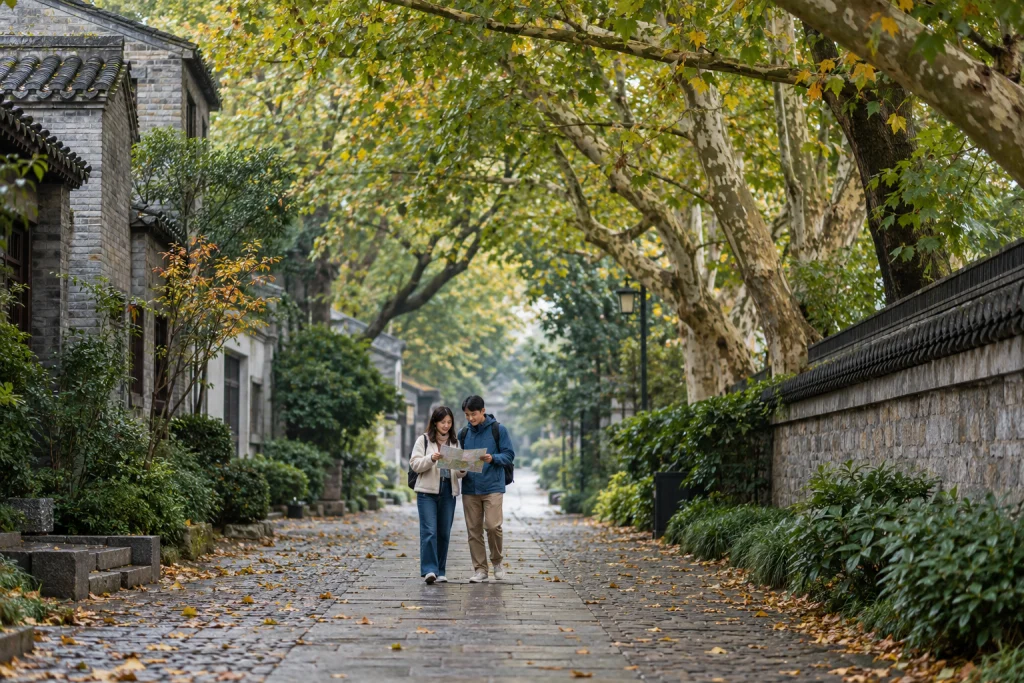
The featured image is a travel scene with fictional travellers, rather than a photograph of a particular Nanjing attraction or Vero Trip customers.
How many days should you spend in Nanjing?
Count usable days after the journey, rather than nights alone. Three nights can provide only two full days if you arrive late and leave early. With one day, choose one main commitment and see it properly. With three, you can separate the major landscape area, a collection visit and a memorial visit without making every evening another appointment.
| Time available | A workable focus | Leave for another visit |
|---|---|---|
| One full day | One booked museum or one Zhongshan zone, then a short city walk. | A city-wide attraction checklist. |
| Two full days | One landscape/heritage day and one museum/city day. | Distant autumn extensions. |
| Three full days | A separate memorial visit, a Zhongshan day and a flexible city day. | An automatic day trip outside Nanjing. |
| Four or more | More collection time, rest and a chosen additional district. | A compulsory hotel change. |
These are planning allowances, not guaranteed visit durations. A keen museum visitor may want longer inside than a family with young children. Someone who mainly wants tree-lined walks can use fewer timed attractions. Set your priorities before you reserve trains, because losing the one usable museum day to a closure can change the whole stay.
Where to stay: choose the journey, not just the neighbourhood name
One hotel is usually enough for a city stay. A base near a useful metro connection can be more practical than a hotel advertised as close to one famous sight. Check the real walk from the appropriate exit, whether lifts serve your route and how luggage reaches the entrance. Being beside a station on the map does not establish a level journey from platform to room.
| Base idea | Why consider it | Check before booking |
|---|---|---|
| Xinjiekou / central interchange | Several city directions from one hotel. | Actual station exit, lifts, traffic and room noise. |
| Daxinggong / central-east | City walks with convenient onward transport. | Which entrance and which museum you actually need. |
| Near Minggugong | A museum-focused stay towards the eastern city. | Evening food and the journey to your other bookings. |
| Qinhuai / Laomendong area | An evening in the older southern neighbourhoods. | Vehicle access, stairs and noise after dark. |
| Nanjing South station area | Useful for a very early train. | Whether saving departure time justifies daily city transfers. |
Ask the hotel to send its Chinese name, address and drop-off instructions before you arrive. In older lanes, a driver may not be able to stop at the front door. For an older relative, request a clear description of steps and lift access instead of accepting “convenient location” as an accessibility answer. A central hotel with a usable breakfast can also simplify an early reservation day.
Do not move to the station for the entire holiday simply because the final train is early. Compare the repeated journeys on all sightseeing days with the one departure transfer. If a final-night move is worthwhile, account for packing, check-out and storing the bags, as well as the cost of the room.
Nanjing Museum: get the institution and passport procedure right
Nanjing Museum’s own visit guidance describes real-name advance booking, with places released at 18:00 for the following seven days, excluding the same day. Foreign-passport holders should make the reservation, then take the original document and successful booking confirmation to the visitor-service green-channel window for the required entry procedure.
The regular schedule is Tuesday–Sunday, 09:00–17:00, with admission ending at 16:00; Monday exceptions and special notices can apply. Permanent collections are free, while particular temporary exhibitions or performances can have separate charges. Use the actual booking slot and the latest notice for your date. A photograph of a booking screen or a hotel recommendation does not replace a successful reservation.
Keep large luggage at your hotel when possible. Select the galleries that interest you and leave time to read, rather than treating the building as a quick stop between distant sights. Confirm the Chinese institution name, 南京博物院: the similarly named municipal museum at Chaotiangong is a different destination. A reservation for one is not a reservation for the other.
Zhongshan: choose a zone before adding attractions
Zhongshan is a broad landscape and heritage area, not one small enclosed attraction. Ming Xiaoling, the Sun Yat-sen Mausoleum, the Music Stage and Linggu are separate choices. The scenic area’s published visitor guide sets out distinct admission arrangements, including a reservation for the mausoleum. Check the current notice for the selected zone rather than applying one attraction’s ticket or closing day to every other part.
Start with your reason for going: stone-lined heritage walks, the mausoleum approach, a wooded landscape or a quieter religious and historic setting. Then work out where you enter, how much walking and climbing you want and where you will leave. A shuttle can cover a transport section without eliminating all walking or steps. Agree a realistic pick-up point before splitting up.
For a family or a visitor with limited walking tolerance, one substantial zone and a rest can be a better day than four abbreviated visits. If you add a second stop, keep it genuinely compatible with the first entrance and exit. Do not depend on social posts promising free entry at a certain dawn hour: arrangements, gates and permitted access need to be confirmed for your date.
The Memorial Hall: allow time and reserve each venue separately
The Memorial Hall of the Victims in Nanjing Massacre by Japanese Invaders is a place for remembrance and historical understanding. Plan a quiet, unhurried visit rather than a photo challenge. Consider the exhibition content and your children’s readiness before making it a family obligation; leave an easy remainder of the day.
The current official visitor guide requires real-name reservations for all visitors, including children, and separate reservations for the three venues. Passports are accepted documents. Reservations open at 08:00 for visits one to seven days ahead. Regular opening is 08:30–17:30, last entry 16:30, with Monday closure except statutory holidays; Lijixiang starts at 09:00. Follow your venue and time slot.
The main historical exhibition and the “Three Victories” exhibition are adjacent but have different entrances; Lijixiang is in a different location. Do not assume that booking the first automatically covers the others. The official booking FAQ explains the distinctions. Its extended summer hours ended on 1 September and should not be carried into an October plan.
The exhibitions are free. The institution’s reservation reminder states that it has not authorised third parties or individuals to act as booking agents. Do not buy an alleged admission place from an unofficial seller. Bring the original document used for your reservation, respect instructions on photography and keep phones quiet.
A realistic three-day city plan
This example assumes three full days between arrival and departure, normally four nights. Swap the order to fit successful reservations and closures. It gives each demanding visit space and makes evening activities optional. You can shorten it to two full days by choosing between the two major institutions, rather than compressing both into one rushed afternoon.
| Day | Main commitment | Flexible remainder |
|---|---|---|
| Arrival evening | Reach the hotel and eat near the base. | A short walk if arrival is early. |
| Full day 1 | One selected Zhongshan zone with realistic walking. | A second nearby stop only if time and energy allow. |
| Full day 2 | Nanjing Museum with the correct reservation. | A short city district or a rest break. |
| Full day 3 | The Memorial Hall, if appropriate for your party and reserved. | A quiet, undemanding remainder. |
| Departure | Collect luggage and reach the correct station. | No distant morning excursion before a fixed train. |
On the flexible city day or afternoon, choose a manageable section around Xuanwu Lake, a neighbourhood walk or an evening around Laomendong and Qinhuai. You do not need to circle an entire lake or climb a wall to enjoy the setting. Ask for the actual entrance when purchasing admission to a wall section: a wall on the skyline is not evidence of a nearby usable access point.
If your main aim is autumn photography, substitute a chosen landscape outing for another activity rather than adding it after a full museum day. Keep your final evening near the base if you must pack and leave early. A programme with room for dinner and rest is easier to complete than an itinerary where every attractive view becomes compulsory.
Autumn photographs, rain and family pace
Autumn colour varies between trees, districts and years. Recent posts can contain older photographs, while precise dates beside photographs may describe a previous season. Look for an explicitly stated capture date close to departure, and keep architecture, lakeside walks and collections as reasons to enjoy the city even when leaves are green. No single November weekend guarantees a particular colour.
Rain changes the comfort of stone paths, hill approaches and exposed wall walks. Waterproof clothing does not make a slippery route suitable for everyone. Shorten the outdoor plan and use an indoor alternative whose admission you can actually obtain. A popular museum is not an unlimited walk-in refuge just because the weather is poor.
| If this happens | Make this change | Keep the original plan honest |
|---|---|---|
| Museum is full | Swap to a city walk or a different open museum with its own admission rules. | A different ticket does not admit you to the original museum. |
| Monday closure | Put outdoor districts on Monday and move the collection visit. | Check each institution separately. |
| Rain or slippery paths | Shorten hill and wall walks; use a suitable booked indoor visit. | Indoor capacity is not guaranteed. |
| Leaves are still green | Enjoy architecture and tree-lined walks or change the photo goal. | Do not chase an old photograph as a live forecast. |
| A child needs a break | End the visit early and return to the base. | Avoid a second emotionally demanding exhibition. |
With children or older relatives, agree a stopping point and an easy return. Carry appropriate water and food within each venue’s rules, allow toilet breaks and do not count a shared bicycle as a universal solution. Foreign visitors need a lawful, practical transport option that works for every member of the party, including the person who is least comfortable walking.
Arriving by train and linking Nanjing with a wider trip
Check whether your ticket names Nanjing or Nanjing South, and book the onward transfer from that station. Keep the Chinese station name and the hotel address available offline. Allow time for luggage, security and finding the departure platform; the rail journey alone is not the hotel-to-hotel journey. Use the passport details on the ticket consistently with the document you carry.
For a longer eastern China holiday, the Shanghai–Suzhou–Hangzhou planning guide helps decide which bases earn an overnight stay. Add Nanjing by replacing time elsewhere or extending the total holiday. Do not insert three full city days into an unchanged week. The Shanghai planning guide covers the separate arrival-base decision.
What to send when asking Vero Trip for help
Send your travel dates, arrival and departure stations or flights, the number and ages of travellers and your preferred walking level. Name the institutions that matter most, whether reservations are already successful and any room, meal, language or step-free requirements. This allows the next proposal to address the difficult connections instead of repeating an attraction list.
Ask the written proposal to identify transport, guiding, admission assistance and exclusions individually. A planning enquiry does not secure museum capacity, and an industrial visit programme is not automatically a Nanjing leisure tour. Confirm the dated services and price before making non-refundable onward arrangements.
Related Journeys to Compare
These existing routes offer starting points for the region or travel interests discussed above. Read the full daily itinerary to see what is included. A visit described in this guide, a specialist session or an international border crossing is added only when confirmed in your own programme.