Use Jianchuan’s Ximen Street to study the boundary between Bai house and town lane. Roofed gates, timber and high screening walls reveal much from public space. For a half-day, choose a short residential stretch, lunch and one Jingfeng feature. Two entrances understood well can tell more than all nine addresses.
Set your map to Jinhua Town, Jianchuan County (剑川县金华镇), in Dali Bai Autonomous Prefecture, Yunnan. This is the county seat. Shaxi’s market square is a separate stop requiring a transfer. A hotel address that says only “Jianchuan County” could put you in either place. Ask for the town name and the street entrance before deciding where to spend the night.
Reading the houses along Ximen Street
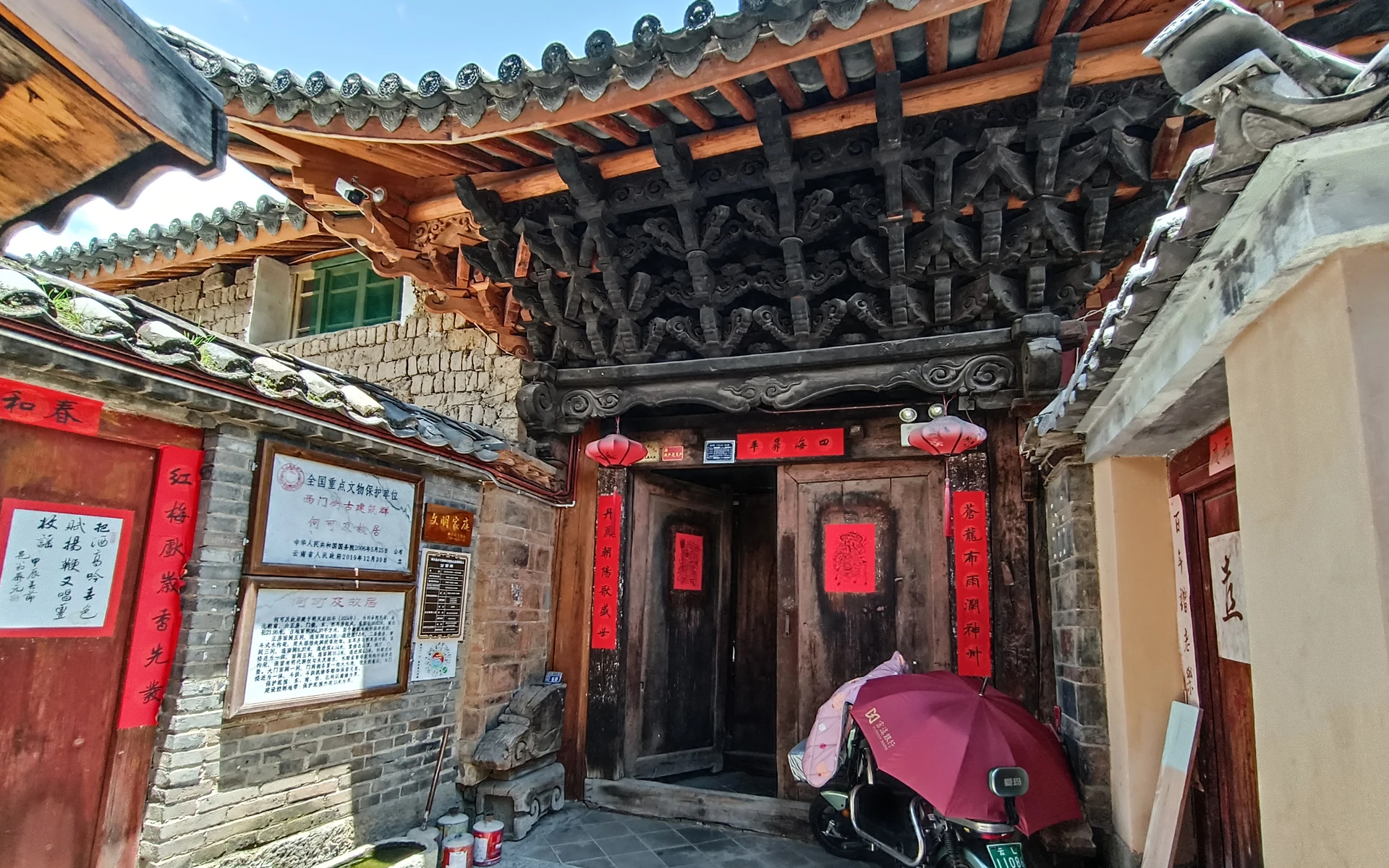
The county’s account names nine Ming-period compounds in the protected West Gate Street group. They include the former residence of He Keji (何可及故居), the Duan Xueyan compound (段学颜宅院), and Zhaozhong Shrine (昭忠祠). Their national listing in 2006 identifies an architectural group. Individual addresses can have different uses and access arrangements. Elsewhere in the old town, later houses sit alongside earlier fabric. Use a posted identification plaque to date a particular building.
Compare entrances from a place where people can pass: canopy depth, supports and how the door screens the house. See what the next gate reveals differently. Use only public side lanes and leave room for deliveries, cycles and residents.
Use san fang yi zhao bi and si he wu tian jing to read a diagram or admitted court: three ranges and screen wall, or four ranges with central and corner courts. A doorway glimpse rarely establishes the entire house plan.
| Stop | What to look for | How to visit |
|---|---|---|
| He Keji former residence and the Ximen Street group | Read the name on a plaque, then look for the transition from stone lane to roofed gate and screened domestic space. | Begin outside. Ask on site which parts, if any, receive visitors that day. |
| Another named address, such as the Duan Xueyan compound | Compare two entrances: roof pitch, timber joints, decoration and the opening between the walls. | Move on after a street-side comparison if the door is closed or someone is using the entrance. |
| Jingfeng complex outside West Gate Street | Look up at the octagonal pavilion, then choose the square stone pagoda or the approach to Dacheng Hall. | Check which grounds are open before walking over. All of these can be approached as exterior architecture. |
From the household doorway to Jingfeng Pavilion
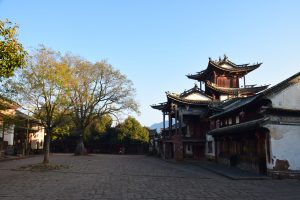
At Jingfeng Pavilion (景风阁), step back to follow three octagonal storeys and the first-level gallery. Trace one eave corner and shift to the next face. Ground-level looking can explain its form even when upper levels are closed.
Choose a contrast: Lingbao’s square stone tower rises in nine repeated tiers, while five-bay Dacheng Hall stretches beneath one eave tier. Compare one feature from an open forecourt instead of another long name list. Children can count shape changes without entering halls.
If grounds close or rain affects paving, keep the second block short. A public-lane photograph can support a later sketch over coffee. A second Ximen pass may suit woodwork interests better than an unconfirmed demonstration or home visit.
A half-day on foot, from arrival to the ride back
Arrive at the edge of the old streets. If coming from Dali, Lijiang or Shaxi, agree a road-accessible meeting point in Jinhua and show the driver the Chinese address. Leave bags at your booked accommodation by agreement, or arrange with your driver how luggage will travel and where you will retrieve it. Allow the first part of the morning for the road journey if sleeping elsewhere. A county-town visit fits most comfortably when the next day has room for an onward transfer.
Walk in before lunch. Give yourself about an hour for a slow look at one stretch of Ximen and its nearby public lanes. This is a suggested allowance, including stops, rather than an opening window. A GoKunming reporter who walked the streets in 2013 described stone gutters, wooden gate decoration and people using the lanes for daily errands. That account explains why it is worth pausing at an ordinary doorway. It cannot tell you which family lives behind it today. Ask before photographing a person, a workshop at work or a view through a domestic entrance.
Eat in town. For a small lunch, look for liangfen (凉粉), a cool, soft starch jelly served with seasoning. Ask for the dressing separately if you want to taste it before adding chilli. A dish of yang rubing (羊乳饼) gives you another local flavour: it is a milk curd, relevant if you avoid dairy. For a group meal ask what is available from Jianchuan’s chicken, potato and radish dishes. Bai ba da wan, the eight-bowl hospitality meal, is a larger undertaking. Confirm portions, time, ingredients and any advance order before building lunch around it.
After lunch, decide between Jingfeng Park and the shorter street return. Its suggested hour needs the walk back to transport added. Name Jinhua, Shaxi or Dali as the actual finish, including bags and any terminal margin; they are different journeys.
Where to sleep and how to divide the nights
Choose Jinhua for repeat street time and Shaxi when its market-town setting dominates the stay. Check a Jinhua room’s legal drop-off, final surface, floor, bathroom and turning space. A courtyard address alone establishes neither luggage ease nor wheelchair access.
| Stay | How to use the days | Where the nights fall |
|---|---|---|
| 3 days, 2 nights | Travel to Jinhua and settle in on day one. Walk Ximen, eat in town and choose Jingfeng on day two. Transfer to Dali or Lijiang on day three. | Two nights in Jinhua. Keep the same room and leave bags there for the walking day. |
| 4 days, 3 nights | Start in Dali. Reach Jinhua on day two for an introductory walk. Use the next day for the old street and pavilion at an easier pace, then depart on day four. | One night in Dali and two in Jinhua. The final road transfer starts in the county seat. |
| 5 days, 4 nights | Start in Dali, sleep in Jinhua on the second night, then finish the county-town visit before transferring to Shaxi. Give Shaxi its own full day before leaving on day five. | One night Dali, one Jinhua and two Shaxi. Confirm the last transfer from Shaxi to your onward connection. |
For help deciding where to spend the longer stay, see the Shaxi transfer and village-walk guide. A day visiting the Shibaoshan grottoes from Shaxi also has its own road and walking requirements. Verotrip’s seven-day Dali and Shaxi artisan itinerary gives Xizhou, Zhoucheng, Shaxi and Shibaoshan separate days before returning to Dali. To include Jianchuan Old Town in that journey, ask for the extra stop and the revised overnight plan to be written into your itinerary.
Access, weather and costs
| What to arrange | Why it matters here | Useful fallback |
|---|---|---|
| Named building or activity | A protected residence may have a private doorway. For any paid or booked interior, check the date, visiting area, payment and original-passport procedure. | Study two signed street façades and use an open park exterior. |
| Walking surface and stamina | Stone paving, gutters, higher thresholds and a longer return to the car can make a short route tiring. | Arrange a seated meal close to the chosen approach and turn back from the first named building. |
| Driver, language and overnight stop | Jinhua and Shaxi are different towns in one county. A driver can reach a hotel address without providing architectural interpretation. | Carry both place names in Chinese and agree a single pickup location and hotel with everyone in the party. |
Price on request. Give your Verotrip travel consultant the starting hotel, final hotel or transport connection, dates, party size and walking requirements. The quotation can then specify the two road legs, waiting time, a guide’s language if requested, meals, admissions and any room reservation. Indicate whether the priority is woodwork on public streets, a particular accessible building or a meal shared by the group. The right plan changes with that answer.
Questions about visiting Jianchuan Old Town
Is this the same place as Shaxi?
No. Both belong to Jianchuan County. Jinhua is the county seat and the starting point for Ximen Street. Sideng is the historic centre visitors usually mean when they say Shaxi. Use the town and hotel names together on a booking or taxi request.
Which building should I start with?
The He Keji former residence gives you a named point within the Ximen Street group. Start by reading its plaque and examining the entrance from public space. If you prefer to study a freestanding building from several angles, make Jingfeng Pavilion your main stop instead.
Can I visit if the private courtyards are closed?
Yes. Street fronts, canopies, timber and the transition from public lane to screened dwelling are the main subjects of this walk. Check signs at each boundary. An open household door is a reason to give someone privacy, unless the host explicitly welcomes visitors.
Is Jianchuan manageable on a transfer day?
Yes, with a realistic road plan and one clear priority. Choose a meal and one street section, fix a latest departure time and agree where bags will be kept. If seeing both the houses and the park matters to you, an overnight in Jinhua makes that choice much less dependent on traffic.
Cover photograph of the former residence of He Keji by Kcx36, August 2024. Cropped, resized and converted to WebP under CC BY-SA 4.0.