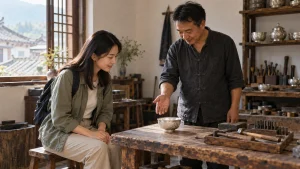
Baisha can be a rewarding place to look closely at embroidery, but decide whether you want to watch, learn or buy before arranging the visit. Those are three different experiences. A shop displaying handmade work is not automatically a teaching studio with an instructor available for walk-in travellers, and a short introduction is not the same as completing a complex traditional piece.
Begin with the work, not a shopping obligation
A 2025 local cultural report describes embroiderers in Baisha producing traditional Naxi motifs and adapting them for everyday objects. It also records visitors watching and trying the craft. This supports choosing Baisha for a craft-focused stop, while the actual teaching arrangements still need to be checked with the studio you will visit.
Ask to see a simple section of work at different stages. Look at how stitches create an outline, fill an area or change the appearance of a colour. An explanation of one small motif can reveal more than a quick tour of many finished items. Ask the maker how they describe the design rather than assigning it a meaning from an unrelated souvenir.
Choose the right format
A demonstration suits travellers who want an introduction without a long commitment. A lesson requires a teacher, prepared materials and enough seated time to practise. A purchasing visit gives you time to compare pieces and understand the work behind them. Combining all three is possible, but the schedule should say so.
For a beginner, choose a manageable sample rather than a design that normally requires extensive work. Ask what can reasonably be finished during the session and what happens if you need more time. The aim can be learning a technique, not producing an object that resembles a master’s finished piece.
| Format | Good for | Confirm in advance |
|---|---|---|
| Watching a demonstration | A short cultural introduction | Maker availability and explanation language |
| Beginner lesson | Trying a technique yourself | Materials, teaching time and take-home sample |
| Family session | A shared seated activity | Suitable age, needle use and supervision |
| Buying or commissioning | An object you will value at home | Maker, material, price and delivery terms |
Language and teaching need a clear agreement
State whether you need an English-speaking teacher or an interpreter. A staff member who can sell a small item in English may not be able to explain a technical process in detail. If interpretation is arranged, ensure the session has enough time for both the making and the explanation.
Ask whether the class is private or shared, how many participants one teacher supports and whether a minimum group size applies. A quiet lesson for two people and a brief activity for a large tour group provide different experiences. Choose the format that fits your attention span and interests.
Buying embroidery carefully
Ask who made the piece, which parts are handworked and what materials are used. Handmade work can vary greatly in complexity, so size alone is a poor way to compare prices. Look at the stitching, finish and the side of the object you will actually use or display.
If commissioning, agree the design, dimensions, price, completion date and delivery arrangements in writing. Photograph the agreed sample with permission. An inspiring conversation is not a substitute for clear terms, particularly when the finished object will be sent after you have left China.
Photography and respect for a working studio
Ask before photographing a person, a detailed design or an unfinished commercial piece. A studio may welcome general visitor photographs while protecting particular patterns. Do not pick up fabric from a workbench or interrupt a difficult stage to request a demonstration.
Keep food and drinks away from the materials, follow the teacher’s instructions around needles and return tools as requested. Children should use an activity suited to their age and concentration. The best family session leaves room for a break rather than requiring everyone to continue after they have stopped enjoying it.
Fit the appointment into a Baisha day
Schedule a lesson as a real time block, with a little margin before the next activity. It can combine well with a village walk or the mural visit, but those have different locations and access arrangements. Do not expect a mural admission ticket to include a craft session.
If the rest of the group has different interests, agree a meeting point and a shorter shared introduction. Some people can then remain for the lesson while others take an appropriate independent break. This works better than rushing the craft enthusiast through the session to keep a sightseeing checklist moving.
Questions before booking
Is a class guaranteed whenever a shop is open?
No. A teaching appointment needs its own confirmation, particularly when language or a private session matters.
Can I take my work home?
Ask what materials and take-home item the activity includes. A demonstration may not include any personal project.
Can Vero Trip arrange this as part of a cultural journey?
Share the kind of experience you want, participants’ ages and available time through Plan My Trip. The proposal should identify the actual activity, language and inclusions.
Plan the next part of your trip
Baisha murals · Heqing silver craft
Visitor information reviewed on 27 October 2026: Yunnan cultural report: embroidery in Baisha. Check the venue or operator again for your travel date.
Baisha village setting; not a photograph of a particular embroidery workshop. Photo: Caitriana Nicholson · CC BY-SA 2.0. Resized and converted to WebP.
The Baisha and Yuhu village route provides a possible local framework. Request mural admission or an embroidery appointment explicitly if it is essential to your day; the village route alone does not include either service automatically.