At Langzhong Gongyuan, read the examination courtyard from both sides. Small candidate bays occupy three edges; the examiner’s hall faces them from the fourth. Seeing those positions together explains the building before its official titles and labels become familiar.
The examination hall is on Xuedao Street (学道街) in the old town of Langzhong, in northern Sichuan. Give it a morning if you enjoy architecture, education or social history. There is time afterwards for a bowl of local beef noodles and an unhurried walk back to your hotel. For a first visit, two nights in Langzhong give you a full day between the journeys into and out of town.
Finding the examination hall on Xuedao Street
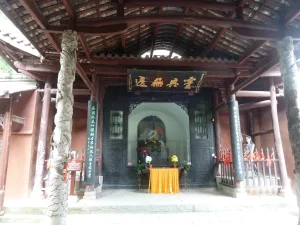
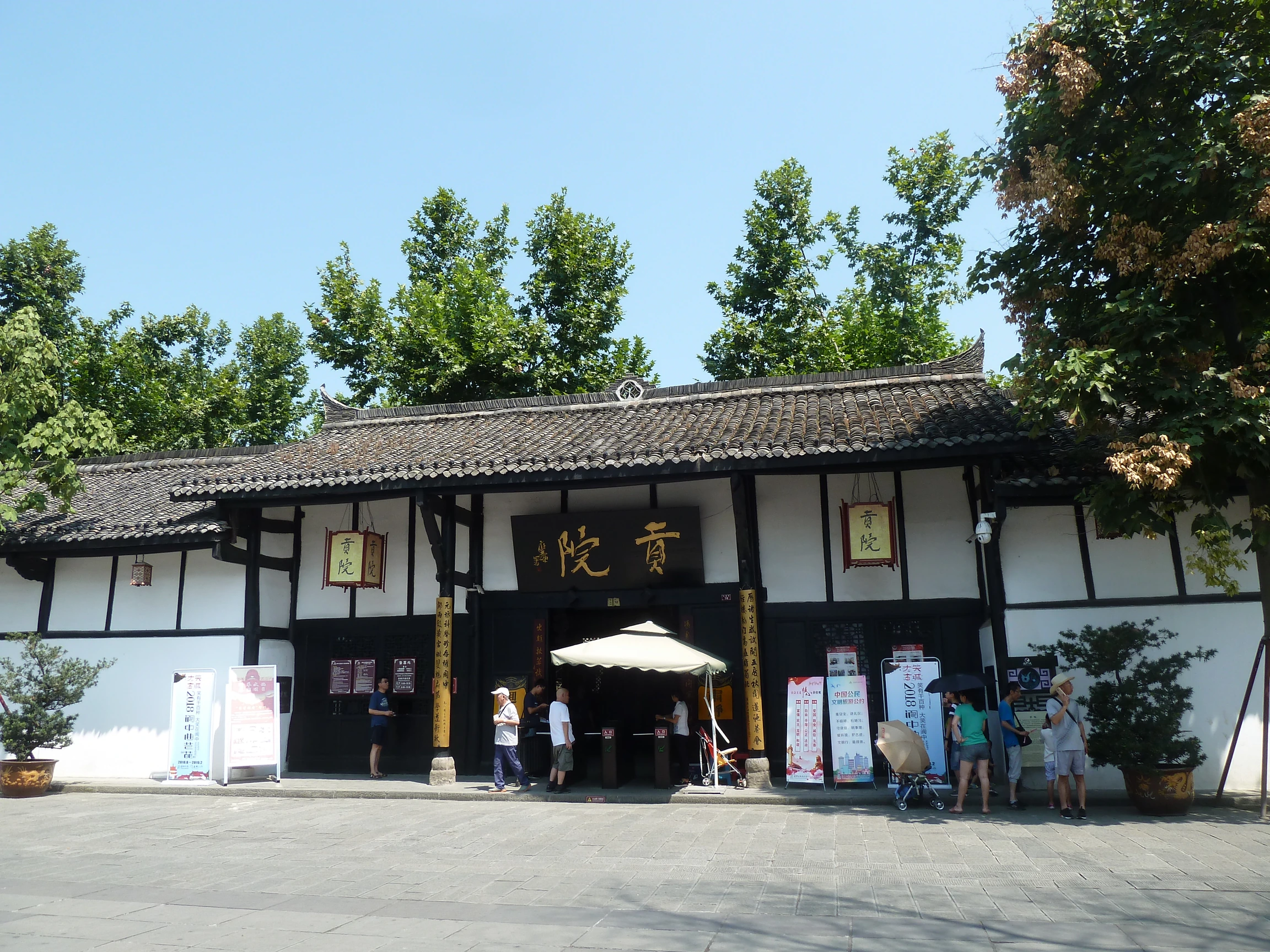
Save 川北道贡院 or 四川贡院 for the building, and 学道街 for the street. This matters if you are using a translation app. The spoken name gongyuan sounds very similar to the Chinese word for a public park. The characters on the examination hall sign are 贡院. The cover photograph shows them in gold above a dark timber entrance, read from right to left.
Approaching from the North Street side, look for Tianjia Lane (田家巷) at the western end of Xuedao Street. The short street continues east towards Yanshikou (盐市口). Save the front entrance as a walking destination and your hotel’s agreed pick-up point as a separate vehicle destination. A driver can take you to a suitable point at the edge of the lanes. The last part of the outing is on foot.
The examinations here were provincial, one stage towards public office. Langzhong’s early-Qing administrative role brought scholars from beyond the town, but success here still left higher examinations ahead. That distinction explains both the compound’s regional importance and its place within a larger system.
Look from a candidate’s bay towards the examiners
Find one haoshe (号舍), a candidate’s bay, then step back to see its neighbours. The repeated openings turn a crowded examination into many individual working places. A side view along the row makes the arrangement clearer than looking straight into a single room.
Across the court, locate Zhigong Hall and the neighbouring officials’ rooms. From the hall’s public approach, turn back towards the bays. The view reverses: each candidate occupied one small place, while supervision faced rows of them across the same court.
With children, choose a candidate’s place and the examiner’s position, then point between them from the permitted walkway. The exercise makes their relationship visible without a performance or lengthy title list. Watch raised thresholds and keep side passages clear for other visitors.
In open rooms beyond the front court, use labels to distinguish historic work or living space from today’s display use. For one useful translation, choose what happened to a submitted answer paper. Following the paper connects the candidate’s task with the officials across the courtyard.
| What to look for | What it tells you | Where to pause |
|---|---|---|
| The gold Gongyuan sign and tiled entrance | This street doorway marks the entrance to a provincial examination compound. | Start on Xuedao Street, then move clear of the doorway to compare the sign with your saved Chinese name. |
| A single bay and its neighbours | Candidates sat individually in a setting designed to accommodate many people at once. | Stand back from one row where you can see the repeated openings without blocking the corridor. |
| Zhigong Hall facing the bays | The larger hall and the rooms beside it place supervision and the handling of papers within the same compound. | Look across from the bays first. Then turn around near the hall to see the examiner’s view. |
What the street adds to the visit
On Xuedao Street, separate the Tang brothers Yin Shu and Yin Ji from the Qing provincial sessions. Each brother earned the highest zhuangyuan distinction in a much earlier period. Their commemoration adds a longer story of scholarship without making them candidates in this courtyard.
After the hall, look for the Zhuangyuan residence name and square opposite. Street, family name and examination gate together show scholarship’s prestige in town. Let any second interior remain a separate access question rather than assuming a named residence is open.
If the exam performance you have seen in travel photographs interests you, ask about your particular date. Festival programmes have included a costumed recreation of candidates and officials. The bays, court and examiner’s hall make a complete visit on a quiet morning as well. Allow any scheduled event to be an addition to the visit, with its own terms and time.
The Zhang Fei Temple on West Street makes a good second visit for a history enthusiast. Its subject is a military commander and the way later generations remembered him. Families who have done enough reading by lunchtime might prefer a stretch of the Jialing riverfront and a place to sit. Leave the rest of the afternoon open for whichever choice suits the group after the morning indoors.
Lunch and the walk back
Look for niurou re liangmian (牛肉热凉面) if you want a local noodle lunch. The name brings hot and cold together in one dish. Ask how the beef topping is served at that shop and whether you can add the chilli yourself. Baoning vinegar (保宁醋) is another Langzhong speciality. Try a little at the table before adding more to the bowl. Anyone who avoids beef or meat stock should order a different dish after explaining their needs.
For something smaller, ask for Baoning zhengmo (保宁蒸馍). This pale, slightly sweet steamed wheat bread is associated with Langzhong, once known as Baoning. Some examples bear a stamp. Break one open while it is warm and the difference between the smooth surface and the soft crumb is easy to appreciate. A bun and a drink make a convenient break if the group prefers to have its main meal back near the hotel.
| Part of the day | Staying inside the old town | Staying at a road-access hotel |
|---|---|---|
| Before the visit | Leave luggage at the lodging by agreement and walk to Xuedao Street. Save a photograph of your own lane entrance. | Arrange a drop-off at an accessible edge of the old town. Note the pick-up point in Chinese before leaving the car. |
| Examination hall and lunch | See the front court, add an open room that interests you and choose somewhere to sit down for lunch. | Use the same walking plan. Agree whether the driver is waiting or returning later so lunch can be taken at a comfortable pace. |
| Return after lunch | Walk back to your courtyard. If you continue to West Street or the river, allow time for the walk back from there. | Walk to the agreed meeting point and ride back to the hotel. On a departure day, allow separately for bags and the onward transfer. |
Choosing a Langzhong base
A courtyard lodging inside the old town makes sense if you like going out briefly before breakfast or returning for a rest between visits. Ask where a car can stop, how much stone paving you must cross with luggage and whether your room is on the ground floor. A charming lane in a photograph gives little indication of the distance from the nearest vehicle access.
For someone travelling with heavy bags, a road-access hotel can make the arrival and departure days easier. Request a room served by a lift if stairs are a concern. Plan one return outing to Xuedao Street with lunch before the ride back. If you arrive in Langzhong by rail, treat the station-to-hotel transfer as its own journey. If coming by road from Chengdu, leave the hall for the next morning rather than tying your admission to the arrival drive.
| Length of stay | How to spend the days | Where the nights fall |
|---|---|---|
| Three days, two nights | Arrive and settle in. Spend the full day on the Gongyuan, lunch and one optional old-town stop. Leave on day three. | Two nights in Langzhong, with the return from the examination hall to the same hotel. |
| Four days, three nights | Give Xuedao Street its own morning. Use the second full day for West Street and the river, with breaks at your base. | Three nights in Langzhong. This allows a visitor who dislikes long periods of standing to split the interiors. |
| Five days, four nights from Chengdu and back | Spend the first night in Chengdu. Travel to Langzhong on day two, visit the Gongyuan on day three, return to Chengdu on day four and depart on day five. | Chengdu one night, Langzhong two nights, Chengdu one night. Keep both longer transfers clear of timed sightseeing. |
The Langzhong old-town itinerary from Chengdu puts the streets, river and the longer journeys in context. Verotrip’s five-day Chengdu, Langzhong, Jiuzhaigou and Huanglong route moves on more quickly. Day two lists the panda base, Langzhong old town and shadow puppetry. Day three continues towards Jiuzhaigou via Tiangong Hall. The published programme leaves the Gongyuan unspecified. If the examination hall is your main reason to stop, request dedicated time for it or choose a longer Langzhong stay.
Tickets, language and a wet-weather plan
Overseas travellers have visited the examination hall. For a particular date, check which entrance and ticket channel accept your original passport, whether the visit needs a reservation and whether a town pass actually covers this interior. Keep your name consistent with the passport when booking. A ticket covering several places is worth considering only for the places you expect to enter during its validity.
An English-speaking companion is especially useful here if you want to follow the distinctions between ranks, offices and the people who handled the papers. Independent visitors can save the Chinese names for the street, compound and candidate bays before setting out. Use the current room labels and ask before photographing them. Earlier visitors’ experiences with English explanations varied, so a plan that relies on listening to a full English tour needs advance confirmation.
The tiled buildings give some shelter, but the courtyard and street remain outdoors. In rain, spend longer with one row of bays, take a seated lunch nearby and omit the extra river walk. If level access is essential, confirm the path between the vehicle, the courtyard and a usable place to sit, including thresholds on the return route. A short distance on the map can still involve a tiring period on your feet.
For an arranged visit, ask a Verotrip travel consultant for a quote for your dates. Price on request. Include your hotel, the number of travellers, your preferred language and the amount of standing that suits the group. Have the written plan specify the entrance, any guiding, lunch arrangements, vehicle waiting and the full journey back. Hotel nights and station transfers can be identified separately if you need them.
Questions about Langzhong Gongyuan
Is the Gongyuan the same place as the Confucian temple?
They are separate sites. The Gongyuan was where scholars sat examinations. The temple served a religious and educational purpose. For the physical arrangement of candidates and examiners, start with the Gongyuan on Xuedao Street.
Can children enjoy it without a costumed activity?
Yes. Ask them to pick one working space for a candidate and then find the place from which an examiner could watch the court. That small exercise works independently of a festival programme or a long explanation.
What if we have time for only one courtyard?
Choose the examination court. Walk alongside the bays, pause facing the chief examiner’s hall and then turn back towards the gate. That sequence includes the candidate, the official and the street where the scholars arrived.
Is one night in town enough to see it?
It can be, if you arrive early enough or have a genuinely free morning before leaving. Check the entrance arrangements and your departure transfer together. Two nights give the hall its own morning and leave room for lunch in Langzhong afterwards.
Cover photograph of Langzhong Gongyuan by STW932, 24 August 2018. Resized and converted to WebP under CC BY-SA 4.0.