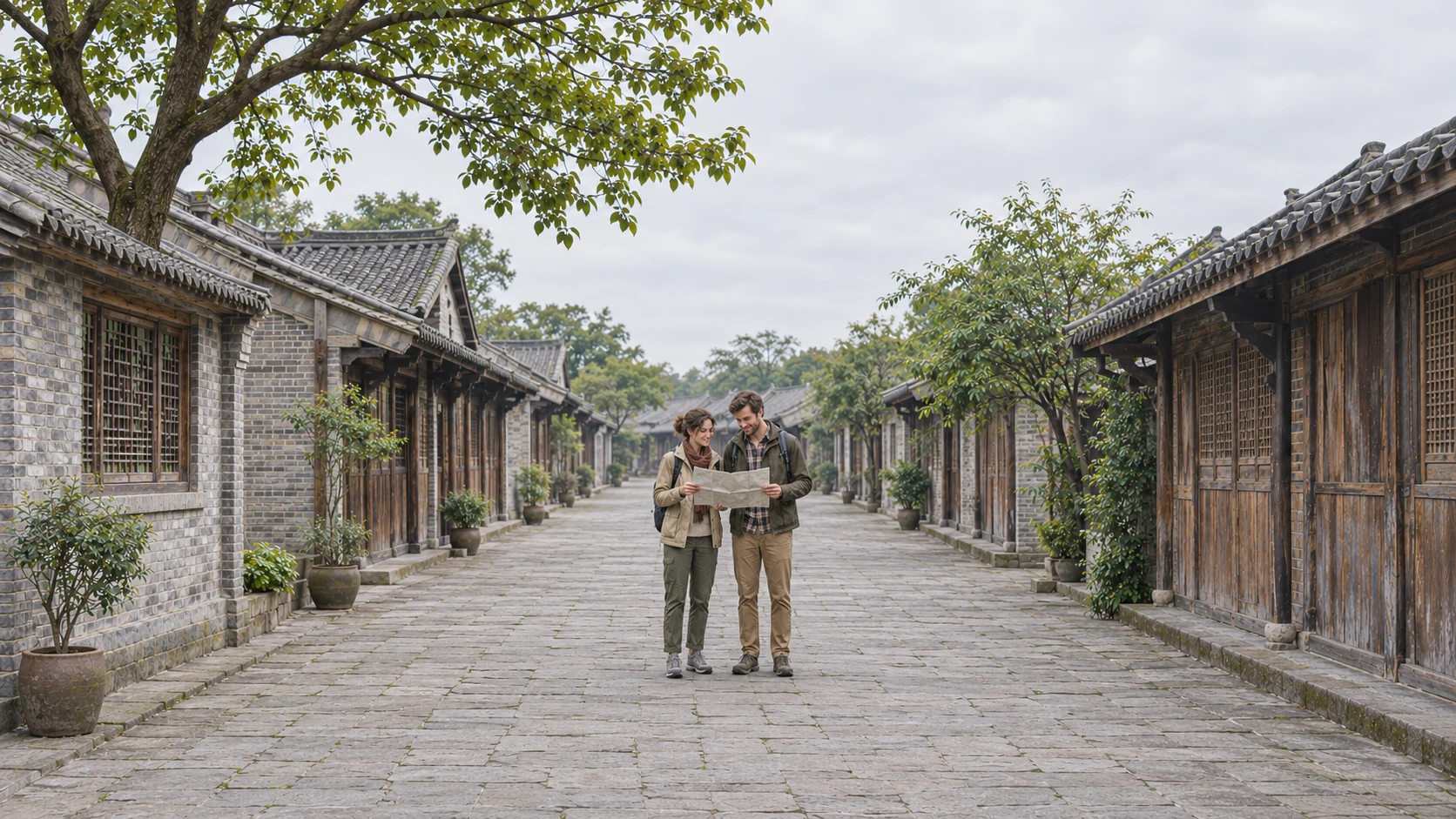
Header image: original AI illustration of two fictional adults planning a walk in a generic Sichuan historic-town lane. It is not a photograph or reconstruction of Xianshi, its guildhalls, wharves, buildings or visitor facilities. It does not show current conditions, real customers, a guide or an operated Verotrip departure.
Choose Xianshi Ancient Town for the transport side of Zigong’s salt story: riverside wharves, merchants’ meeting places and streets that grew around trade. A selective visit from a Zigong hotel can be enough. Stay in the town only when an evening and a slower morning matter more than keeping one city base.
Start with a manageable street-and-river walk, then choose a guildhall, temple or Chen family ancestral hall according to your interests and the day’s access. Keep a seated meal and the complete return in the plan. You do not need a boat, a staged performance or every historic interior to make the visit worthwhile.
Find Xianshi, then decide what you want to understand
Save 仙市古镇, Xianshi Ancient Town, with its location in Yantan District, Zigong. The Fuxi River, 釜溪河, is the organising feature of this visit. Use the actual visitor entrance and pickup pin rather than asking a driver simply for an old town somewhere around Zigong.
A Sichuan Daily field report explains how salt from Zigong travelled along the Fuxi River through Xianshi towards Chongqing. That gives the visit a useful question: what did moving and trading salt require after it had been produced? Look for relationships between river, landing places, streets and community buildings.
This complements the industrial and museum subjects described in our Zigong salt museum and Shenhai Well guide. Xianshi is a separate place with a different focus. A museum admission, city transfer or explanation booked elsewhere does not automatically extend to the town.
Choose a river walk, merchants’ halls or a temple visit
For an initial introduction, pair a short public riverside section with one street that interests you. Historical wharf steps explain the river connection, but viewing them from a safe visitor area is enough. Descending to the waterline is optional only where access is actually permitted and the footing is suitable.
For merchants’ history, look at Banbian Street, 半边街, and the names Nanhua Palace, 南华宫, and Tianshang Palace, 天上宫. A July 2026 Zigong media field report identifies these as guildhalls connected with Guangdong and Fujian merchants respectively. Their community role gives a more useful starting point than treating each doorway as an isolated photo stop.
Ask which visitor spaces are open before making an interior the centre of the outing. A historical building name does not establish unrestricted entry. Religious use, heritage protection and temporary arrangements can affect what you can see. Keep passageways clear and ask before photographing people or a ceremony.
| Interest | Start with | Keep optional |
|---|---|---|
| Salt transport | Public river view and wharf setting. | Steps down towards the water and any boat activity. |
| Merchants and architecture | Banbian Street and an open selected guildhall. | Entering every named historic building. |
| Family or religious history | Chen Family Ancestral Hall or Jinqiao Temple. | A second long explanation if the party prefers a rest. |
If the party includes both keen history readers and people who mainly want a gentle walk, split the interests without splitting the transport. One person can choose a longer explanation while others take an agreed nearby seated break. Establish a shared meeting place and a workable contact method first.
What Chen Family Ancestral Hall adds
Chen Family Ancestral Hall, 陈家祠, is associated with Xinhe Street, 新河街. The provincial newspaper describes its reuse as a family-culture exhibition venue. This offers a change of scale from the river: a building organised around family, shared values and public interpretation.
Read the courtyard arrangement as well as the exhibition. How do entrances and successive spaces shape a visitor’s movement? Where is decoration concentrated? A Sichuan University of Science and Engineering field visit draws attention to the hall’s structural and decorative features. You can look for these without needing to memorise an architectural vocabulary.
Keep restoration in view. Sichuan Daily records repairs and timber protection work here, so a heritage label should not be read as proof that every visible component is untouched. Ask which features are historic, repaired or part of a later exhibition if that distinction matters to you.
A family-culture display may need more explanation than a river view. Decide whether translated written notes are enough or whether you want an accompanying English-speaking guide for selected places. A driver’s contact assistance and historical interpretation inside a building are different services.
Jinqiao Temple and the value of a shorter route
The university account also records a visit to Jinqiao Temple, 金桥寺, including its main hall, and notes that only the entrance gate remained at the Jiangxi Temple site during that 2025 visit. This is a reason to choose the subject carefully rather than arrive expecting every old temple name to mean a complete interior complex.
For a temple-focused visit, first ask about the current public entrance, photography and any active religious use. Keep voices low and leave worshippers room. Do not enter a closed hall or follow someone through a private doorway because it seems to connect to another street.
The historical study visit is not a current waymarked walking circuit. Use the visitor map and conditions on arrival to select the order. If steps or standing become tiring, keep the street introduction and one priority place, then finish with a meal instead of continuing merely to complete a list.
A short outing or a complete local day?
A shorter Xianshi outing suits travellers who want to see how the salt story reaches the river. Give it one main heritage interest, a public street section and a rest. Keep the leaving time realistic when a railway departure is fixed, and remove an optional interior before reducing the return margin.
For a full local day, give the morning to the main interest: guildhall architecture, Chen family history or a selected temple. Take lunch as a proper pause. Use the afternoon for the river setting and a second modest choice only while the party is comfortable. This rhythm gives room for explanation without making the whole day a succession of admissions.
Crafts and performances need a separate decision. A May 2026 on-site report describes staff preparing a salt-merchant role-play programme for the May holiday and arranging craft experiences with businesses. Those are dated examples of organised activities, not a daily English-language programme or an automatic part of a town walk.
If a workshop is the main reason for coming, establish the actual host, language, session, materials and fee beforehand. Watching a working craftsperson is different from joining a booked activity. Ask before handling tools, filming close-ups or entering a working space.
Stay in Zigong or sleep beside the old streets?
A Zigong city base is a practical first choice when the trip also includes a separate museum day. It lets you compare meal choices and keep luggage in one room. Check the actual hotel position: a property chosen for a dinosaur visit and one chosen for urban salt-history stops may lead to different local journeys.
Three days and two nights in the same Zigong hotel provide one complete middle day. Arrive and settle in on day one, devote day two to Xianshi, then depart on day three. This is enough for a town-focused pause, but it does not also create a full museum day between those two nights.
Add one night if you want a separate full day for the salt museum and well site. Four days and three nights then allow arrival, two local sightseeing days and departure. Reverse the local days around the actual opening arrangements. A dinosaur visit is another choice: add suitable time or replace a block using the dedicated dinosaur museum guide.
| Pattern | What it gives you | Main trade-off |
|---|---|---|
| Zigong city, two nights | One full local day between arrival and departure. | A separate museum day needs more time or a changed focus. |
| Zigong city, three nights | One town day and one separate salt-history day. | An extra hotel night and local transfers. |
| An ancient-town night | An evening and a slower morning around the streets. | Room access, bags and onward transport need particular attention. |
Choose an old-town room only after checking its precise location, bathroom, stairs, noise and seasonal heating or cooling. Establish the lawful vehicle drop-off and the remaining walk with bags. A charming courtyard image does not establish a quiet room, a lift, luggage assistance or an English-speaking reception.
Ask the selected property to confirm registration with each traveller’s original passport. For an arrival-day visit, agree where the main suitcases stay before check-in. After checkout, include storage and collection in the return journey; do not assume a shop, temple or visitor facility accepts large cases.
Getting there and completing the return
For rail travel, work from the exact station printed on the booked ticket. Put the station-to-hotel or station-to-town stage in the plan before allocating sightseeing time. A train described as arriving in Zigong does not complete the journey to a particular old-town entrance.
For a vehicle from a city hotel, specify the outward pickup, visitor drop-off, waiting arrangement and final address. Decide whether you want a return to the same hotel, a station finish or an onward drive. These are different journeys and should be quoted accordingly, including baggage collection and any changed waiting time.
A Chengdu same-day outing spends more of the day on intercity travel. Choose it only after comparing the actual outward and return connections with the time left in Xianshi. Keep the town as the priority rather than promising a complete town visit, both salt sites, a long lunch and an evening event between fixed trains.
For self-driving, establish lawful driving documentation and rental acceptance separately. Confirm parking and the final approach, then walk only on open visitor routes. An advertised riverside path or a future road project is not permission to drive into historic lanes or to follow a waterside route through a closure.
Rain, river edges, meals and a comfortable walk
Use shoes with grip for stone paving, thresholds and steps. Keep a rain layer accessible. A town visit can involve substantial standing even when the distance is modest; state how long each traveller is comfortable walking before selecting interiors and riverside sections.
In light rain, shorten exposed walking and choose an open interior that interests you. Heavy rain, slippery wharf steps, high water or a local restriction are reasons to leave the river edge alone. Do not cross barriers, board an unarranged boat or substitute an informal bank path for a closed visitor route.
Ask about step-free access to the specific entrance, toilets and rest point if travelling with a wheelchair, stroller or walking aid. Neither the word ancient nor a recently improved visitor centre establishes an accessible circuit. A shorter street section with a dependable pickup can be a better choice.
For lunch, decide whether you want a simple seated meal or a longer introduction to Zigong cooking. Ask about ingredients, spice, portions and any price by weight before ordering. Tell the planner about allergies and dietary needs; a vegetable dish or a local speciality name does not establish vegetarian, halal or allergy-safe preparation.
Foreign visitors, admission and service costs
The July 2026 local field report explicitly describes domestic and overseas visitors being shown around Xianshi. That supports ordinary international visitor access in context. It does not establish the booking method, document procedure or English assistance at every hall, workshop and hotel.
Carry the original passport used for any reservation, and ask how it will be processed for the actual admission. Compare public street access with the charges or appointments for chosen interiors and activities. No current entrance price, discount, opening hour or performance timetable is promised here.
| Item | Specify in writing | Check separately |
|---|---|---|
| Transport | Actual hotel or station, vehicle capacity, waiting and complete finish. | Extra stop, changed return, parking and overtime. |
| Interpretation and visits | Chosen interiors and language, guide scope and duration. | Workshops, materials, performances and admission. |
| Stay and meals | Named room category, actual nights and meals if supplied. | Bag handling, drinks, purchases and personal insurance. |
Price on request. The written proposal should identify actual services, exclusions and change terms. This guide does not confirm a departure, a particular vehicle, English guiding, admission, accommodation, meals or insurance. A separate operator’s public itinerary is research context, not evidence that its inclusions are supplied by Verotrip.
Questions about Xianshi Ancient Town
Is Xianshi the same visit as the salt museum?
No. Xianshi focuses on streets, community buildings and river transport. The museum and Shenhai Well explain other parts of the salt story at separate sites. Choose the combination that interests you and give each its own travel time.
Do I need to stay overnight in the ancient town?
Only when the evening and next morning are part of your purpose. A city hotel with both local transfers arranged is a useful alternative. Check the exact room and final walk before choosing an old-town stay.
Can I count on a boat or a salt-merchant performance?
No. Keep the basic visit ashore. A specific activity needs its own current availability, permission, language and booking conditions; a holiday report or photograph does not confirm it for your date.
What should I send when asking for a plan?
Send dates, arrival and onward bookings, party ages, walking limits, bags, room preferences and the main interest: river trade, guildhalls, temples or family history. Use Verotrip’s planning enquiry and say whether you want a city return or an ancient-town night.
Updated 6 November 2026. Cultural orientation draws on dated newspaper and university field visits. Interiors, activities, river access, passport procedures, rooms and transport must match the actual travel date; historical programmes and construction reports are not current service promises.