Choose Laitan Ancient Town for the relationship between old lanes, a defensive gateway and Erfo Temple’s Buddhist cliff carvings. It is a cultural outing near Hechuan that rewards time with a knowledgeable explanation. Give the town and temple a usable day with road transfers, rather than treating them as a quick photograph between unrelated Chongqing sights.
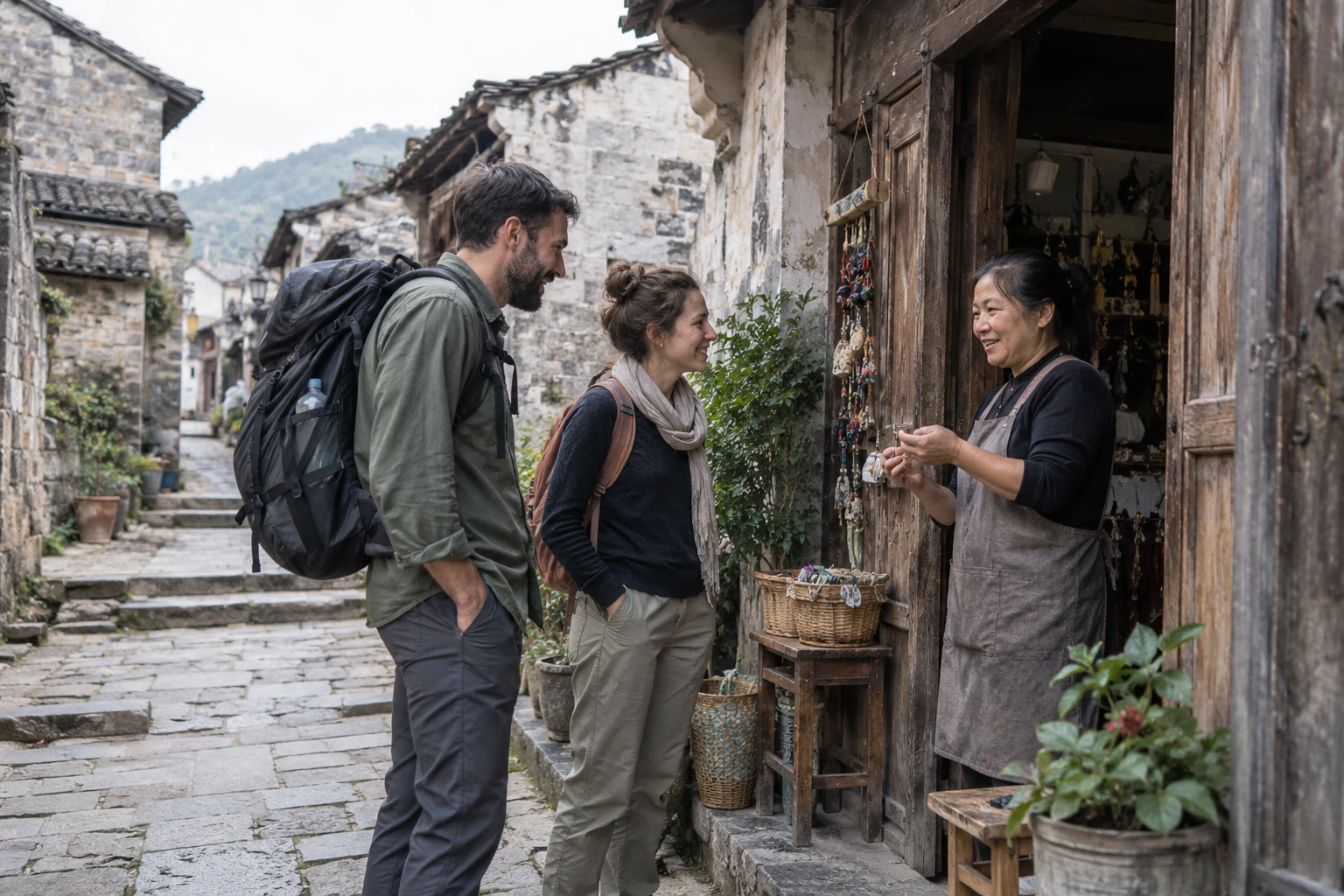
Cover: illustrated travel scene with fictional people: visitors chatting on an old-town lane. Illustrative context, not an exact-site photograph or a record of Vero Trip guests, guides or services.
Use 涞滩古镇 and 合川 when sharing the destination. Laitan is in the wider Chongqing municipality, but its local approach is separate from a central-city walking itinerary. Confirm the exact arrival station or hotel and the final transfer before setting the visiting window.
Three parts of a coherent visit
Hechuan’s local media describes Laitan on the western side of the Qu River, with a hill setting, old streets and a defensive gateway. The town and temple should be understood together. A public-lane walk provides the setting for a more focused look at the religious and artistic heritage.
| Part of the visit | What to look for | Check separately |
|---|---|---|
| Old lanes | Stone surfaces, building fronts and the town’s daily life | Public versus private space |
| Defensive gateway | How the entrance and enclosure organise movement | Current accessible sections |
| Erfo Temple upper area | The setting of the temple buildings | Opening and worship boundaries |
| Erfo Temple lower hall | The relationship between cliff, sculpture and protective hall | Access, interpretation and photography rules |
A June 2026 article from the Sichuan gazetteer office, written by heritage specialists, distinguishes the temple’s upper and lower halls. It locates the cliff carvings within the lower hall and discusses their Chan Buddhist context. Do not assume that arriving in the town guarantees access to every hall or a specific viewing angle.
Look at the carvings as a connected scene
Rather than trying to identify every figure, ask a guide to explain how the arrangement relates to Buddhist teaching and the surrounding rock. The specialist account emphasises a relationship between the main teaching scene and groups of listeners. That offers a way to read the space beyond counting statues.
Choose a guide who can explain the art in your preferred language and distinguish documented history from interpretation. A transfer driver has a different role. If suitable interpretation is unavailable, prepare a small number of questions and allow time to read the venue’s own information.
Follow restrictions on photography and lighting. Do not touch carvings, use surfaces as supports or try to enter a protected space for a closer look. Restoration or conservation work can limit access; the opportunity to see a particular feature needs checking for your date.
A day with a comfortable cultural pace
Arrive during a useful part of the morning and check the temple’s current opening before beginning a long town walk. If the carvings are your main interest, organise the day around the confirmed temple visit and place the lanes and meal around it.
Allow a proper lunch and a short rest. Revisit an interesting public street or gateway afterward rather than immediately adding another distant attraction. A compact geographical area can still deserve several unhurried hours when explanation is part of the experience.
Keep the departure comfortable for the drive back to Hechuan or your onward connection. If the temple area you wanted is unavailable, decide whether the remaining town visit justifies the journey before setting out.
| Stage | Main purpose | Decision to settle |
|---|---|---|
| Before departure | Confirm temple access and the return ride | A plan if the key hall is unavailable |
| Morning | Priority cultural visit with interpretation | Guide language and walking needs |
| Lunch and afternoon | Town lanes and defensive architecture | Rest, meals and public access |
| Return | Reach the agreed vehicle or connection | Complete road time, not only map distance |
Transport and a sensible base
A Hechuan base may simplify a local outing and onward rail travel. A central Chongqing base can also work with a sufficiently generous day, but include the whole transfer and traffic. Do not assume a hotel’s municipality label means it is near the town.
Give the driver the exact Chinese destination and agree the legal drop-off and return point. Confirm waiting time, vehicle capacity and luggage. If combining train and road transport, identify the correct station from your actual booking.
A local overnight is a choice for pace rather than a requirement. Check the property’s stairs, room facilities, evening food and passport registration. If there is no suitable confirmed local room, use a base with dependable arrangements instead of forcing a rural stay.
Tickets, etiquette and the complete service
Public town access and admission to a heritage or religious space are different questions. Check the current ticket components and passport procedure. A broad claim that an old town is free should not be taken as proof that every temple hall, exhibition or activity has no charge.
Respect worship and avoid treating a ceremony as entertainment on demand. Keep voices low, follow signs and ask before photographing people. Leave doorways, steps and shared spaces clear while discussing the architecture.
For an arranged visit, a written proposal should separate transport, guide, admission and meals. It should identify any access limitation that affects the main purpose of the trip. This guide does not promise a ceremony, all-hall entry or a live performance.
Walking and weather
Wear shoes with grip on uneven and wet stone. Ask about stairs, gradients and resting places if anyone has limited mobility. A shorter town walk may be possible, but the exact temple approach needs its own assessment.
Bring water and a light rain layer. Stay on public routes and avoid climbing walls or stepping onto heritage fabric for a photograph. The fictional travel scene used as illustration is not an exact image of Erfo Temple or evidence of current access.
Questions visitors often ask
Is the temple the same as the town entrance?
No. Confirm the specific halls and any separate admission. The town’s public spaces and protected temple areas have different conditions.
Do I need a guide?
A suitable art or cultural explanation adds value if the carvings are your main interest. Confirm knowledge and language rather than assuming a driver provides interpretation.
How should I include Laitan?
Use our regional guide and share your Hechuan or Chongqing base with Vero Trip so the proposed outing has realistic transfers and the right cultural focus.
Planning information reviewed 29 October 2026. Sources: Sichuan gazetteer office: Erfo Temple carvings; Hechuan media centre: Laitan town. Confirm current access and operating arrangements for your travel date.
Related Journeys to Compare
These existing routes offer starting points for the region or travel interests discussed above. Read the full daily itinerary to see what is included. A visit described in this guide, a specialist session or an international border crossing is added only when confirmed in your own programme.