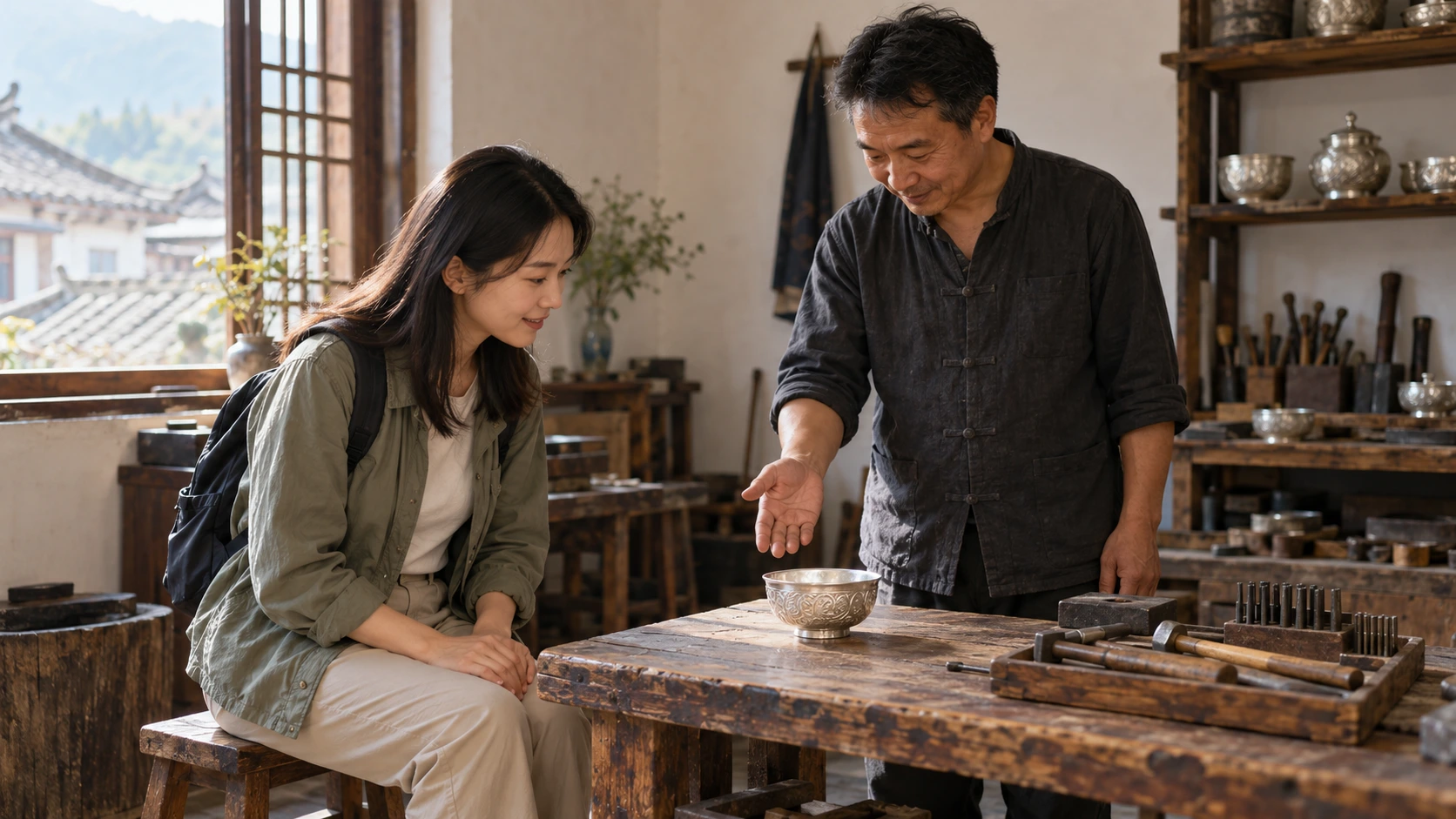
illustration: fictional adult visitors and a fictional silversmith looking at a bowl. This is not a photograph of a particular Xinhua workshop, real maker, customer or Vero Trip tour.
Visit Xinhua Village (新华村) in Heqing for the making of silverware, the relationship between workshops and village life, and time to understand an object before deciding whether to buy it. A useful visit centres on one craft conversation or a prearranged lesson, followed by a short walk and a rest. Shopping can be optional throughout.
For most travellers, the first decision is where Xinhua fits into the journey: a focused outing from a Lijiang base, a deliberately allocated stop on a Dali–Lijiang road transfer, or a longer craft visit in Heqing. Give the workshop its own time. Do not add it to an airport transfer merely because the village appears nearby on a map.
Find the right Xinhua
Save the full location as Heqing County, Caohai Town, Xinhua Village: 鹤庆县草海镇新华村. The county government identifies Yindu Shuixiang, or Silver Water Town, with Xinhua Village northwest of Heqing county town, on the Dali–Lijiang corridor. Xinhua is a common place name in China; a search result without Heqing can point to an entirely different destination.
The same county tourism profile places the village substantially nearer Lijiang and its airport than Dali Old Town. Use that geography to compare plans, rather than turning the published kilometre figures into driving minutes. Your actual hotel, chosen road route, traffic and the length of a hosted visit determine the working schedule.
This is a contemporary place of work as well as a visitor destination. A January 2026 Dali media report describes silver shops, production workshops and creative courtyards along stone-paved lanes, with the silver gateway as a landmark. Start with the production you want to understand, then leave time to see the surrounding streets.
Choose observation, a lesson or shopping
| Your priority | A suitable visit | Confirm before committing |
|---|---|---|
| Understand the craft | One hosted explanation of an object and the stages used to make it. | Which process can be seen, its fee and the working language. |
| Make something | A supervised activity appropriate to your experience and available time. | The task, materials, safe tools, duration and take-home item. |
| Choose a finished piece | A small number of comparisons with time to examine details. | Material description, price calculation and written purchase terms. |
| Travel with mixed interests | A compact workshop stop, then a lane walk or seated break. | A meeting point and a realistic finish for the whole party. |
Ask for the activity you mean. Watching a few moments of hammering is different from a guided explanation, and neither automatically includes a lesson. A shop may be welcoming while its production area is busy, private or unsuitable for visitors. Arranging a host in advance gives the visit a clearer purpose.
A practical visit around one workshop
Begin with an object and a question
Choose a bowl, cup, piece of jewellery or another object that interests you. Ask the maker what happens first, which stages are visible today and what remains to be done. The English-language Yunnan Gateway feature describes Xinhua work ranging from household vessels to jewellery and decorative pieces. That range gives you several ways to approach the craft without needing to buy a large object.
Look for a useful explanation of how a shape is formed, how a pattern is applied and how separate parts are joined. You need not see every stage in sequence. A working craftsperson may be finishing an existing order rather than preparing a demonstration for visitors. Ask before touching work in progress or lifting a tool.
Compare the workshop with the display
A showroom helps you compare finished pieces; a production bench helps you understand a process. Ask which work was done in that workshop and which items came from elsewhere. The answer may vary across the display. A hand-finished detail, a hand-shaped body and an object made entirely by hand describe different things.
Take notes on one or two details you can recognise, such as a join, the fit of a lid or a repeated decorative pattern. This gives the conversation a concrete focus. Avoid trying to judge authenticity solely from the age of the furniture, the sound of hammering or a dramatic story about the maker.
Leave room for the village
After the main visit, take a manageable walk along public lanes and pause where visitors are welcome. Keep residential doorways clear and ask before entering courtyards. The village setting can give context to the craft, but an open front door does not make a private home part of your itinerary.
If the party separates, agree one collection point and a finish time before browsing. A person keen on metalwork can then stay for a conversation while others rest. Keep the day bag light and arrange secure luggage storage with your accommodation or transport provider rather than carrying suitcases through workshops.
What a hands-on session should specify
Request a named task and ask what a beginner can reasonably complete. Establish whether the material is included, how much will be used, who performs any heating or finishing, and whether the object can leave with you that day. An unfinished item and a finished keepsake are different outcomes.
Explain children’s ages, your party size, any difficulty standing and the language you need. Ask about the available seating and supervision. A technical craft explanation may require interpretation even when a shop can handle a simple sale in English. Do not assume that meeting a maker includes English teaching or that the same task suits every age.
Agree the total charge before work begins, including any extra material, finishing or delivery. If you would rather observe, say so clearly. Participation is worthwhile when the task is understood and the workshop is ready to host; it need not become a requirement for appreciating the village.
Buying silver without rushing the decision
Start with the intended use and a spending limit. Is the object jewellery, decoration, a drinking vessel or a gift? Ask the seller to identify the material, any plating or other components, and which parts of the price cover weight, design and labour. Craftsmanship can add value beyond the raw material, but a craft story alone does not verify metal content.
Heqing’s government description includes gold, silver and several copper alloys among local metalwork materials. The practical lesson is to read the description of the particular piece. A silver-coloured surface or an item displayed in a silver village should not be treated as proof that every part is solid silver.
Inspect the details relevant to the object: joins and closures for jewellery, handles and lids for vessels, and any finish that will touch skin or food. For something intended for hot drinks or cooking, ask the maker about its actual intended use and care. Do not use a decorative object as kitchenware merely because it resembles a pot.
Keep a written description, itemised price and receipt, along with any material or testing documentation the seller supplies. Ask what exchange, repair or delivery terms apply, especially if you will soon leave the region. A stamp or a verbal assurance is not an independent assessment. If an important detail remains unclear, leave the purchase for another time.
For a commission, agree the dimensions, design, materials, finish and delivery arrangements in writing before paying. Include how changes will be handled and what photographs or other confirmation you expect before dispatch. A same-day village stop is rarely the right setting for an expensive decision made under a departure deadline.
Rest stops and a comfortable pace
A county report announces public rest areas at the Xinhua Silver Town book bar (新华银器小镇书吧) and the second floor of Xitian (喜甜二楼), described as requiring no purchase, with reading, charging and tea facilities. Ask locally whether they are operating and where to find them on your date. This is useful rest-stop information, not confirmation of a workshop opening time, accessible route or restaurant meal.
Wear comfortable shoes for the lane surfaces and keep rain or sun protection in your day bag. Tell your host beforehand if you need regular seating, a toilet nearby or a route that avoids steps. Confirm these details for the actual premises rather than relying on a general description of the village.
Leave a meal break in the plan. A workshop appointment does not include food unless that is explicitly arranged, and a cup of tea does not replace lunch. If you add a countryside or waterside pause, use the current public visitor route; do not assume access through fields, a boat service or a particular bird sighting.
Fit Xinhua into Dali and Lijiang
| Travel pattern | How to shape it | What to avoid |
|---|---|---|
| From a Lijiang base | Give the craft visit and return transport a dedicated block. | Assuming the hotel, airport and village are the same pickup area. |
| Dali to Lijiang by road | Place the stop in the agreed road sequence and arrange luggage handling. | Promising several long village visits before a fixed arrival time. |
| From Dali Old Town | Compare the return drive with staying farther north. | Treating Heqing as a small excursion beside the old town. |
| Before a flight or train | Work backward from the full departure and luggage arrangements. | A commission or extended lesson with no spare time. |
Our suggested relaxed sequence is arrival and a brief orientation, one agreed workshop visit, a short browsing period, then a meal or seated break before continuing. Extend the craft block if a lesson is the purpose of the trip. This is a planning outline; the host’s confirmed availability and your transport connection set the final times.
Compare your bases in the Dali stay-planning guide. If textiles interest you as well, the Baisha embroidery guide explains a different craft visit near Lijiang. Keep those activities distinct rather than assuming one booking includes both.
Questions before choosing Xinhua
Is it worth visiting if I do not buy anything?
Yes, when the craft is your interest and the host has agreed to an observation or explanation visit. Clarify any hosting fee. Watching, learning and purchasing should have separate expectations.
Can I walk into a workshop and make a silver bracelet?
Do not rely on that being available. Request the task, supervision, material allowance and price in advance. A busy production shop may offer sales or observation without teaching.
Does every shop sell the same material?
No single village label establishes the composition of every object. Ask about the exact item, including other metals, plating and decorative components, and retain its written description.
Is Xinhua a confirmed stop on every Dali–Lijiang tour?
No. A route via Shaxi or another village may follow a different sequence. Ask for Xinhua by its full Heqing location and allow a separate visit block.
Can Vero Trip plan the visit?
Use Plan My Trip to send your dates, hotels, group size, language and whether you want observation, a lesson or shopping time. Price on request. The written proposal should identify any confirmed host, transport, guiding, activity materials and fees. No purchase or named maker’s availability is implied by this guide.
Sources and image
Information reviewed on 31 October 2026: Heqing county’s scenic-area profile; Dali media’s reported workshop and village visit, January 2026; Yunnan Gateway’s silver-craft feature, August 2019; Heqing county’s metalwork description; and the county announcement of public rest spaces. Confirm individual premises, services and prices for your travel date.
Main image: illustration created for Vero Trip, showing fictional adults discussing a bowl in an imagined silver-craft workspace. It does not document a specific Xinhua workshop, real craftsperson, customer, product or guided tour. Natural photographic styling is illustrative.
Related Journeys to Compare
These existing routes offer starting points for the region or travel interests discussed above. Read the full daily itinerary to see what is included. A visit described in this guide, a specialist session or an international border crossing is added only when confirmed in your own programme.