Plan an Erenhot border crossing by car as two linked border procedures, followed by a separate onward journey. Erenhot, also called Erlian or Erlianhot, is in China’s Inner Mongolia Autonomous Region; Zamyn-Uud is across the border in the country of Mongolia. Before driving there, establish that your passengers, driving documents and particular vehicle can use the road crossing on your intended date.
The important first choice is whether your own vehicle will cross or you will travel as a passenger. A border bus, a Chinese rental car and a foreign-registered campervan involve different arrangements. Obtain the answer for your registration country, ownership, licence and direction before reserving a connection from Zamyn-Uud or an onward drive into China.
Updated 15 October 2026
Choose the movement you actually need
Write “Erenhot–Zamyn-Uud road crossing”, your direction and your transport mode in the enquiry. The railway is a separate passenger option to investigate; a train ticket does not transport your road vehicle or settle its customs obligations. Equally, visiting a border monument or shopping area does not authorise an international crossing.
| Your plan | Establish before booking | Main consequence |
|---|---|---|
| Take your foreign-registered car or campervan across | Admission for the vehicle and passengers, driver entitlement, insurance, receiving contacts and departure obligations. | Both countries’ vehicle arrangements must work; personal immigration permission is only one part. |
| Leave the vehicle and cross as a passenger | Lawful storage or return, the actual passenger service, pickup point, luggage and onward transfer. | Leaving China or Mongolia yourself does not discharge the vehicle’s customs obligations. |
| Drive a Chinese-registered rental or private car into Mongolia | Registration-specific road restrictions, the driver’s licence and contractual permission. | Do not assume ordinary domestic rental use extends across the border. |
| Enter China from Mongolia with a vehicle | China entry and temporary road-use documents, insurance, receiving plan and the first permitted driving stage. | Reverse geography requires its own paperwork and handover; it is not an automatic reversal of an outbound booking. |
There is a particular distinction for mainland Chinese licences and Chinese-registered small vehicles. The Chinese embassy’s July 2024 notice, still published on its consular site, says Mongolia does not recognise mainland Chinese licences, including notarised translations. It also describes restrictions on Chinese-registered small vehicles and a narrowly limited border-resident exception. Obtain advice for the actual combination of driver and vehicle; neither a domestic rental booking nor another traveller’s foreign-plate experience resolves that case.
For other licence countries, confirm the documents Mongolia accepts and any international permit requirement before departure. British travellers can consult the UK’s country-specific driving advice; its licence instructions should not be applied indiscriminately to every nationality.
Understand the approach without confusing towns and checkpoints
On the Chinese side, Erenhot can form the final stage after travel through Inner Mongolia. On the Mongolian side, Zamyn-Uud is the immediate town, with Sainshand and Ulaanbaatar farther along the regional corridor. These are places for arranging the journey, not a promise to reach the capital on clearance day.
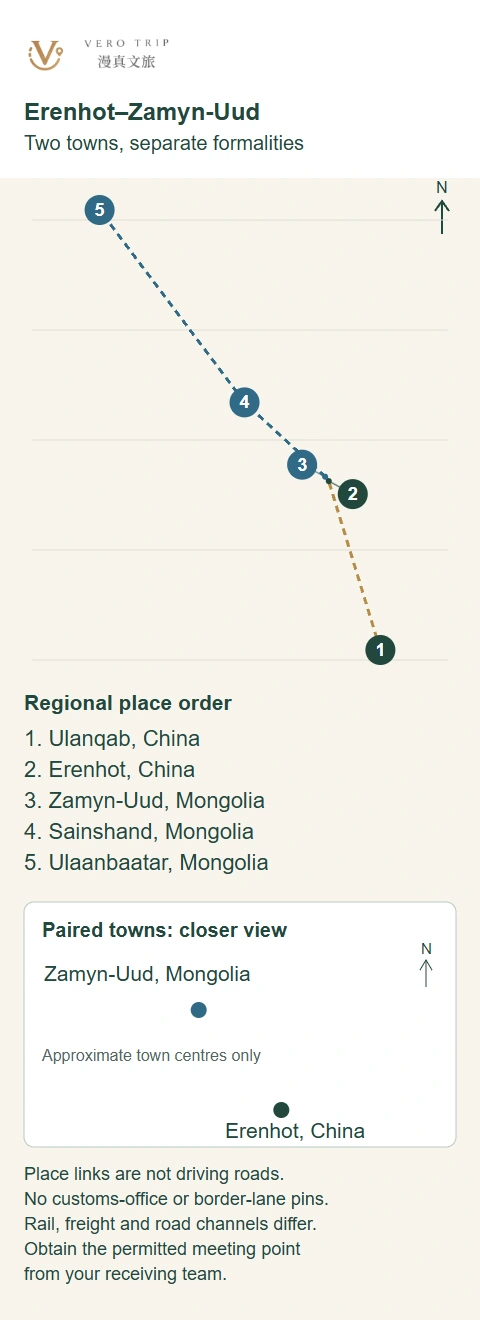
Keep a border-town overnight option even if your preferred plan continues farther. Ask for the actual time needed after release, the remaining daylight and the driver’s working day before selecting the first hotel. A Beijing or Hohhot sightseeing stay belongs in its own travel block, with its road or passenger connection to Erenhot separately arranged.
For a longer journey, the Laos–China–Mongolia route guide covers the Chinese travel stages. The China overland transit guide helps select entry and exit countries. This page concerns the Erenhot handover and vehicle crossing itself.
Build a Mongolia vehicle file before the crossing
The Mongolian embassy’s temporary motor-vehicle admission guidance lists the vehicle certificate, owner’s passport, notarised owner authorisation where the driver is not the owner, host or inviter contact details, and the original Carnet document if the vehicle has one. Its wording does not establish a universal requirement for every vehicle to obtain a Carnet.
| File to prepare | What to check together | Question for the responsible party |
|---|---|---|
| Passengers and driver | Passports, nationality-specific entry documents and accepted driving entitlement for each driver. | Does this permission cover our purpose, land port, dates and proposed stay? |
| Vehicle and ownership | Registration, vehicle category, owner details and authority to use it across borders. | Are translations, notarised authorisation or further papers needed for this ownership arrangement? |
| Customs and local contact | The proposed temporary admission, any existing Carnet, inviting or receiving contact and exit plan. | Which declaration, advance information and security arrangement apply to this vehicle? |
| Insurance and assistance | Territory, dates, named drivers, vehicle class, exclusions and recovery arrangements. | What covers an accident or breakdown after crossing, and who responds? |
The embassy guidance says an approved temporary entry produces a customs-endorsed sheet to keep in the vehicle and return on exit. It also describes a tax-deposit consequence when documents do not meet requirements. Ask customs or the responsible receiving party about the basis and amount for your case; another owner’s deposit is not a tariff for your vehicle.
The UK government’s Mongolia entry guidance advises own-vehicle travellers to notify the relevant authorities in advance and complete a customs declaration. Arrange that work before driving to the checkpoint. Request a written list naming who submits the information, who receives the reply and what you must carry in original form.
Keep the China vehicle exit or entry separate
If the car entered China temporarily elsewhere, review its permitted route, validity and intended exit with the team responsible for that entry. Have the Chinese temporary vehicle papers, customs records and insurance available for the Erenhot departure. Ask what evidence confirms the vehicle has left and how any security arrangement is closed.
If you are entering China from Mongolia, arrange China’s own vehicle and driving documents before treating Erenhot as the start of an unrestricted drive. Chinese temporary-entry vehicle guidance covers registration and translation, entry evidence, inspection conditions and Chinese compulsory motor liability insurance, with receiving-plan requirements for organised foreign self-drive visits. The applicable local procedure needs an answer for Erenhot; a Beijing office’s fee or processing period is not an Erenhot promise.
Make a simple expiry sheet for passenger stay, temporary driving permission, vehicle documents, insurance and customs departure. Plan inside all relevant limits. An extension to one document does not extend the others, and changing the exit date may also change the receiving team’s appointment.
Arrange the actual road channel and handover
Erenhot’s May 2026 controlled-area notice distinguishes road passenger inspection, road freight inspection, railway facilities and other restricted areas. People and vehicles entering those areas are subject to border management. Get the permitted approach and meeting point from the receiving team; a map pin labelled “border” is insufficient.
Ask whether you remain with the car during each stage, where passengers present their documents, and when luggage must be accessible. If travelling without your own car, establish whether the transport crosses with you or another vehicle receives you after formalities. Obtain the driver’s contact, vehicle identification and missed-meeting procedure for each part. Do not assume you can walk between facilities or substitute a freight vehicle for an arranged passenger service.
| Stage | Your practical action | Keep available |
|---|---|---|
| Before leaving the hotel | Confirm both sides’ appointment, current operation and exact meeting point. | Original documents, receiving contacts and the agreed waiting hotel. |
| Departing-country formalities | Follow the assigned channel and complete passenger and vehicle departure requirements. | Vehicle records, declarations and any customs release evidence. |
| Arriving-country formalities | Present the relevant immigration and vehicle documents; follow inspection instructions. | Accessible bags, ownership papers, insurance and local contact details. |
| After release | Check that returned documents match the traveller and vehicle; contact the onward hotel or driver. | Entry records, vehicle endorsement, expiry dates and overnight address. |
A 2026 Erenhot customs report describes road-passenger baggage inspection and assistance for older people, pregnant travellers and children. Ask staff or the receiving team for the help you need. It does not guarantee a particular queue time, vehicle release or step-free transfer through every stage.
Protect the crossing day from an unrealistic connection
Obtain the passenger and private-vehicle calendar for both sides, including holidays, last acceptance times and any advance appointment. Put dates and time zones on the instruction sheet. Do not substitute a customs headquarters’ office hours or an old freight announcement for that answer.
The April 2026 freight notice states a temporary period from 1 May to 30 September 2026. It concerns freight and its stated period has ended; it is not evidence of current tourist hours. Capacity figures or reports of faster inspections similarly do not establish how long your car will take.
Agree a lawful place to wait before the border and another after release. Confirm parking height and length for a campervan, check-in flexibility and the price of an extra night. Keep the first long onward drive, domestic train or flight flexible enough for the agreed contingency. For Mongolia-bound travel, consider the onward stages through Sainshand separately from crossing into Zamyn-Uud; for China-bound travel, separate local formalities from the later Inner Mongolia or Beijing visit.
Food, luggage, weather and the first Mongolian night
Pack a small bag that stays with the passengers: passports, essential medication, warm layers, drinking water, child supplies and a change of clothes. Organise other bags so requested items can be reached without emptying the whole vehicle onto the roadside. Ask about food, medicines, equipment and other items requiring declaration before travel; keep the applicable customs rules with the packing list.
Plan meals before departure and carry suitable provisions for delays within import rules. For halal requirements, explain ingredients, preparation and cross-contact needs, including hotel breakfast. Arrange prayer timing and an appropriate space with the receiving contact. Neither a border-town location nor a general “Mongolian meal” description confirms those needs.
Open-country weather can change the driving plan. The official Mongolia travel advice highlights rapid weather changes and limited rural communications. Check the actual forecast and road advice, agree fuel and assistance stops, and keep an offline copy of contacts and the first hotel address. Confirm child seats, rest stops and help with bags before selecting a transfer vehicle.
Mongolia’s Immigration Agency FAQ requires the person or entity providing accommodation to register a foreign guest online within 48 hours after entry. Confirm this with your first hotel or host and retain the confirmation. If you will camp or travel independently without such a booking, ask the agency how your arrangement must be registered. Accommodation registration, your allowed stay and the vehicle’s customs endorsement are separate matters.
If the car cannot cross or cannot continue
Pause the vehicle movement while the responsible parties resolve the problem. If the passengers can travel but the car cannot, establish lawful return or storage before switching to a passenger crossing. If the port date changes, check every document’s validity and the onward transport again. A border closed to your movement is not permission to choose a different lane or drive to another crossing.
In Mongolia, vehicle customs responsibilities must be addressed if the car breaks down or your journey ends early. Contact customs and the responsible assistance provider before arranging storage, transport out or any proposed sale. Flying home or handing the keys to a hotel does not settle the vehicle’s position. Request the authorised process, costs and evidence that will close the admission.
Ask for a plan with named responsibilities
Through Plan My Trip, send the direction, dates, passenger nationalities, driver licence countries, registration country, vehicle type and ownership, plus your intended first overnight and next destination. Add luggage, mobility, children, food and prayer requirements. Start with this summary and use an agreed secure method for any later identity-document submission.
Compare proposals by who handles each country’s paperwork and handover, the actual transport and receiving team, insurance, included services, waiting charges, cancellation terms and customs-security arrangements. The China self-drive collection supplies related planning options; an enquiry does not establish vehicle admission or reserve a cross-border service.
If your priority is a regional holiday instead of taking the car across, consider the five-day Inner Mongolia grassland and desert itinerary as a separate China trip from Hohhot. It is not a Mongolia border-transfer product; arrange any connection and vehicle obligations separately.