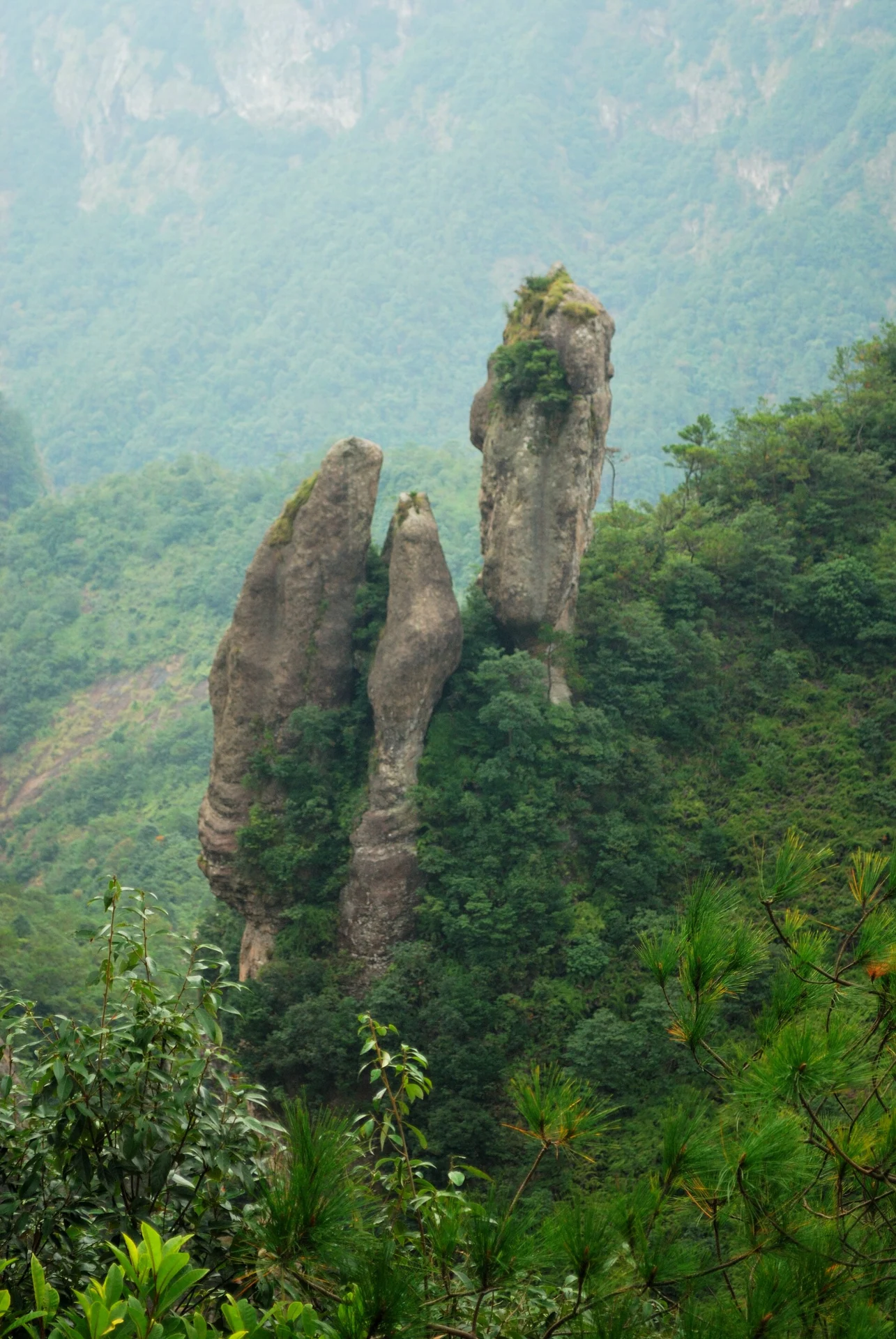
Allow two days around Yandang Mountain if you want to see its main valley areas without making the visit a race between entrances. Lingfeng, Lingyan and Dalongqiu are separate scenic areas within the wider destination. Choose a base near the visitor corridor, plan the local transfers and leave room to adjust the walking when weather or energy changes.
Cover: Mountain scenery at Yandang in Zhejiang. Photo: Glasreifen · CC BY-SA 4.0. Resized and converted to WebP.
This guide concerns the Yandang Mountain destination around Yandang Town in Yueqing, within the Wenzhou region of Zhejiang. Save 雁荡山 alongside your accommodation address. Reaching the railway station or a town hotel is the beginning of the local visit, rather than the end of the transport planning.
Choose the areas that give you different experiences
The destination operator identifies Lingfeng, Lingyan and Dalongqiu as its three signature scenic areas. At Lingyan, the temple setting sits between large rock faces, with the Tianzhu and Zhanqi cliffs forming part of the landscape. That combination of cultural detail and enclosing cliffs gives you a useful contrast with a visit focused mainly on a waterfall or individual rock forms.
| Area or interest | How to use it | What changes the visit |
|---|---|---|
| Lingfeng | A first introduction to the mountain’s rock scenery | The walking route and any separate evening arrangements |
| Lingyan | A temple and cliff setting with time for the main valley | Steps, operating paths and the group’s pace |
| Dalongqiu | A visit centred on its waterfall landscape | Rainfall, visibility and the time available for the approach |
| Additional paths or viewpoints | An extension when the main programme is comfortable | The actual route, transport connection and return effort |
Choose two main areas when you have only one usable day. A longer list can look attractive on a booking page while leaving little time to sit, look or walk without rushing. For photographers, revisiting a favourite area in different light can be more valuable than adding another entrance.
A two-day plan with one local overnight
| Day | Main focus | Where to keep flexibility |
|---|---|---|
| First touring day | Arrive early enough for one selected scenic area, then settle into the local base | Queues, lunch and the actual arrival time |
| Evening | Dinner and an optional locally confirmed evening visit | Weather, separate admission and the return to your hotel |
| Second touring day | Visit the other priority area or areas, then leave | A firm departure cutoff for the station transfer |
This plan assumes a useful part of the first day is available. Arriving late in the afternoon and leaving early the next morning creates a different trip, even though it spans two calendar dates. Add a second local night when both travel days are short or when you want more sustained walking.
Keep an evening visit optional until the current programme and access are confirmed. A scenic area offering day and evening experiences does not make them one continuous ticket or guarantee a particular performance. If you prefer a quiet evening after walking, choose accommodation and dinner accordingly.
Where to stay: solve the evening as well as the morning
The useful accommodation question is how the property connects to the scenic corridor. Ask for the exact address, the distance from the drop-off to the room, access to meals and the transport available after your final visit. A convenient location for one entrance may still require a transfer to another.
Xianglingtou appears in the operator’s published visitor-transport corridor, making that name useful when comparing local bases. Confirm the actual property location and current transport stops rather than assuming every hotel with Yandang in its name serves the same route.
Guests who need easy room access should ask about stairs, lifts and the walk with luggage. If you have a late arrival, arrange check-in and dinner in advance. Those details can matter more to a comfortable first evening than a room’s mountain-themed photograph.
Local transport needs its own plan
The operator’s transport information describes a corridor linking the railway-station area, visitor facilities, Xianglingtou and several scenic stops. Use that as a framework for asking about the current service. Confirm the operating route, boarding point, last return and ticket arrangement for your date; do not build the day around an undated promise of free travel.
If you arrange a vehicle, specify every entrance and the return meeting point. A driver can connect areas but cannot remove the walking inside them. Keep your main bags at the agreed storage point and carry only what you need on the paths. When public transport is the plan, check how the final scenic stop connects to your departure station.
For a wider China journey, our gateway-city guide helps you compare the approach to the region. Use your actual train booking to establish the local touring window rather than treating rail journey time as hotel-to-hotel time.
Walking effort, rainfall and photographs
Choose your walking route by its steps, gradients and return distance. A valley visit can be very different from a longer climb to an upper viewpoint, and the more ambitious walker’s choice may not suit everyone in the party. Ask for a clear description of the whole route before adding optional extensions.
Wear shoes with grip and carry a light waterproof layer. On wet days, prioritise an operating route with a manageable return and be willing to drop an exposed extension. Waterfall flow, cloud and the visibility of the peaks change with conditions; there is no single photograph that a booking can guarantee.
Keep photography pauses out of narrow passing places and follow signs around wet rock and viewpoints. If rain or low visibility removes your main reason for visiting an area, discuss a shorter programme rather than continuing simply because it appeared in the original list.
Budget for the route you actually want
Compare admission for the selected areas, any separately ticketed evening experience, local transport, guiding, meals and the overnight. A multi-area ticket can be useful only when the areas and its validity fit your available days. Check passport entry, cancellation terms and the services included before purchase.
For families, include proper meal and rest breaks in the local schedule. A short, satisfying visit to two areas is often a better use of a day than asking children to keep moving through every possible stop. Any specialist climbing or adventure activity needs a separate assessment and booking.
Frequently asked questions
Can I visit Yandang Mountain in one day?
Yes, as a selective visit. Choose the areas that matter most and leave enough time for transfers and walking. Two days give more room for weather, an overnight and an optional evening experience.
Do I need a car for every part?
Check the current visitor transport first, then decide whether a vehicle improves your particular route. Whichever transport you choose, the scenic-area walking and departure cutoff still need planning.
What should I include in an enquiry?
Send your train or flight details, available nights, preferred walking effort and any interest in an evening visit through Plan My Trip. This allows the proposed route and local base to match the time you actually have.
Planning information reviewed 29 October 2026. Sources: Yandang operator: Lingyan and visitor transport; Yandang operator: itinerary choices. Confirm current access and operating arrangements for your travel date.
Plan This Visit as Part of Your Journey
This guide introduces a possible visit rather than a confirmed package departure. Share your dates, starting point and the experience you want through Plan My Trip. Vero Trip can check access, travel time, language support and the services to include before quoting.
For the wider area, explore Hangzhou, Zhejiang and confirm the separate transfer needed for this visit.
Explore related travel themes for other ways to shape the journey.