To drive from Thailand to China, plan the journey through Laos and arrange the China vehicle entry before leaving home. A northern approach runs from Chiang Khong to Houay Xay across the Fourth Thai–Lao Friendship Bridge, then through northern Laos to Boten and Mohan in Yunnan. Departing from Peninsular Malaysia adds the drive through Thailand; departing from Singapore adds Malaysia first.
The route on a map is only one part of the decision. Each traveller needs the correct entry permission, each driver needs a recognised licence or local permit, and the car needs its own customs and road-use documents. Confirm all three for the outward and return journeys before buying inflexible accommodation or committing to a convoy.
Which starting point changes your preparation?
Choose the row that matches the vehicle and its location, then check the nationality of everyone travelling. A Singapore resident driving a Malaysian-registered car does not automatically follow the same vehicle procedure as a Singapore-registered car.
| Departure | Overland sequence to Yunnan | First vehicle check |
|---|---|---|
| Thailand | Thailand → Laos → China | Thai-registered car: temporary export and return documents. Other registration: check the car’s existing Thai admission and lawful exit. |
| Peninsular Malaysia | Malaysia → Thailand → Laos → China | Owner’s authority, home registration and country-by-country insurance. Malaysian registration is listed among Thailand’s FVP exemptions. |
| Singapore | Singapore → Malaysia → Thailand → Laos → China | Singapore departure documents and Malaysia VEP for the Singapore-registered car. Singapore registration is also listed among Thailand’s FVP exemptions. |
The Malaysian route here starts on the peninsula. A vehicle in Sabah or Sarawak needs a separate transport plan to reach it; do not include that movement in a continuous road itinerary. Allow for your actual starting town, the slowest driver and the journey home.
Thailand: establish what happens to the car on departure and return
For a Thai-registered private vehicle, the Thai government’s land-border temporary-export guidance describes a simplified customs declaration, the registration manual and owner authorisation when applicable. Keep the declaration for re-import and return within its specified period. This published guidance uses a March 2020 information baseline: ask the departure customs office for its current checklist and deadline before travelling.
Also ask the Department of Land Transport which international vehicle document, translation and identification markings apply to your proposed Lao and Chinese journey. Describe a financed, company-owned or borrowed car accurately; obtain the relevant owner’s or finance provider’s cross-border consent instead of relying on another driver’s experience.
Malaysia: separate Thailand’s vehicle exemption from everything else
The Thai DLT’s published FVP manual, dated September 2021, exempts vehicles registered in Laos, Malaysia and Singapore from that regulation. It does not remove separate immigration, customs, licensing or insurance obligations. For vehicles covered by the scheme, the manual requires a licensed Thai agency to apply at least five working days ahead and excludes motorhomes from eligible vehicle categories. Have DLT confirm the applicable process for an unusual vehicle or registration; do not infer that an exempt country’s motorhome is automatically admitted.
The same manual recognises driving licences issued by ASEAN authorities, with a certified English translation if the licence has no English. Check the actual licence and vehicle class of every intended driver. A story about a Chinese-registered car requiring Thai arrangements is not a checklist for your Malaysian-registered car.
Singapore: complete the first border before thinking about Mohan
LTA’s overseas-driving guidance lists printed motor insurance, printed road tax, a valid licence and a suitable stored-value card for checkpoint charges. Check its three-quarter fuel-tank rule where applicable. Keep the documents accessible, not beneath the holiday luggage.
Malaysia’s transport ministry notice states that full VEP enforcement at the Malaysia–Singapore land border began on 1 July 2025. Singapore-registered private vehicles must complete registration, installation and activation of the RFID tag. Check the official VEP portal; a submitted application is not the same as an activated tag.
Plan the Lao transit and the correct China border
The ADB’s description of the northern corridor connects Chiang Khong, the Fourth Friendship Bridge, Houay Xay and Route 3 towards Boten. Vieng Phoukha and Luang Namtha provide useful names when discussing the northern Lao stages. Boten is on the Lao side; Mohan (磨憨) is on the Chinese side, in Mengla County, Xishuangbanna.
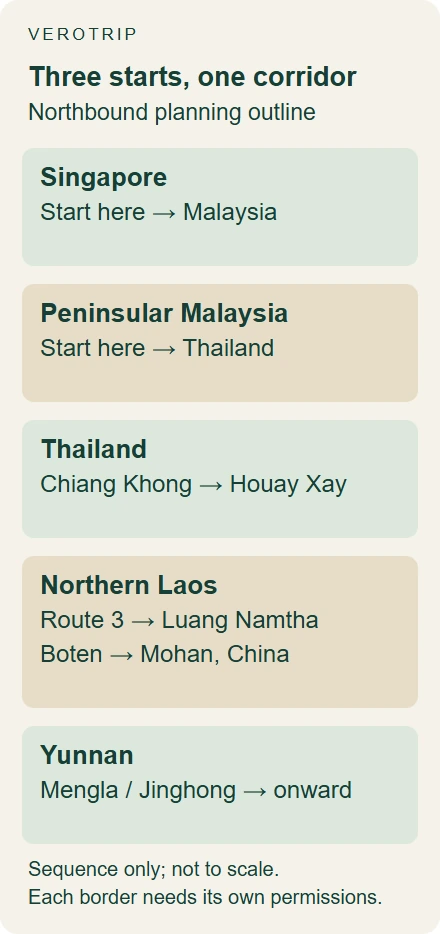
Use this as a route outline, then agree the precise checkpoints, meeting places and permitted itinerary. Luang Prabang and Vientiane are optional diversions, not compulsory stops between Houay Xay and Boten. Adding them changes the driving, nights, insurance dates and potentially the paperwork.
Singapore MFA’s Laos advisory tells motorists to apply for a temporary vehicle import permit through the Lao Embassy in Singapore and says motor insurance is compulsory on entry. Singapore travellers should follow that application contact; travellers based elsewhere should obtain the procedure for their own registration and entry port from the relevant Lao authorities. Do not assume that buying insurance at a border completes every vehicle formality.
The Lao Trade Portal’s temporary-import guidance separately calls for a customs declaration and valid vehicle registration, followed by re-export within the authorised deadline. Keep a copy of the admission record and know how its exit will be recorded. Repeat the check on the southbound return, including any new admission required.
For passengers who need a Lao eVisa, the official eVisa FAQ lists the Fourth Friendship Bridge and Boten International Checkpoint as designated ports. It lists Boten Railway Station separately. The eVisa rules concern the person: neither a rail ticket nor an eVisa approval grants permission to drive a car through a road checkpoint.
Check passports, drivers and the vehicle separately
For an ordinary tourism visit to mainland China, the following passport arrangements may help with the passenger side. Eligibility still depends on the traveller, visit purpose and previous stays. Other passport holders in the same car must use their own applicable rules.
| Ordinary passport | Published China visa-free arrangement | What to check before departure |
|---|---|---|
| Thailand | Up to 30 days per visit; cumulative stays up to 90 days in 180 days. | Previous visits, purpose and whether a longer stay needs a visa. |
| Malaysia | Up to 30 days per visit; cumulative stays up to 90 days in 180 days. Bilateral agreement effective 17 July 2025. | Remaining allowance and a return plan within it. |
| Singapore | Mutual arrangement for stays up to 30 days, effective 9 February 2024. | Passport and purpose eligibility; obtain advice for a longer stay. |
See the official notices for Thai passport holders, Malaysian passport holders and Singapore passport holders. These arrangements do not approve the vehicle or replace permission to drive.
Under China’s temporary-entry vehicle rules, foreign vehicles need temporary Chinese plates and a vehicle permit carrying an authorised area or route and validity. Entry approval, customs documents, registration, inspection evidence and compulsory Chinese motor liability insurance are distinct parts of preparation. Ask the receiving operator to identify the applicable route and authority documents for your case.
Each person who will drive needs the applicable Chinese driving permission. An overseas licence or International Driving Permit alone does not replace it. Shanghai traffic police’s temporary-driving-permit explanation distinguishes driving an admitted foreign vehicle from renting a Chinese vehicle and ties the permitted class to the driver’s overseas entitlement. Agree the local application and collection arrangements for every driver, including a partner who may take over when someone is tired.
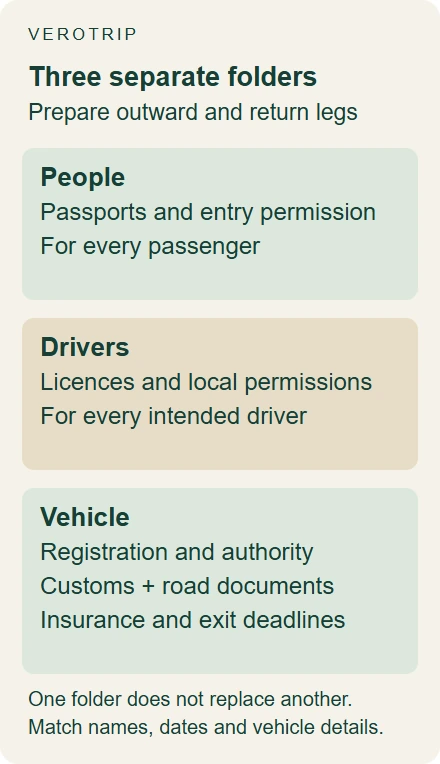
Start an enquiry with nationality, vehicle registration country, ownership, make, model, dimensions, fuel type, driver-licence country and proposed dates. Once the responsible provider and secure document channel are agreed, supply the required copies and translations. Keep originals together, with an offline backup accessible to a second adult.
Build an insurance and assistance checklist for each country
Ask the insurer to confirm the named vehicle, countries, drivers and dates in writing. Check liability cover separately from damage to your own car, roadside recovery and personal medical cover. The table is a list of questions to resolve, not a statement that a single policy covers the journey.
| Stage | Motor cover to establish | Assistance question to ask |
|---|---|---|
| Malaysia | For a visiting Singapore car, the policy’s Malaysian territory and named-driver cover. | Who arranges towing, and where can the vehicle be taken? |
| Thailand | Applicable compulsory cover and any additional liability or own-damage policy; distinguish these from FVP status. | Does recovery cover the northern route and the return? |
| Laos | Compulsory motor insurance and confirmation that the policy actually covers Laos. | Who answers in a language you can use, and what happens in a remote breakdown? |
| China | Compulsory Chinese motor liability cover for the temporary-entry vehicle; ask separately about wider protection. | How will repairs or recovery fit the permitted route and re-export deadline? |
Do not combine insurance premiums, service fees and refundable security into one unexplained “border cost.” Request an itemised quote with currency, payee, inclusions and cancellation terms. If a security mechanism applies, obtain its purpose, amount, recipient, release evidence and conditions in writing. Another traveller’s payment is not a quotation for your registration or vehicle value.
How should you divide the driving and overnight stops?
Work backwards from the return deadline and the days you actually want in Yunnan. Then allow time for each country’s transit and formalities. A navigation estimate covers driving; it cannot predict inspections, document collection, a missed office window or a family member needing a rest day.
| Stage to plan | Useful stopping area | Decision before committing |
|---|---|---|
| Approach to Laos | Your Thai approach stops, ending near the agreed Chiang Khong departure point. | Avoid combining a long arrival drive with an uncertain border appointment. |
| Northern Laos | Houay Xay and/or Luang Namtha, according to progress and booked arrangements. | Confirm parking, arrival window, route conditions and the next permitted crossing date. |
| Boten–Mohan formalities | A lawful overnight option on the side where you and the car are admitted. | Keep the first onward booking changeable; collect the required permissions before the longer drive. |
| Yunnan holiday | Mengla/Jinghong, then Pu’er and Kunming if included in the authorised itinerary. | Protect sightseeing and rest time; leave room for the return and re-export. |
Singapore MFA warns about poorly maintained or poorly lit rural Lao roads and rain-related disruption, and advises avoiding driving after dark. Take current conditions seriously rather than using an old “hours to the border” post as a target. If delays remove the daylight margin, use the agreed overnight option and inform the receiving contact.
For children and older travellers, ask for accessible rooms, a short walk from parking, suitable seat restraints and regular comfort stops. Carry a small overnight bag so a one-night wait does not require unloading the whole car. For Muslim travellers, identify meals and prayer breaks before leaving a larger town; use the Yunnan meals, hotels and prayer guide for the Chinese stages and confirm specific venues directly.
For an electric car, verify connector compatibility, permitted adapters, charging applications, payment access and a backup stop with the vehicle maker and charging operators. Test accounts before departure. A charger symbol on a map does not establish that your imported car can use it, and one driver’s range does not predict yours.
Choose a realistic Yunnan extension and a fallback
After a long approach, a southern Yunnan stay around Xishuangbanna and Pu’er may suit a family better than immediately continuing to Dali, Lijiang and Shangri-La. Use the Yunnan regional route guide to compare the southern and northwestern regions. Additional destinations must fit the vehicle’s authorised itinerary and the time available for return.
If the car’s admission cannot be arranged, return it lawfully before switching to a flight or an available passenger rail connection for a different Yunnan holiday. Do not assume you can park a temporarily imported car in Laos and leave without it: Article 21 of Laos’ customs implementing instruction requires the driver to leave with the vehicle within the authorised period. Resolve any exceptional situation directly with customs before making separate travel plans. Passenger transport does not carry your private car across the border. Local rental also requires the relevant Chinese driving permission and the rental company’s acceptance.
For travellers who would rather concentrate on the holiday, compare private Yunnan tour options. Agree the vehicle, driver, itinerary and price for that local service separately. A China holiday booking does not include foreign-car admission unless the written scope explicitly and lawfully provides it.
Questions to settle before leaving home
Can we take a right-hand-drive car or campervan?
Disclose the exact registration, steering position, vehicle class and dimensions. Obtain a decision for every country on the route. A reported crossing by another right-hand-drive passenger car does not prove acceptance of a campervan, commercial vehicle or modified car.
Does visa-free entry let us turn up at Mohan?
It addresses the eligible person’s stay. Arrange the vehicle case, driver paperwork and receiving appointment beforehand; bring the actual confirmations and contacts required for your journey.
Can we change the return border or add more destinations?
Ask the responsible operator and authorities before changing an approved plan. Check the customs exit record, road permissions, insurance and each passenger’s stay allowance together. Do not treat a short trip out of China as an automatic renewal for the car.
Plan the Yunnan part of your journey
Ask VeroTrip about your Yunnan itinerary with your departure town, travel dates, group size, children or mobility needs, and preferred stops. State whether you plan to arrive with an admitted private car or want a locally arranged holiday. Keep any foreign-vehicle admission arrangements separate from the local travel proposal.
For the foreign-car entry itself, obtain a case-specific plan from a receiving agency authorised to handle the proposed journey. Give it the passenger nationalities, vehicle registration country and type, ownership details, all intended drivers, and entry and exit dates. Before paying, obtain the applicable acceptance process, insurance and assistance details, and an itemised written scope. An itinerary enquiry to VeroTrip does not establish vehicle-entry acceptance or book a border service.