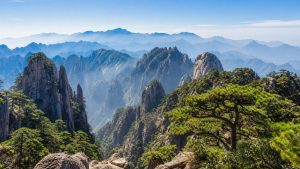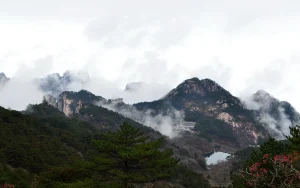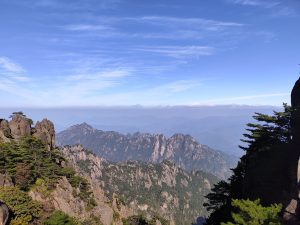
For your first Huangshan hike, choose between a shorter walk returning by the same cable car, a full Yungu-to-Yuping mountain crossing, or one night in a mountain hotel. All three involve steps. If your priority is the Guest-Greeting Pine and a manageable outing, start with Yuping; if you want the Shixin and Beihai side, start with Yungu. Choose the crossing only when your group is comfortable with repeated climbs and descents.
This Huangshan hiking map guide gives named route connections, hotel choices and return arrangements. The diagrams are schematic and not to scale: use the scenic operator’s current visitor map, signs and staff directions for navigation. The suggested routes depend on the selected paths and cable cars being open on your travel date. They omit Tiandu Peak, the Lotus Peak summit and the West Sea Grand Canyon, which need separate access decisions.
Choose the mountain day you can enjoy
A mountain day means time at Huangshan itself, after reaching your base. It does not promise that a train arrival, mountain crossing and onward departure fit the same date. Stay near the entrance you will use when practical, then keep the following journey flexible.
| Route choice | Choose it when | Main planning trade-off |
|---|---|---|
| A · Yungu return | You want a selected Shixin or Beihai-area walk and the option to turn back. | Return to the same upper cable-car station; extending to Bright Summit changes the effort. |
| B · Yuping return | Guest-Greeting Pine is your main goal and you prefer a smaller walking area. | Steps remain between the upper station and viewpoints; skip additional summit climbs. |
| C · Yungu to Yuping | Your party wants a full mountain walking day through the central areas. | A one-way crossing has climbs as well as descents and uses different lower cable stations. |
| D · Mountain overnight | You want a room break and opportunities for evening or morning views. | The exact hotel determines the path; sunrise and cloud seas depend on weather. |
“Back mountain up, front mountain down” usually describes Yungu ascent and Yuping descent. It is not a promise of downhill walking throughout, fewer queues or suitability for every child. Repeated stone steps can be hard on knees even when the route looks gentle in photographs. If your group needs genuinely limited walking, discuss the exact upper-station-to-viewpoint section before booking.
Understand the gates, cable cars and railway stations
Tangkou is the usual base for the South Gate. Yungu and Yuping are different cableways reached through the southern approach. Huangshan North railway station is a road-transfer starting point; its name does not mean you are at the mountain’s North Gate. Tunxi, the older city centre, is another base with a separate transfer to the mountain.
| Approach | Cableway and mountain area | Match it to your plan |
|---|---|---|
| South Gate · Tangkou | Yungu: Yungu Temple to the Bai’e / Shixin / Beihai side. | Routes A, C and D start here. Confirm the shuttle and upper-station walking connection. |
| South Gate · Tangkou | Yuping: Ciguang area to the Yuping / Guest-Greeting Pine side. | Route B uses this cableway both ways; C and D descend here. |
| North Gate approach | Taiping cableway to the Danxia / Xihai side. | Use a route built around this approach; arrange the road return if descending elsewhere. |
| East Gate · Tanjiaqiao | Donghai cableway to the eastern mountain area. | A separate approach opened in June 2026; match entrance, hotel and descent before selecting it. |
The scenic administration’s opening report records the East Gate and Donghai cableway launch on 11 June 2026. Older guides naming only three mountain cableways miss this change. Donghai is different from the West Sea Grand Canyon sightseeing funicular: booking one does not arrange the other.
For the southern routes below, take the booked scenic shuttle to the correct cableway approach. A car transfer to Tangkou does not deliver you directly to a mountain hotel. Keep the entrance direction, cable-car names and railway station in your booking notes in both English and Chinese.
Routes A and B: shorter walks with the same cable car back
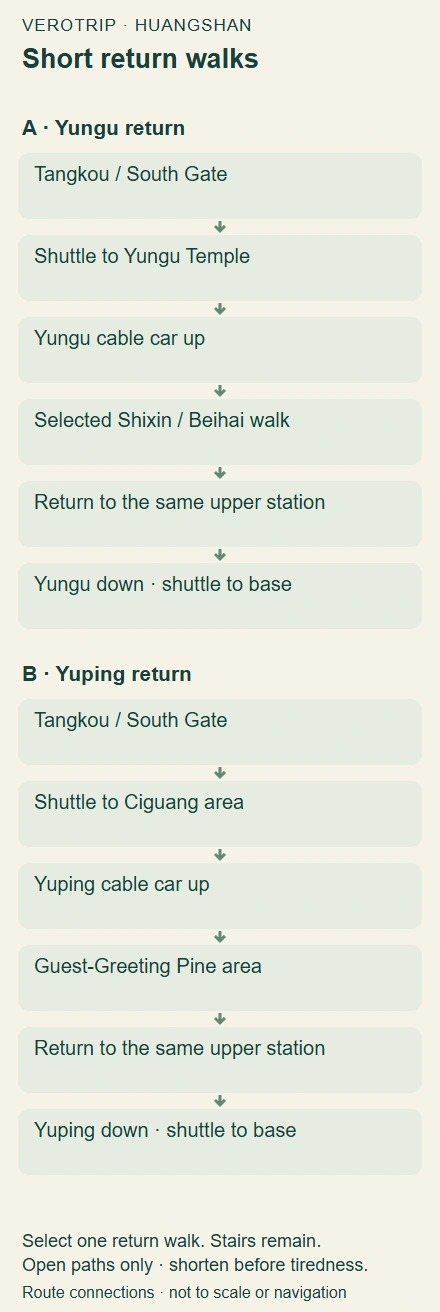
A · Yungu, with a selected Shixin or Beihai walk
Start from Tangkou’s South Gate transfer arrangement, travel to Yungu Temple and ascend by Yungu cable car. From the upper-station area, choose a manageable walk toward Shixin Peak (始信峰) and, if the group wants more, the Beihai area (北海). Turn back along the open signed route to the same upper cable station for descent and the shuttle below.
The named area is a choice, not a requirement to reach every lookout. Decide your turnaround with enough time to retrace the path while the cableway is operating. Adding Lion Peak, distant viewpoints or Bright Summit can change a modest walk into a much longer day. For a young child or an older traveller unfamiliar with stairs, test a short section first and keep that return available.
B · Yuping and Guest-Greeting Pine
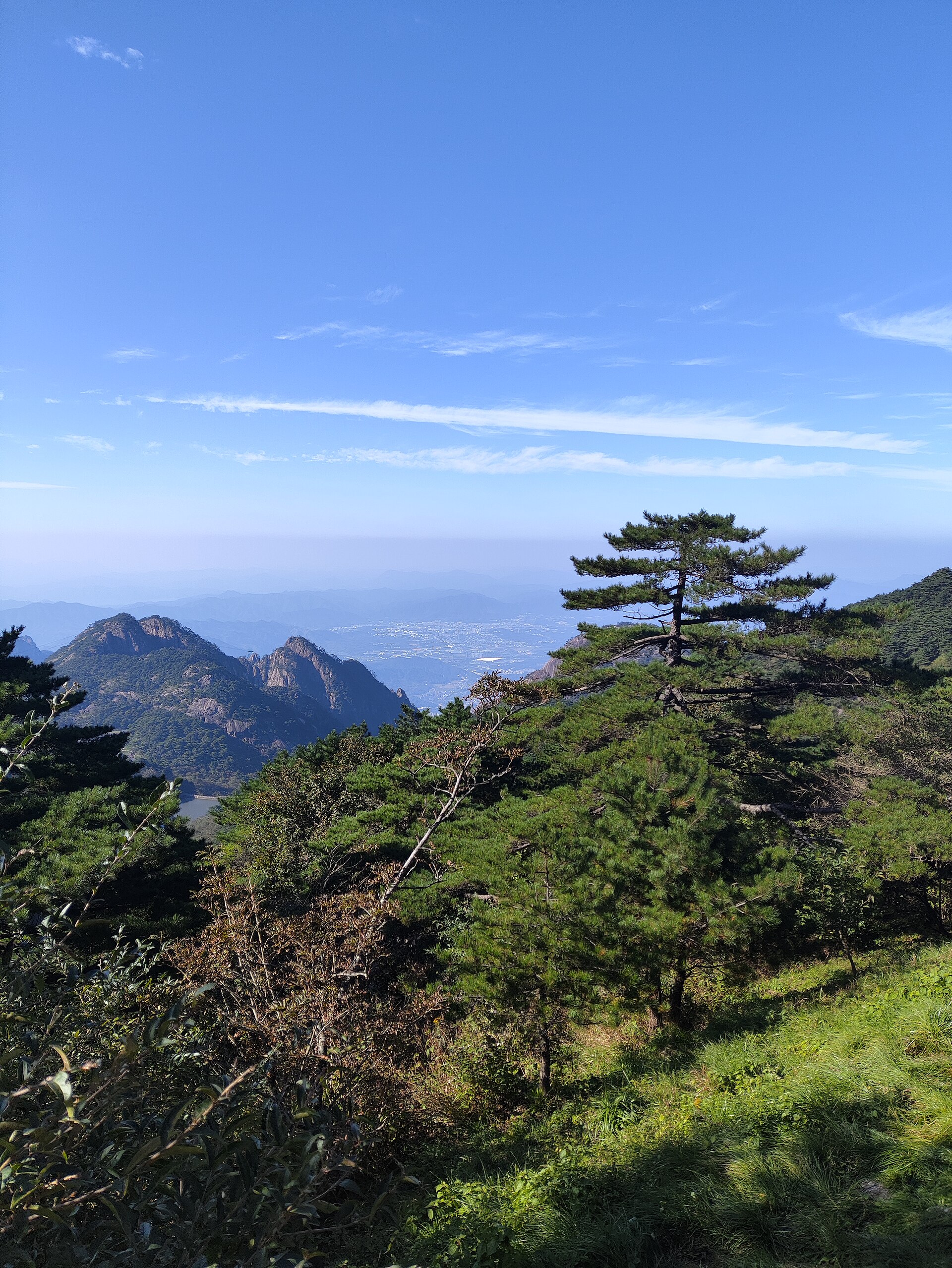
Use the South Gate transfer toward the Ciguang area and ascend by Yuping cable car. Follow the open visitor path toward the Yuping and Guest-Greeting Pine area (迎客松), then return to the same upper station and descend. This concentrates the outing on a different part of the mountain rather than starting at Yungu and crossing over solely to reach the pine.
Check the steps and walking between the station and your chosen viewpoint with the operator. The cable car does not make this a step-free visit. Leave Tiandu and Lotus summit climbs outside this plan; seeing their surrounding landscape is different from climbing them.
Route C: Yungu to Yuping through the central mountain
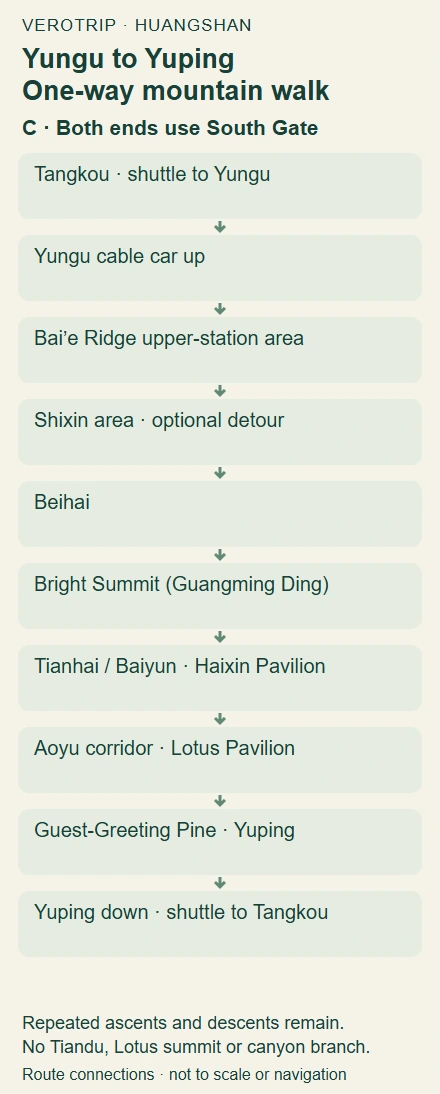
For a fuller first visit, the operator’s published route connections link the Yungu side with Beihai, Bright Summit, Tianhai and the Yuping side. Follow this sequence only through the open signed corridor:
Yungu ascent → Bai’e upper-station area → optional Shixin-area viewpoint → Beihai → Bright Summit (光明顶, Guangming Ding) → Tianhai / Baiyun area → Haixin Pavilion (海心亭) → Aoyu corridor (鳌鱼峰) → Lotus Pavilion (莲花亭, Lianhua Ting) → Guest-Greeting Pine → Yuping descent.
Lotus Pavilion is a route waypoint, not the Lotus Peak summit. At branching paths around Aoyu, use the current direction and any diversion indicated by staff. Avoid treating a narrow or steep shortcut as the default for children or anyone uncomfortable with exposure.
This is a substantial mountain walk even with cable cars at both ends. Start with a usable morning, keep rest and meal breaks, and remove optional viewpoints when queues use the available time. If you are already tired on the Yungu side, consider the return walk before committing to the crossing. Once farther along, ask staff for the appropriate open descent arrangement rather than improvising a cross-mountain shortcut.
The lower Yungu and Yuping stations differ, although both southern arrangements return toward Tangkou. Confirm the descending shuttle, pickup point and collection of stored bags. A driver waiting at the ascent station may not be where you finish. Keep any onward train clear of the uncertain walking and queue time.
Route D: one night on the mountain, with a room on your route
An overnight stay buys a place to stop and more opportunity for changing light. It does not need to become a checklist of every peak. The example below uses a confirmed room in the Tianhai / Baiyun area; a room in Beihai calls for a different split.
| Day | Walking sequence | Keep the pace workable |
|---|---|---|
| Day 1 · reach the room | Yungu ascent → Bai’e / optional Shixin → Beihai → Bright Summit → Tianhai / Baiyun-area hotel. | Travel with a small overnight bag; protect check-in and a rest break before adding a viewpoint. |
| Day 2 · descend | Optional nearby open morning viewpoint → breakfast / checkout → Haixin → Aoyu corridor → Lotus Pavilion → Guest-Greeting Pine → Yuping down. | Choose the morning outing around the actual room and conditions; leave time for the shuttle and bags below. |
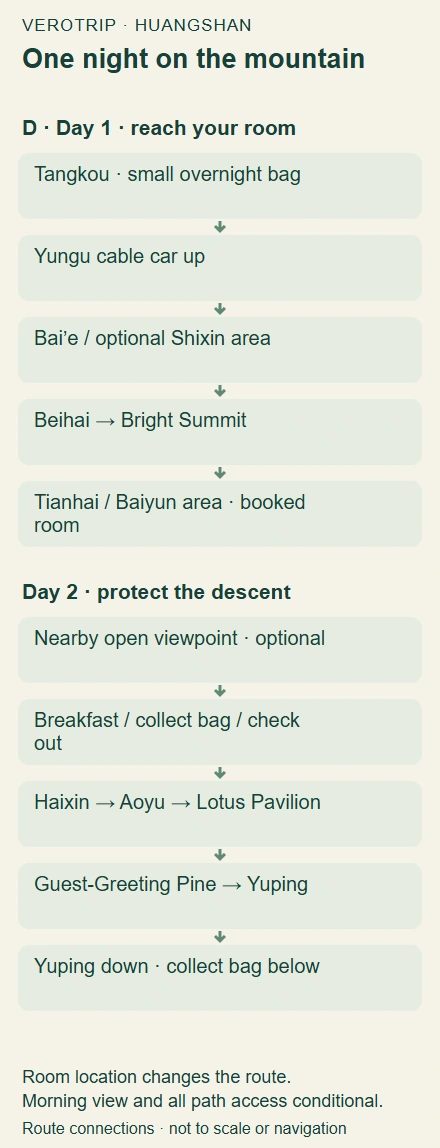
A hotel near Bright Summit is not interchangeable with one farther down in Tianhai. Walking uphill to sunrise and back for breakfast adds effort. Ask the hotel for an appropriate nearby open viewpoint and a sensible time to return. Locate that path in daylight, carry a light if walking before dawn and skip it when weather or your group’s condition makes it unsuitable.
| Room area | Route implication | Ask before paying |
|---|---|---|
| Beihai / Shixin side | Works for a shorter first day from Yungu or a return on that side. | Which viewpoints are close to this particular building and how much walking follows on day two? |
| Bright Summit / Tianhai area | Can divide a central crossing, but the hotels are not at the same elevation or position. | How far is the room from the main corridor, meal area and proposed morning viewpoint? |
| Yuping area | Places the stay nearer Guest-Greeting Pine on the southern mountain side. | Does the booked route reach this room without an extra crossing, and which descent is included? |
Check the named hotel, room category, private or shared bathroom, meal inclusion, heating arrangements and cancellation conditions. “Mountain accommodation” is not enough information. If your preferred room is unavailable, change the walking plan to the confirmed alternative instead of crossing the mountain twice to preserve an old itinerary.
Peaks, canyon branches and weather can change the plan
Lotus Peak has a rotation-closure system; the city’s May 2026 account describes it as resting. Its summit is excluded from these diagrams. Tiandu Peak and the West Sea Grand Canyon also have separate access conditions. A general Huangshan ticket is not a promise of admission to every branch.
The scenic administration’s 11 August 2026 notice, republished from its official account, kept Tiandu, the canyon and specified other areas temporarily closed after a typhoon and directed visitors to the official platform for reopening information. That dated notice is not a permanent forecast. Check “黄山旅游官方平台” for your actual date, and add either branch only when it is open, any separate reservation is obtained and the extra walking fits your group.
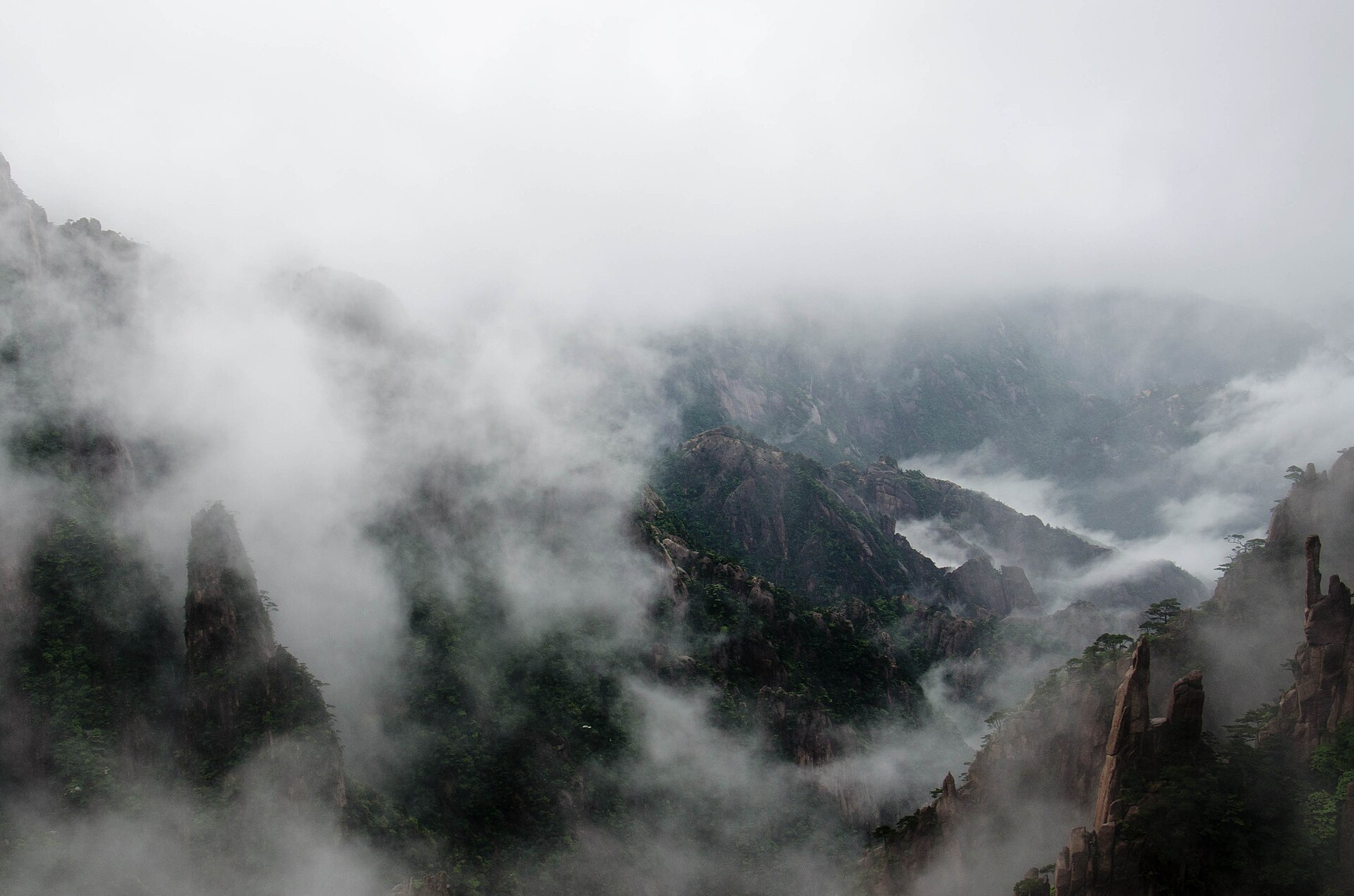
Mountain cloud can move in after a clear morning. A misty day may still be worthwhile on open paths, but it can remove the long views you travelled for. With heavy rain, thunder, strong wind or ice, follow closures and staff instructions. If the planned cableway changes service, walking the entire descent is not an automatic fallback; agree a shorter open route or change the mountain day.
Keep a lower-level alternative, such as time in Tunxi or a separately arranged Huizhou village visit, subject to local conditions. Avoid scheduling that village on the same day merely to fill a weather gap if the road transfers would create another rushed outing. See the Huangshan destination guide for the wider region.
Foreign-passport booking, luggage and meals
Book the actual date, entrance direction and cableways, with each traveller’s details matching their document. The city’s May 2026 visitor notice described overseas visitors entering with their passport and booking information. Carry the original passport and your order. Its temporary May discount does not establish your trip’s price. If a booking form only displays Chinese identity-card fields, ask the official platform or your booking provider for the foreign-passport procedure before paying.
For an overnight, ask the hotel below about advance and overnight bag storage, opening hours and collection after descent. Carry passport, medicines, phone, charging supply, water, food and a warm or waterproof layer in the bag you keep. An upper station is not the hotel lobby; a wheeled suitcase adds difficulty on stairs. Do not assume a porter, luggage transfer or free storage is included.
Agree where dinner and breakfast will be taken and carry food that works if your timing changes. Vegetarian-looking Anhui dishes may contain meat stock or animal fat. Halal food, allergies and prayer needs need specific arrangements: bring a translated ingredient note and discuss suitable packed food or meals and a room break, rather than assuming facilities at every mountain stop.
| Cost or service | Confirm separately | Why it matters |
|---|---|---|
| Mountain admission and shuttles | Date, entry direction and the ascent / descent transport. | A road transfer and a scenic shuttle are different services. |
| Cableways | Named uphill and downhill rides; any extra canyon funicular. | A “cable car included” label can leave the descent unclear. |
| Room and meals | Exact hotel, room type, breakfast / dinner and refund rules. | Two mountain hotels can produce very different walking days. |
| Guide and vehicle | Walking accompaniment, language, pickup and finish. | A driver below does not provide interpretation on the mountain. |
| Optional peaks and insurance | Required reservations and cover for the planned activity. | An optional climb changes effort and may have separate access conditions. |
Plan the route and the service together
Compare the existing one-day Huangshan mountain enquiry and two-day Huangshan overnight enquiry. Request a dated programme with the route, departure conditions, guiding language and included services before booking; these map examples do not set a group departure or fixed price.
Send VeroTrip your dates, arrival and departure station or city, number and ages of travellers, passport nationality, comfortable walking level, concerns about steps or heights, luggage and meal needs. Say whether Guest-Greeting Pine, a shorter walk or a mountain overnight is the priority. Use Plan My Trip to agree the entrance, room and return in one proposal. If you are still choosing a destination, compare the China hiking route guide and hiking and mountain travel collection.